Megamasers vs. the Distance Ladder: A New Estimate of the Hubble Constant ✛
Context
The Hubble constant is measured in two main ways: from the cosmic microwave background (early Universe) and from the distance ladder (late Universe). Their values disagree: 67.4 versus 73.5 km/s/Mpc—this is the 'Hubble tension'. Megamasers allow direct distance measurements without the ladder, making them an arbiter in this debate. Previous analysis of megamaser data gave a value consistent with the ladder, tipping the scales toward new physics. However, peculiar velocities of galaxies can skew the result, and properly accounting for them could change the conclusion.
Methods
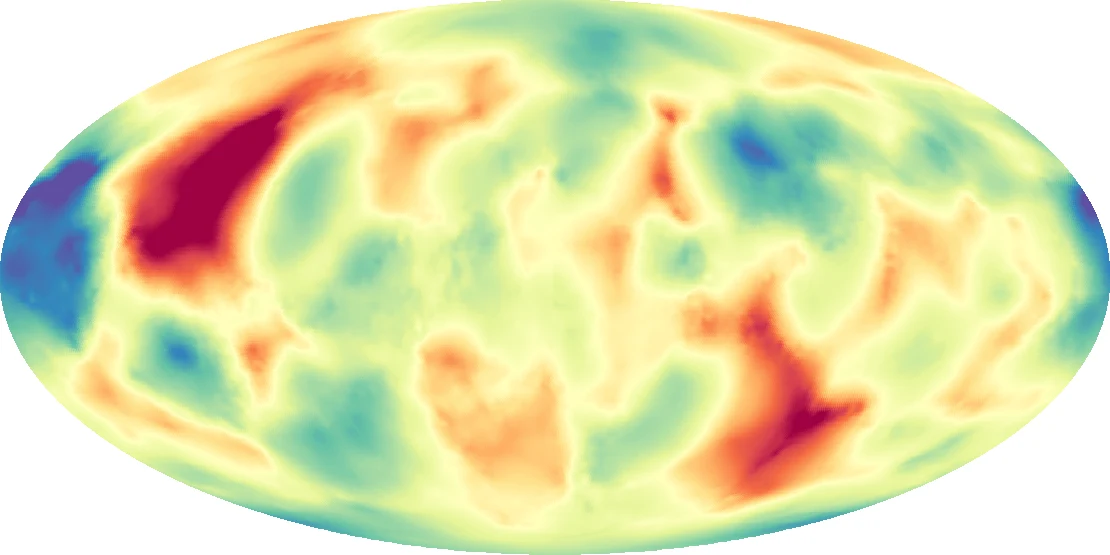
Data on six megamaser galaxies from Pesce et al. (2020) were used: distances and redshifts. For each galaxy, the peculiar velocity was computed using two velocity field reconstructions: the old one (Carrick et al. 2015, based solely on 2M++ survey data) and the new one (McAlpine et al. 2025, adding constrained cosmological simulations to account for nonlinear motions). Redshifts were corrected for these velocities. Then a distance–redshift relation was fitted via maximum likelihood, treating the peculiar velocity uncertainty as a free parameter with a uniform prior.
Results
With the new M25 reconstruction, the Hubble constant is 69.7±2.6 km/s/Mpc when the velocity uncertainty is fixed at 150 km/s. Treating this uncertainty as a parameter and marginalizing over it shifts the likelihood peak to 68.7 km/s/Mpc. The probability that the true value is not less than the distance-ladder value (73.5 km/s/Mpc) is 2.9% for σv ≤ 150 km/s and 4.9% for σv ≤ 200 km/s. This corresponds to a tension with the ladder at about 2.2σ. All six megamasers have positive peculiar velocities, with the three most distant participating in a coherent bulk flow, systematically inflating the H0 estimate.
Implications
The result shows that peculiar velocities can significantly bias megamaser-based Hubble constant estimates. Accounting for these velocities with an accurate reconstruction changes the conclusion: megamasers now support the CMB value rather than the distance ladder. This weakens the case for new physics and shifts suspicion to systematic errors in distance ladder calibration.
Future development
The topic will evolve in several directions: searching for new megamaser galaxies to enlarge the sample, improving distance measurement techniques, and further enhancing the accuracy and resolution of velocity field reconstructions. It is crucial to check whether the bias persists with a larger sample and with other reconstructions.
Impact
The work impacts cosmology and extragalactic astronomy: it underscores the need to account for peculiar velocities in local measurements and calls into question the reliability of the distance ladder as a standard.
Next steps
Immediate steps include reanalysis with more megamasers, comparison with other direct distance methods (e.g., gravitational lensing or gravitational waves), and detailed investigation of systematics in Cepheids and Type Ia supernovae.
Key open problems
In cosmology, the Hubble tension remains unresolved—the discrepancy between early and late Universe measurements. This work links it to possible systematics in the distance ladder rather than new physics. This directly touches on the calibration of standard candles and the reliability of local measurements.
The knowledge machine's view
This section is addressed to the author of the paper and their colleagues. Neighbouring works were found by meaning-based search across our archive, not by word overlap. We do not review: we show the field around the work.
What the work does
The authors re-analyze distances and redshifts of six megamaser galaxies using a new velocity-field reconstruction based on cosmological simulations. They correct the redshifts for peculiar velocities and obtain an H0 value of about 68–70 km/s/Mpc, which agrees with the cosmic microwave background data and disagrees with the distance-ladder value at more than 2σ.
Where its strength is
The work shows that accounting for peculiar velocities with a more accurate velocity-field reconstruction can significantly alter conclusions about the Hubble constant, shifting suspicion toward systematics in the distance ladder. This is a concrete example of how local inhomogeneities affect global cosmological measurements.
Where it could go next
- It might be interesting to compare the result with other direct H0 measurements that do not rely on the distance ladder, such as those from gravitational lensing or gravitational waves, to check the consistency of the conclusions.based on: A Cosmic Ruler Made of Seventeen Lenses · Gravitational waves measure the expansion rate of the universe arXiv:2608.07470v1 arXiv:2605.27227
- There is a related paper analyzing two independent pieces of evidence against the Hubble tension; it might be worth seeing how their conclusions relate to your peculiar-velocity correction.based on: Cosmic Detective: Two Independent Clues Against the Main Cosmological Debate arXiv:2606.03634v1
- Our archive contains a review discussing why cosmic data do not converge to a single point; this could provide context for interpreting the remaining tension between measurements.based on: Why Cosmic Data Refuse to Converge arXiv:2606.12822
Worth trying
- Apply a similar peculiar-velocity correction to other megamaser galaxies when new data become available, to increase the sample size.
- Test how the result changes when using alternative velocity-field reconstructions, for example, those based on other simulations.
- Combine the megamaser analysis with other direct H0 measurements to obtain a combined constraint.
Why this may matter
If the systematics in the distance ladder are confirmed, this would resolve the Hubble tension without invoking new physics, which is important for all of cosmology.
Nearby works in our archive
- The Cosmic Tuning Fork: Why the Universe Plays Two Different Notessimilarity 0.67
- Cosmic Clocks Diverge: A New Mystery of the Universe's Expansionsimilarity 0.64
- Supernova Echoes: A Fresh Measure of the Hubble Constantsimilarity 0.62
- Cosmic Detective: Two Independent Clues Against the Main Cosmological Debatesimilarity 0.61
- A Cosmic Ruler Made of Seventeen Lensessimilarity 0.60
- Gravitational waves measure the expansion rate of the universesimilarity 0.60
- Why Cosmic Data Refuse to Convergesimilarity 0.59
The closest work in the archive sits at 0.67 by meaning — the usual level for our corpus.
Original abstract
as written by the authors arXiv:2608.06247v1
Megamaser distances can be measured without using the traditional distance ladder. As such, they provide an independent probe of the local expansion rate, quantified by the Hubble constant $$H_0$$. We re-analyze megamaser distance and redshift data to obtain a new, more accurate, estimate of $$H_0$$. The main improvement in our analysis is the use of a new velocity field reconstruction to correct redshifts for peculiar velocities. This reconstruction utilizes constrained cosmological simulations in addition to redshift survey data to more accurately capture both coherent flows as well as nonGaussian individual galaxy motions. We argue that previous estimates of $$H_0$$ from megamaser data were susceptible to bias due to peculiar velocities. By correcting for peculiar motions using this new reconstruction we obtain a value of $$H_0$$ that is consistent with the value from the Cosmic Microwave Background (CMB) and in tension with the value from the local distance ladder at greater than a $$2\sigma$$ level, whereas previous results showed consistency with the distance ladder and tension with the CMB at greater than $$2\sigma$$. Our results suggest that the Hubble tension is due to some heretofore undetermined systematic in the distance ladder rather than new physics.
Megamasers are natural cosmic lasers: water molecules in accretion disks around supermassive black holes amplify microwave radiation. Their angular sizes and velocities allow distance measurements with a few percent accuracy, making them a valuable cosmological tool.
Key numbers
- Number of megamasers: 6
- New H0 estimate (marginalized): 68.7 km/s/Mpc
- Tension with distance ladder: 2.2σ
- Probability H0 ≥ 73.5 km/s/Mpc: 2.9%
- Peculiar velocity of NGC 6323: 671 km/s