A Tailwind for Six Runners: How Peculiar Velocities Skewed the Hubble Constant ✛
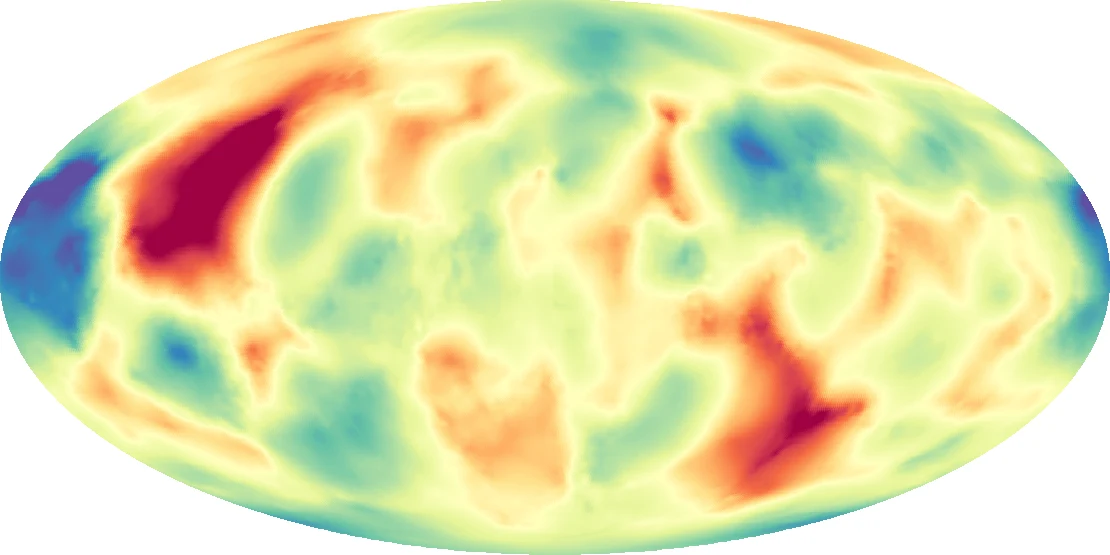
Six runners sprint down the track, and officials time their speed without noticing a tailwind. The wind blows at their backs, and the stopwatches show a better result than the truth. Roughly this is how six megamasers — natural cosmic lasers in distant galaxies — misled astronomers measuring the expansion rate of the universe.
Megamasers allow distances to galaxies to be determined directly, without the long chain of intermediate steps known as the distance ladder. From their redshifts and distances, astronomers calculate the Hubble constant — the number describing the expansion rate of the universe. In 2020, an analysis of six such objects gave a value of about 73 km/s/Mpc, matching the distance ladder and contradicting cosmic microwave background data (67.4 km/s/Mpc). It seemed the scales tipped in favor of new physics. But all six galaxies shared a common feature: they move in the same direction relative to the cosmological expansion.
A new reconstruction of the velocity field, based on cosmological simulations, showed that the three most distant megamasers participate in a coherent flow that accelerates their apparent recession. When this "tailwind" was accounted for and the redshifts corrected, the Hubble constant fell to 68–70 km/s/Mpc. The probability that the true value is at least 73.5 km/s/Mpc was only 2.9%.
Now megamasers support the value from the cosmic microwave background, not the distance ladder. This shifts suspicion to systematic errors in the calibration of Cepheids and Type Ia supernovae — steps on the ladder. The tension between early and late measurements does not disappear, but its explanation may lie not in new physics but in unaccounted motions of matter in the nearby universe.
The six runners are still running, but now the officials know about the wind. They recalculated the results, and the picture changed: the expansion of the universe turns out to be slower than recently thought. The wind at their backs turned out not to be a random gust but a steady flow, noticeable only with precise measurement.
Megamasers are natural cosmic lasers: water molecules in accretion disks around supermassive black holes amplify microwave radiation. Their angular sizes and velocities allow distance measurements with a few percent accuracy, making them a valuable cosmological tool.