Structural Crisis of Massive Galaxies ✛
Context
Alongside this work on the archive are studies of galactic halos, globular clusters, and neural network methods for finding clusters. All of them touch on how galaxies assemble and redistribute matter. This paper follows the same vein but asks a harder question: not just 'are galaxies similar on average' but 'does the entire distribution of shapes match'. This is a shift from average relations to full population statistics, which for massive galaxies had not been done systematically before.
Methods
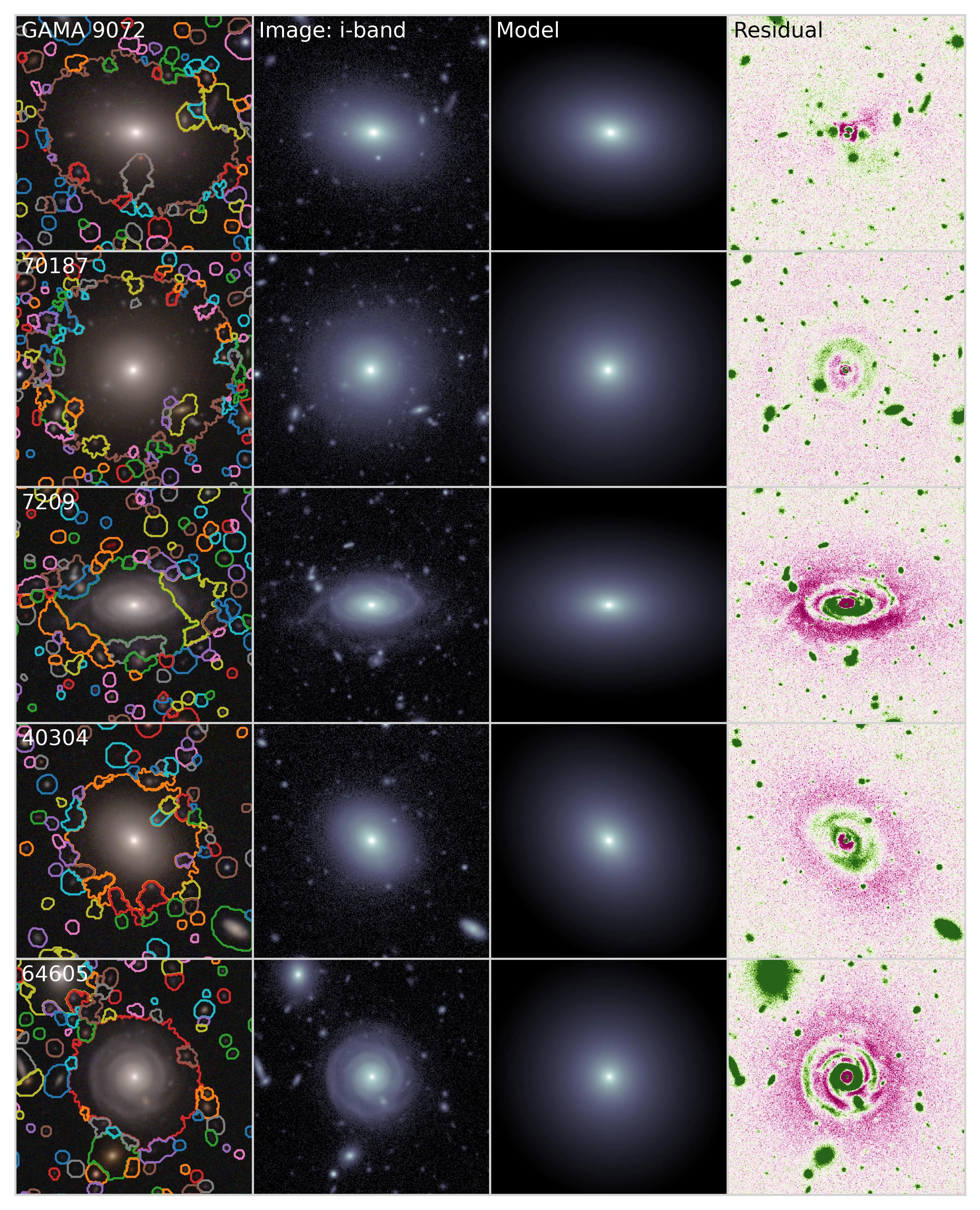
The researchers took 6348 real galaxies with masses above 10 billion solar masses from the Hyper Suprime-Cam and GAMA surveys. For each, they measured the Sérsic index (how concentrated the light is toward the center), radius, flattening, asymmetry, and concentration. Then they generated artificial images of galaxies from the three simulations, passing them through the same processing pipeline as the real images: adding noise, atmospheric blur, and pixelation. After that, they constructed structural abundance functions, analogous to mass functions but for each shape parameter separately. The comparison was done over the same mass and star formation rate intervals.
Results
All three simulations failed the test: the discrepancies with observations exceed five standard deviations in nearly all subsamples. For the Sérsic index, EAGLE and SIMBA strongly underproduce galaxies with large bulges, while TNG50, on the contrary, creates too many among star-forming galaxies. In terms of size, all simulations overproduce extended galaxies but underproduce compact ones. Particularly telling is the deficit of very flat disks: no model reproduces their observed number. IllustrisTNG performs best, SIMBA worst, but even the best result is far from reality. Meanwhile, the global stellar mass function of all three models agrees with observations, which underscores that having the right total number does not mean having the right structure.
Implications
The work shows that matching integral properties such as the mass function can hide fundamental errors in the distribution of mass and angular momentum. This calls into question the confidence that current models correctly describe the physics of galaxy formation. The difference from neighboring works is that here, for the first time, the full distributions of structural parameters for massive galaxies are systematically compared across three leading simulations using the same image processing pipeline. Previously, such comparisons were limited to average relations or individual parameters.
Future development
The natural next step is to move from one-dimensional distributions to multi-dimensional ones: joint abundance functions of mass, size, shape, and star formation rate. This will identify the specific regions of parameter space where models break down and provide stronger constraints on feedback and accretion physics. It is also important to extend the analysis to lower masses and higher redshifts to understand how structural discrepancies evolve over time.
Impact
The results will directly influence the development of the next generation of cosmological simulations, forcing them to be calibrated not only on total mass but also on structural distributions. This is also important for interpreting data from future sky surveys such as Euclid and the Rubin Observatory.
Next steps
Construct multi-dimensional structural abundance functions and compare them with new simulations. Check whether the discrepancies persist at higher resolution and with other feedback models.
Key open problems
In galaxy astrophysics, the problem of accurately reproducing the balance between gas accretion, star formation, and feedback, which determines internal structure, remains unsolved. This work shows that current models cannot simultaneously correctly describe the total number of stars and their spatial distribution, pointing to a missing understanding of angular momentum transport and star formation suppression processes.
The knowledge machine's view
This section is addressed to the author of the paper and their colleagues. Neighbouring works were found by meaning-based search across our archive, not by word overlap. We do not review: we show the field around the work.
What the work does
The authors compared the distributions of shapes, sizes, and flattening of 6348 massive galaxies from the HSC and GAMA surveys with three cosmological simulations (IllustrisTNG, EAGLE, SIMBA), using a unified image-processing pipeline. All simulations showed systematic discrepancies in structural parameters, despite agreement with the stellar mass function.
Where its strength is
This work provides the first systematic comparison of the full distributions of structural parameters of massive galaxies across three leading simulations, using identical data processing. It reveals that agreement on integrated properties masks errors in the distribution of mass and angular momentum.
Where it could go next
- One could link the found discrepancies to the physics of gas accretion and feedback, comparing with work on gas halos around galaxies to understand which processes in simulations lead to the underproduction of flat disks and compact spheroids.based on: Cosmic Hazes: How Galaxies Are Wrapped in Gas arXiv:2604.10595
- It would be interesting to test how structural parameters relate to kinematics: the difference between rotational support and random motions might explain the deficit of flat galaxies, if compared with analyses of rotation and velocity dispersion.based on: Galaxies: Spinning or Shivering? arXiv:2602.01098
- The analysis could be extended to halos and outer regions, comparing with studies of halos around galaxies to see whether structural mismatches are reflected in the distribution of gas and metals at large radii.based on: Halos Around Galaxies: Where Is the Missing Oxygen Hiding? arXiv:2604.18808
Worth trying
- Apply the same image-processing pipeline to a sample of galaxies with known kinematics to separate the contributions of rotation and dispersion to structural parameters.
- Investigate how the discrepancies depend on feedback parameters (e.g., the strength of supernova and AGN winds) by varying them within a single simulation model.
- Check whether simulations reproduce the correlation between flattening and gas content, using data on gas disks.
Why this may matter
It shows that testing cosmological models requires diagnostics sensitive to the distribution of mass and angular momentum, not just the total stellar content, which could guide improvements in simulation physics.
Nearby works in our archive
- Cosmic Hazes: How Galaxies Are Wrapped in Gassimilarity 0.57
- Halos Around Galaxies: Where Is the Missing Oxygen Hiding?similarity 0.56
- Galaxies: Spinning or Shivering?similarity 0.55
- A Galaxy Loses Its Memory in the Blink of an Eyesimilarity 0.55
- A Gravitational Census of Invisible Giantssimilarity 0.53
- Cosmos Without Averaging: How Inhomogeneity Changes the Universesimilarity 0.53
The archive is sparse around this work: the closest review is only 0.57, against a usual 0.64. It looks like few have drilled nearby.
The Sérsic index of galaxies typically lies between 1 (a pure exponential disk) and 4 (a classical de Vaucouleurs elliptical profile), but in simulations values up to 8 are found, which is almost never observed in reality.
In Liu Cixin's novel 'The Three-Body Problem', the Trisolaran civilization tries to predict the structure of their chaotic star system but faces fundamental limitations in modeling. Similarly, modern galaxy formation simulations face limitations in reproducing structural diversity, despite impressive computational power.
Key numbers
- number of observed galaxies: 6348
- mass threshold: 1010 solar masses
- significance of discrepancies: >5σ
- error scatter: 0.2–1.8 dex
- survey area: 126 square degrees