Stair steps and stride length. If the stride matches the step height, climbing goes smoothly. Similarly, X-rays reflect off atomic layers of a crystal — the reflected waves reinforce each other when the path difference is a multiple of the wavelength. In other words, to 'detect' a maximum, two rays that have traveled different distances must arrive in phase.
History
The law was first formulated by William Lawrence Bragg in November 1912 (Cambridge) based on experiments with X-ray diffraction on zinc sulfide crystals. Independently and almost simultaneously, Russian crystallographer Georgy Wulf arrived at the same result (1913). For this work, William Henry Bragg and William Lawrence Bragg received the Nobel Prize in Physics (1915) — the only case where a father and son shared the prize.
How it works
Used in X-ray, neutron, and electron diffraction to determine the atomic structure of crystals. The method allows deciphering complex molecular architectures — from simple salts to ribosomes. Limits of applicability: work with single crystals, the radiation wavelength must be comparable to interatomic distances; with very strong lattice distortions, the law transitions to a more general dynamic theory of diffraction.
Fun fact
Bragg's law allows measuring distances between atoms with an accuracy of tenths of a nanometer — this is how the double helix of DNA was determined.
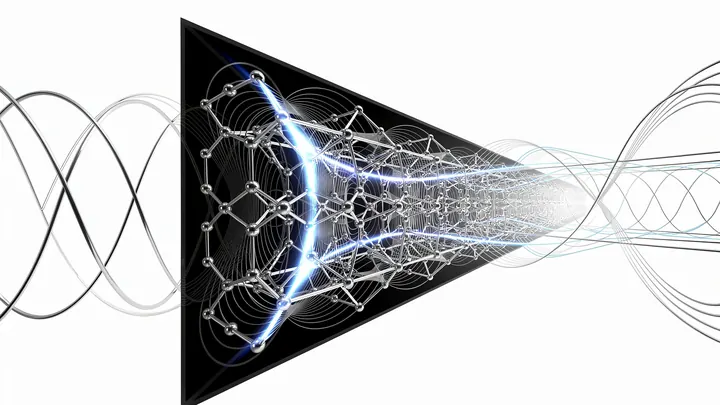
The mirror races along at nearly forty thousand kilometers per second. Light that strikes it bounces back, but changed, like a ball volleyed by a racket in mid-swing. That's exactly the kind of mirror scientists have built inside an ultra-thin glass thread filled with hydrogen.
First, a powerful laser pulse is sent down the fiber.
The Universe is humming, but our ears catch only the bass. LIGO hears the rumble of black hole mergers — the infrasound of space. Higher up, in the gigahertz range, the flutes and violins of primordial gravity ring out.
In astrophysics, some numbers seem random yet recur with the persistence of a spell. One such number is the ratio of X-ray brightness to H-alpha hydrogen emission in turbulent gas tails. From galactic winds to ‘jellyfish’ slicing through clusters, this ratio steadily holds at around three.
The James Webb Space Telescope peered into the era when the expansion of the Universe stretched the light of distant objects into the red, and found a scattering of strange sources — 'little red dots'. Their spectra broke the usual patterns: they are blue in the ultraviolet, but deep red in the optical, as if seen through a cherry veil.
A flashlight doesn't cast a uniform circle of light; it has a bright spot in the center and a blurred halo at the edges. If you switch it off quickly, the edges are the last to fade, and by how the light dies, you can guess the shape of the reflector.
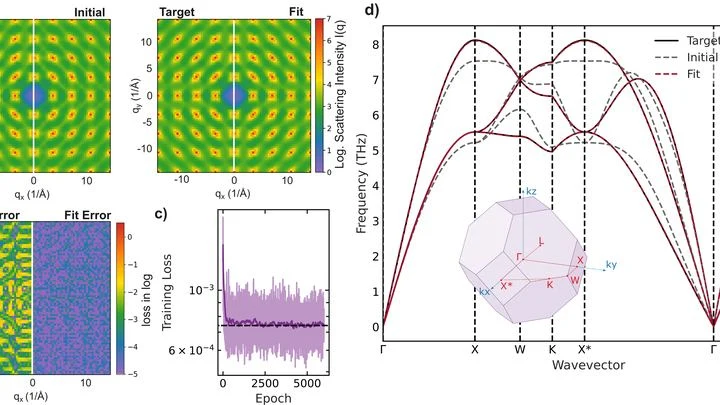
Heat a crystal, and its atoms start to jiggle like plucked strings. An X-ray beam passing through the crystal scatters off these vibrations, painting on the detector not only sharp spots but also faint, smeared patterns. These patterns are like fingerprints: from them, you can reconstruct how strongly atoms pull and push on each other.
An atomic nucleus isn't always round. It can stretch out like a melon or flatten like a pumpkin. And its size depends on this shape — just as the size of a pie depends on the shape of the dough.
Scientists calculated the shapes and sizes of nuclei of berkelium isotopes — a heavy element produced in reactors.
When an X-ray beam reflects off a crystal, it paints a pattern of spots and streaks on a detector. If the crystal is perfect, the pattern is simple. But inside a real material, atoms are often shifted — compressed in some places, stretched in others. The pattern then looks like ripples from a stone thrown into water, and deciphering it by hand is nearly impossible.
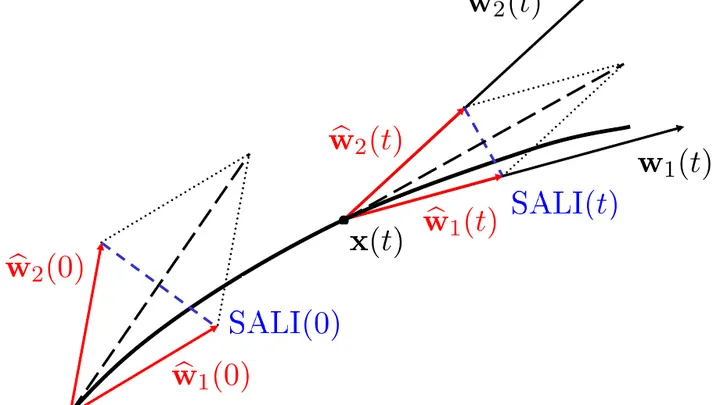
Drop a stone into a calm pond — the ripples spread evenly. Drop it into a churning stream — the water swirls unpredictably. Scientists have long wrestled with a similar question: how can you tell from a single particle's path whether its motion is chaotic? Previously, this meant comparing the particle's path with neighboring ones, which is complicated and time-consuming.
Two particles cling to each other like climbers on the same rope and fly toward a wall. When they hit, will they bounce off together, or will the rope snap? What does it depend on? Physicists considered the simplest case: everything happens on a single line, the particles attract only when they occupy the same point, and the wall is perfectly rigid.
Four cesium atoms hang in vacuum, held by laser tweezers like beads on an invisible thread. Around them is a ring resonator, a closed loop of mirrors where light circulates without obstacles. When a probe beam strikes this tiny chain, something strange happens: the atoms scatter light not uniformly in all directions, but predominantly in one direction.