Where the Electron Lives: Topology of the Band Structure in Real Space ✛
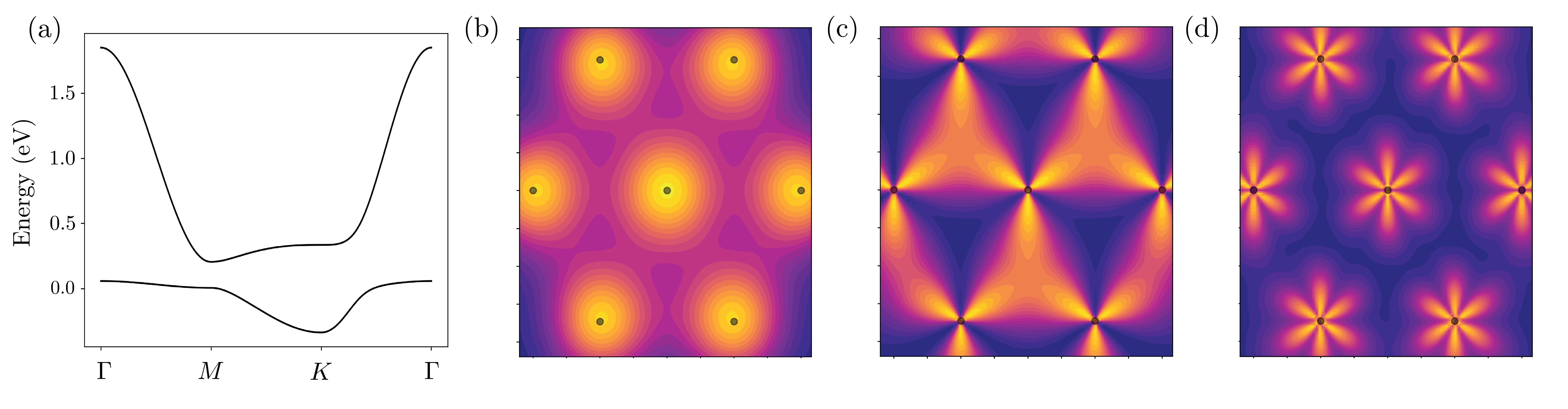
Electronic charge is a tumbleweed that moves camp depending on energy. In tungsten selenide (WSe₂) crystals, this is seen with utmost clarity: at a bias of −1.4 V, near the K point of the Brillouin zone, the maxima of tunneling current sit in the centers of hexagons, where there are no atoms. At −1.9 V, closer to the Γ point, the charge moves onto tungsten atoms. The shift is only 0.16 nm, half the distance between neighboring metal atoms. This is no optical illusion: a scanning tunneling microscope probes the surface with a needle, and its images directly reflect where electrons feel most at home.
Previously, band topology was studied in momentum space, through Berry phases and symmetry indicators. But the wave function from which these properties derive lives in real space, inside the unit cell. Now it turns out that topological obstruction can be diagnosed by a purely real-space feature: the shift of the charge center within the band. This distinguishes the method from earlier ones, where topology manifested through boundaries or interference. In WSe₂, the K point hosts a chiral d-orbital state with a nontrivial phase under 120° rotation, which forbids localization on an atom. Therefore, the Wannier functions of the valence band are centered in the voids.
Practical benefits are already visible: STM images of transition metal dichalcogenides have often been interpreted inconsistently, with bright spots attributed sometimes to metal atoms and sometimes to chalcogen atoms. Now there is a clear criterion: in an obstructed insulator electrons cannot localize on atoms, and this is visible through the charge shift. The method applies to any crystal with an isolated band and high-symmetry points separated in energy. For condensed matter physics, this means STM becomes a tool for verifying symmetry indicators directly in coordinate space. Looking ahead, it could enable the search for new topological materials without complex calculations and quality control of two-dimensional semiconductors in electronics and optoelectronics.
The distance over which the charge maximum shifts in WSe₂ is only 0.16 nanometers, roughly 600 times smaller than the thickness of a human hair.
In Greg Egan's novel 'Permutation City', characters manipulate quantum states to alter the properties of matter. Here, scientists are essentially taking the first step toward such control: seeing where exactly in the crystal the electron lives and how that relates to global topology.