Flickering Debris: White Dwarf Transits Vanish and Return ✛
Context
White dwarfs are the final evolutionary stage of most stars, and they often disrupt the remnants of planetary systems. Over 40% of white dwarfs have atmospheres enriched with metals from tidally disrupted planetesimals, while infrared excess and gas disks indicate ongoing disruption. The first transiting white dwarf, WD 1145+017, discovered in 2015, showed irregular dimming with a period of 4.5 hours, confirming the tidal disruption model. Since then, several other systems have been found with periods ranging from hours to hundreds of days, but only WD 1145+017 had an orbit near the Roche limit. The work on ZTF J1944+4557 stands out: it is the second case with an orbit at the Roche limit and the first where a complete disappearance and return of transits has been observed, opening new avenues for studying debris dynamics.
Methods
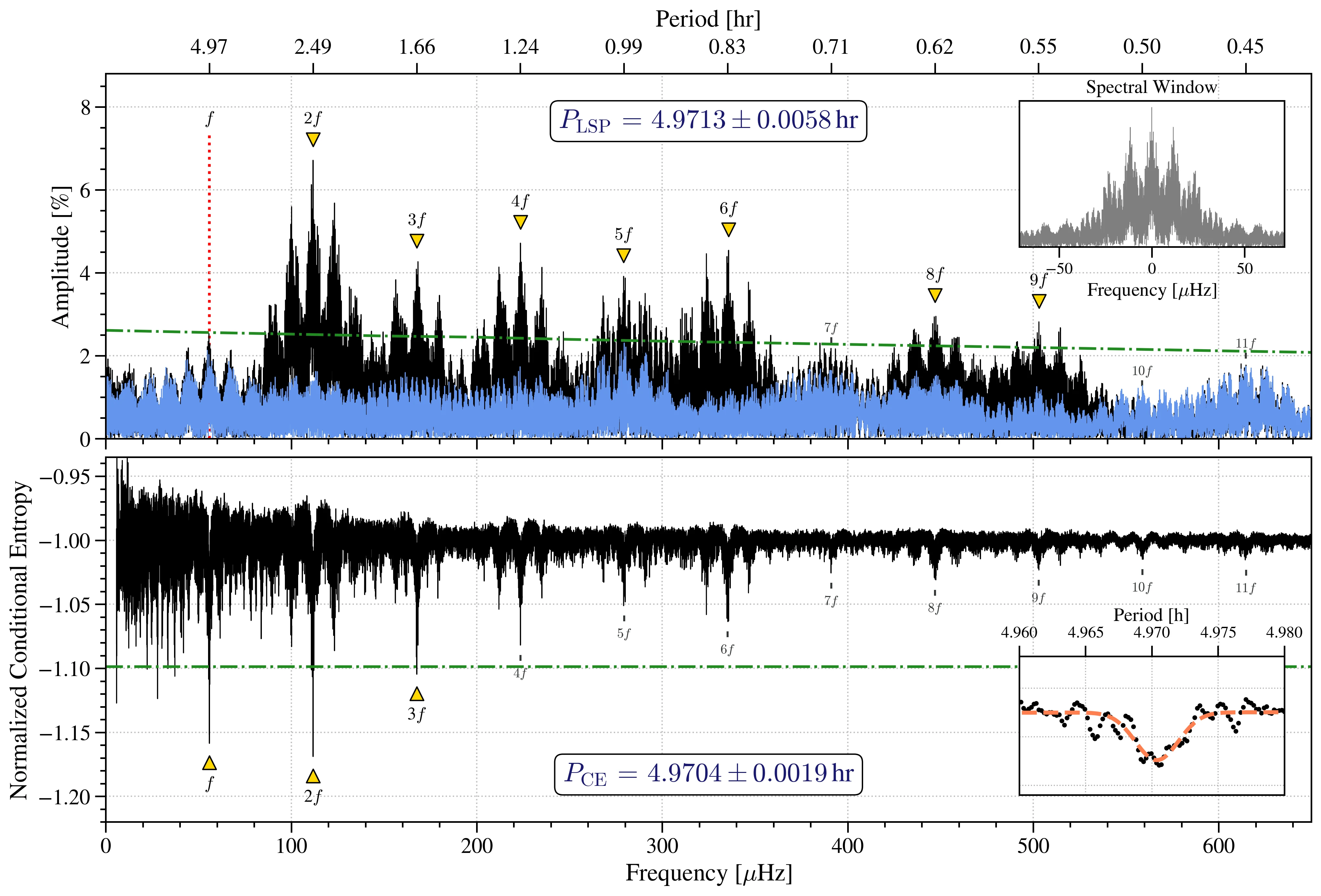
The authors conducted over 123 hours of high-speed photometry from four observatories (Palomar, McDonald, Perkins, Lowell) over 3.3 years, using the CHIMERA, ProEM, PRISM, and LMI instruments. The period was determined using Lomb-Scargle periodograms and conditional entropy, which is independent of signal shape. Simultaneously with transits on June 20, 2023, they obtained five spectra with Keck LRIS, each with 600-second exposures, to measure the equivalent width of the Ca K line inside and outside transit. The color of the transits was assessed from simultaneous observations in g, r, and i filters, and archival Spitzer IRAC and WISE data were used to search for infrared excess.
Results
The orbital period of the debris is 4.9704 ± 0.0019 hours, corresponding to a circular orbit with a semi-major axis of 1.3618 solar radii, near the Roche limit for a white dwarf of 0.79 solar masses. Individual transit depths exceeded 30%, and durations varied from 15 to 40 minutes. Transit activity ceased from May to October 2024 and resumed in March 2025 with the same period. The equivalent width of the Ca K line remained constant inside and outside transit (0.59 ± 0.13 Å versus 0.63 ± 0.14 Å), but the observed Fe II and Na I lines could not be reproduced by photospheric models, indicating circumstellar gas. The transits are colorless: extinction coefficients (g-r)/g = 0.002 ± 0.004 and (g-i)/g = -0.010 ± 0.012, placing a lower limit on dust particle size of about 0.2 microns. No infrared excess was detected, with an upper limit on dust mass of 4×$10^{15}$ g.
Implications
This work stands out among neighboring studies because it documents for the first time a complete cycle of transit disappearance and resumption in a white dwarf. Unlike WD 1145+017, where transits vanished in 2022 without returning, and ZTF J0328-1219, where only one of two periodicities disappeared, here we see a resumption with the same period. This allows direct constraints on the depletion and replenishment timescales of the debris disk. Furthermore, the combination of colorless transits and evidence of circumstellar gas, in the absence of infrared excess, provides new constraints on the composition and dynamics of disrupted planetesimals.
Future development
The topic could develop toward long-term monitoring of the system to identify recurring activity cycles and test hypotheses about disk replenishment mechanisms. Future surveys such as the Rubin Observatory and the Roman Space Telescope will provide denser coverage and allow the discovery of more such systems. Infrared photometry of transits with Roman will help refine particle size distributions through Mie scattering theory. High-resolution ultraviolet spectroscopy could separate the contributions of photospheric, circumstellar, and interstellar absorption.
Impact
The results will influence models of debris disk evolution around white dwarfs and strategies for finding transiting systems in future surveys.
Next steps
Long-term monitoring is needed to confirm the cyclical nature of the activity and to search for a possible external perturbing body. Deeper infrared observations are also required to constrain the mass and geometry of the dust disk.
Key open problems
In the field of white dwarf studies, an unresolved question is how quickly and by what means debris disks are replenished after depletion. The observed disappearance and resumption of transits over 1-2 years challenges models that predict replenishment timescales of hundreds of years, and points to the possible role of an external body or rapid dynamical processes.
The knowledge machine's view
This section is addressed to the author of the paper and their colleagues. Neighbouring works were found by meaning-based search across our archive, not by word overlap. We do not review: we show the field around the work.
What the work does
The authors conducted over 123 hours of high-speed photometry from four observatories over 3.3 years to monitor debris transits around the white dwarf ZTF J1944+4557. They determined a period of 4.97 hours, recorded the disappearance of transits from May to October 2024, and their return in March 2025. Spectroscopy revealed the presence of circumstellar gas, and the transits were colorless, which places a lower limit on the dust grain size of about 0.2 microns.
Where its strength is
This is the first documented case of a complete disappearance and subsequent reappearance of transits around a white dwarf, providing a unique opportunity to study debris dynamics in real time. The long-term monitoring and multi-observatory observations allowed this phenomenon to be reliably captured.
Where it could go next
- It might be interesting to compare the changes in transit activity with the irregular dimming of Tabby's star, where variable obscuration, possibly from dust clouds, is also observed. This could help distinguish the mechanisms causing the disappearance and return of transits.based on: A Symmetric Shadow in the Chaos of Tabby's Star arXiv:2607.20643v1
- Related work on the mineral composition of dust around the star HD 15407A analyzed the composition of debris. For ZTF J1944+4557, a similar dust composition study could be useful to understand the origin of the debris and its evolution.based on: The Mineral Fingerprint of Star HD 15407A arXiv:2607.21948v1
Worth trying
- Check whether the disappearance of transits correlates with changes in the spectral lines of the circumstellar gas, for example, in the equivalent width of Ca K.
- Search for possible periodicities in the appearance and disappearance of transits using longer observational baselines.
- Assess whether collisions between debris fragments can explain the observed variability by modeling the evolution of the particle cloud.
Why this may matter
This object could become key to understanding how planetary systems are disrupted and how debris evolves near white dwarfs. Observing the full cycle of transit disappearance and return offers a rare chance to test models of debris dynamics.
Nearby works in our archive
- A Flickering Fragment of a Dead Systemsimilarity 0.53
- Cosmic Waltz: How a White Dwarf Became a Radio Beaconsimilarity 0.51
- A Giant Star with a Magnetic Heartsimilarity 0.51
- Gravitational Infancy: Record Orbits in the Cradle of HD 114082similarity 0.51
- A Symmetric Shadow in the Chaos of Tabby's Starsimilarity 0.49
- The Mineral Fingerprint of Star HD 15407Asimilarity 0.49
The archive is sparse around this work: the closest review is only 0.53, against a usual 0.64. It looks like few have drilled nearby.
Transit depths reach 40%, equivalent to an eclipse of nearly half the white dwarf's surface by a debris cloud the size of the Moon.
The idea of disintegrating planetary systems around white dwarfs echoes Arthur C. Clarke's novel 'Rendezvous with Rama', where a giant object passes through the Solar System, leaving traces of destruction.
Key numbers
- orbital period: 4.9704 hours
- transit depth: up to 40%
- transit duration: 15-40 minutes
- dust particle size: ≥ 0.2 microns
- disappearance duration: 7 months