Light Makes a Crystal Conduct Current express
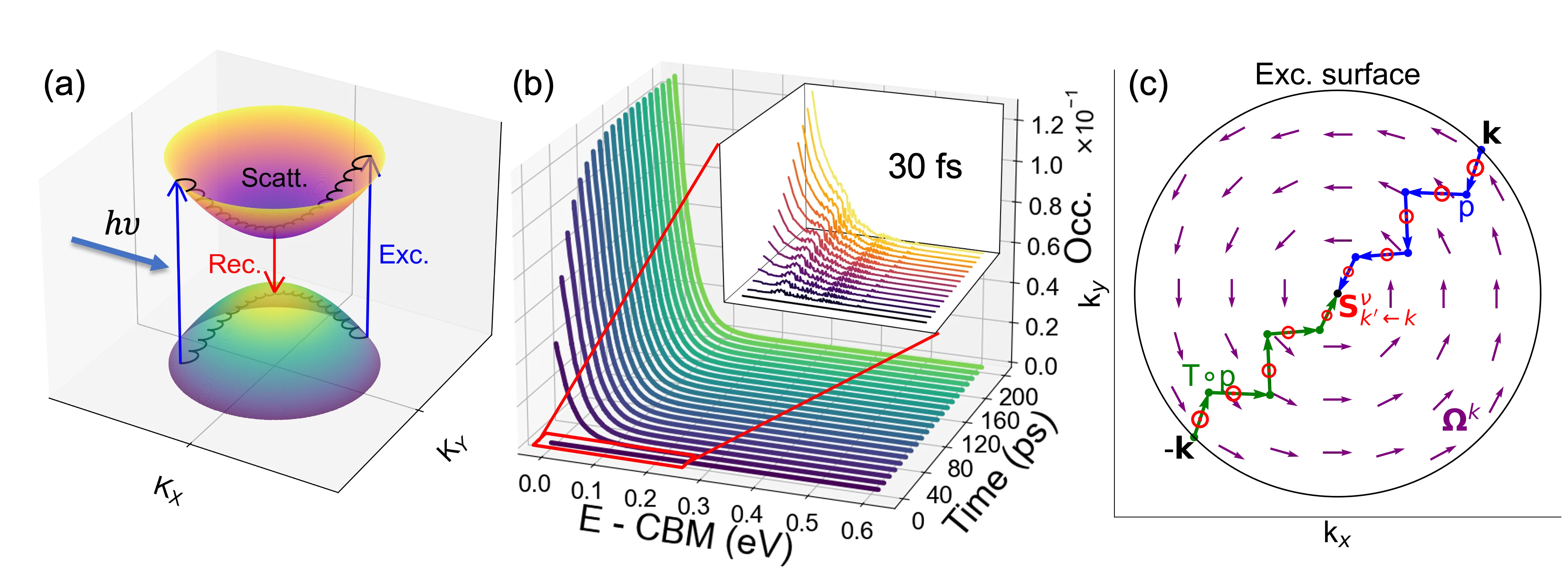
A crystal without a center of symmetry is like a staircase where all the steps are tilted in the same direction: electrons, given a kick by light, roll predominantly in one direction. This is how a direct current is born — the photogalvanic effect. Until now, theorists could only describe the moment of light absorption, but not what happens next: how electrons collide, lose energy, and eventually form a stable flow.
The new work provides a complete picture. The authors built a method that tracks electrons over time, taking into account all quantum collisions: electrons scatter off lattice vibrations (phonons), transition between bands, and recombine with holes. For barium titanate, a classic piezoelectric, calculations showed that phonons make a significant contribution to the shift current — the current that arises from the displacement of electron clouds upon photon absorption.
The method also explains a puzzle from experiments: with ultrashort laser pulses, the photogalvanic current first flows in one direction, then in the other. It turns out that such a bipolar transient current arises because phonons interfere differently at different stages of the process. First, electrons are accelerated by light, and then the lattice gradually 'adjusts,' changing the direction of the total flow.
The connection between current and the geometry of quantum states, Berry curvature and quantum metric, becomes transparent. These quantities describe how the phase of the wave function changes as one moves through the Brillouin zone, and they determine the magnitude of the photogalvanic response. The practical benefit is obvious: accurate calculation will allow designing materials for solar cells operating on the bulk photogalvanic effect and for terahertz radiation detectors.
Original abstract
as written by the authors arXiv:2601.01059
The photogalvanic effect is the generation of a second-order direct current by illumination of a non-centrosymmetric material. In this work, we develop a first-principles real-time density matrix (FPDMD) formalism enabling the calculations of the photogalvanic current in all time regimes: transient and steady. Unlike past \textit{ab-initio} studies which focused only on the photo-excitation process, our first-principles theory framework encodes all quantum scatterings (intra/interband relaxation and electron-hole recombination) mediated by bosons (photons and phonons), and is thus predictive of photogalvanic currents in realistic materials. In particular, for the linear photogalvanic effect, we find electron scatterings mediated by phonons contribute significantly to the shift current for prototypical piezoelectrics like BaTiO$$_3$$. For the circular photogalvanic effect, we develop a self-consistent theory of a steady injection current that incorporates realistic scattering mediated by phonons. Our formulation developed for photogalvanic current elucidates its connection with fundamental quantum-geometric quantities such as the Berry curvature and the quantum metric. A phonon-based explanation is proposed for the bipolar transient photogalvanic current observed by the THz emission spectroscopy.
Barium titanate is the very material used to make capacitors in most electronic devices: every smartphone contains tiny layers of this crystal.