Are you one of the authors of this paper? Email us from your institutional or work email address mentioning this article's arXiv ID and we'll verify you and give you edit access to this page.
Are you an author who sees something we missed or got wrong? Write to us — the subject line already carries the paper id. We read every note and correct the write-up.
The James Webb Space Telescope spotted a pair of red "eyes" in a distant galaxy — revealed by a gravitational lens.
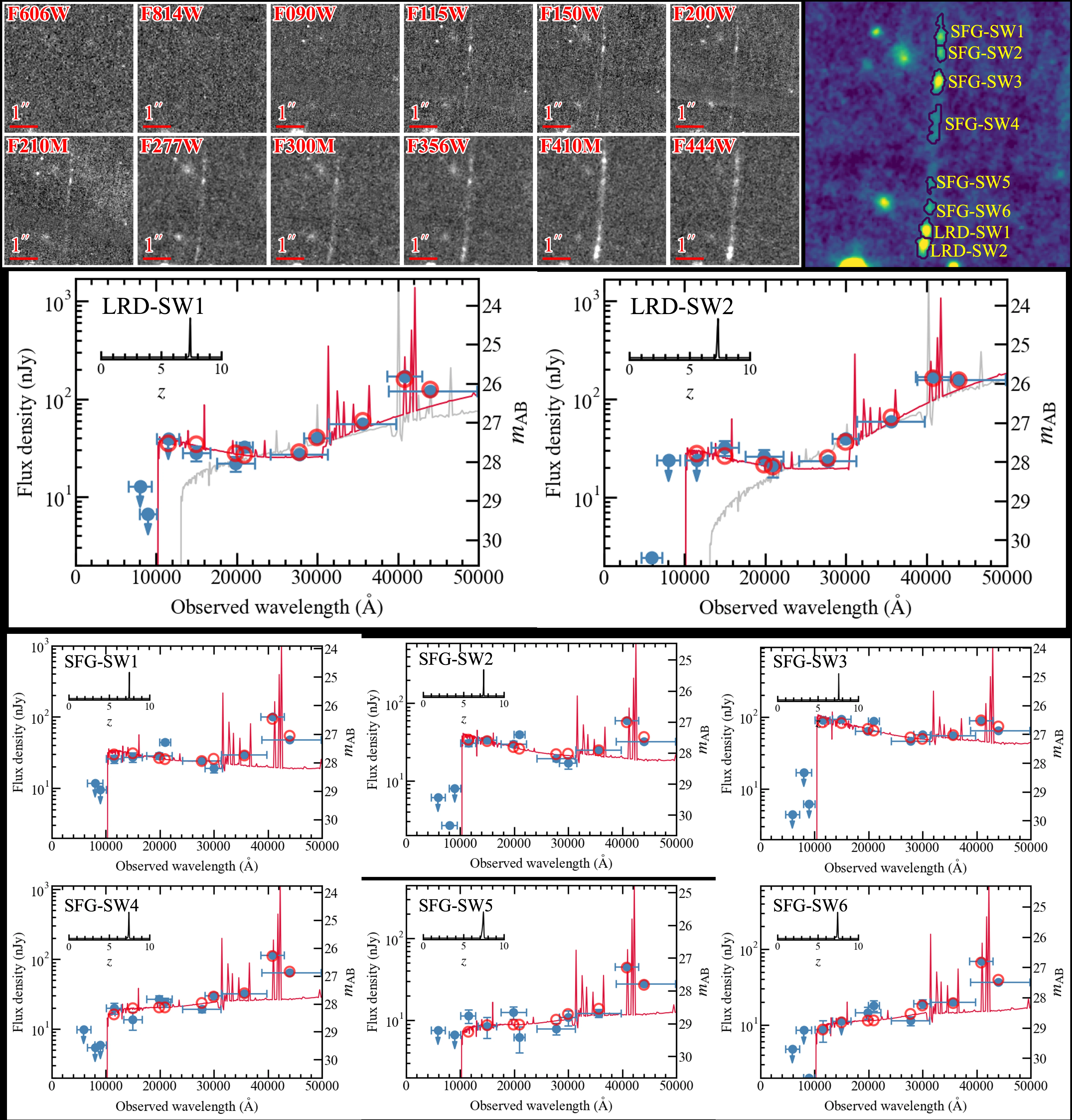
Thanks to gravitational lens — an effect predicted by Fritz Zwicky, where a galaxy cluster acts like a magnifying glass — the James Webb Space Telescope spotted two red dots in a galaxy 800 million years after the Big Bang. These objects, dubbed the Red Eyes, turned out not to be in the center, as one might expect, but on the very outskirts — like a pair of glowing pupils peering into the void.
The lens amplified their shine 20 times: without it, the dim "eyes" would have stayed invisible.
Each eye is an intermediate-mass black hole, surrounded by scorching gas. They are separated by just 70 parsecs — on cosmic scales, that’s tighter than our distance to the Milky Way’s center. The finding upends the idea of black hole growth: perhaps the supermassive monsters in galaxy cores are assembled from many such wandering "pupils" that merged and devoured matter on the fringes. In other words, every giant started out as a pair of red eyes.
The pair of Red Eyes is separated by 70 parsecs — nearly 30 times less than the distance from us to the Galactic Center. For black holes, that's an extremely tight proximity.