Red Eyes: Cosmic Lens Reveals a Pair of Black Holes express
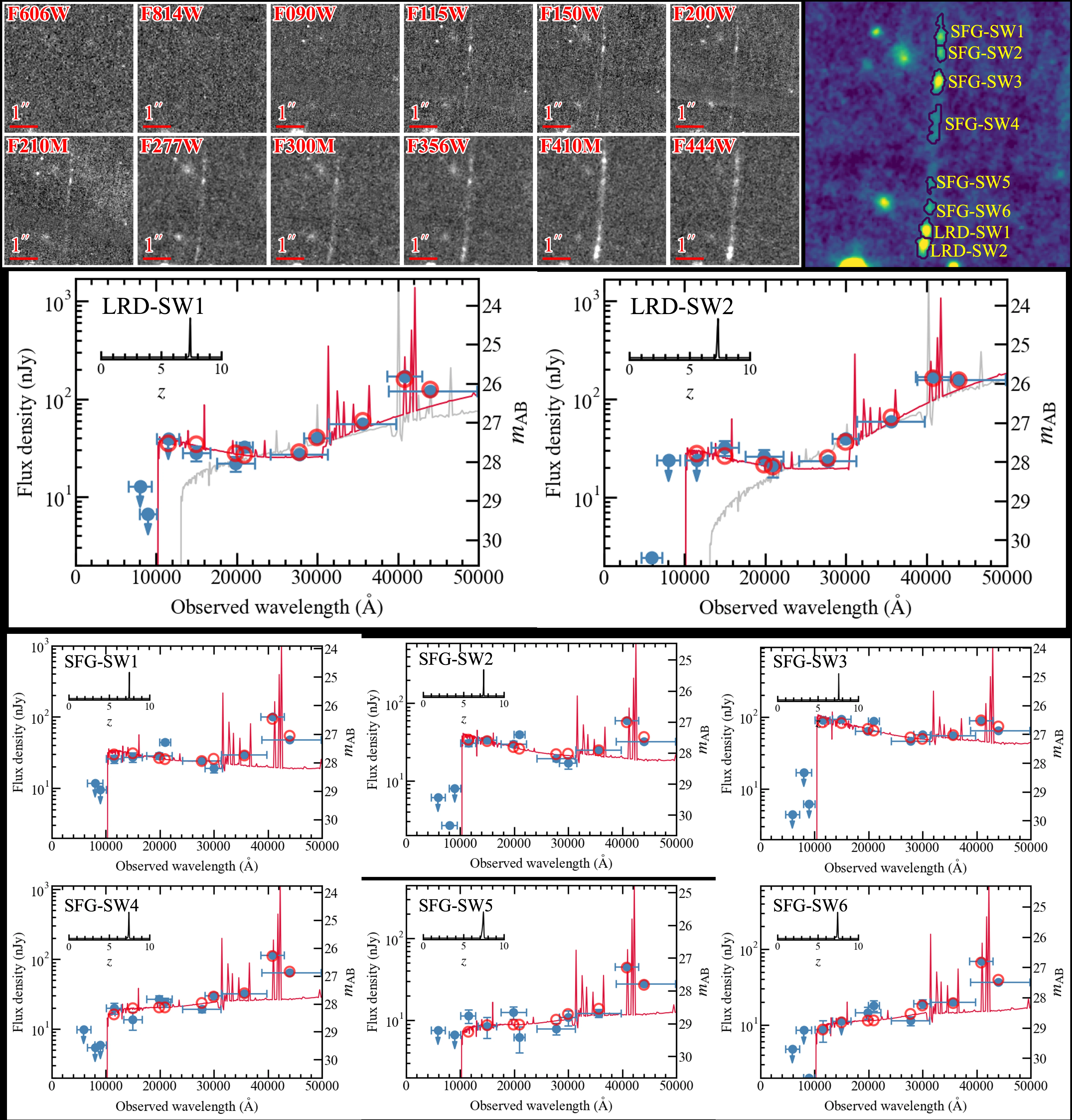
Thanks to gravitational lens — an effect predicted by Fritz Zwicky, where a galaxy cluster acts like a magnifying glass — the James Webb Space Telescope spotted two red dots in a galaxy 800 million years after the Big Bang. These objects, dubbed the Red Eyes, turned out not to be in the center, as one might expect, but on the very outskirts — like a pair of glowing pupils peering into the void.
Each eye is an intermediate-mass black hole, surrounded by scorching gas. They are separated by just 70 parsecs — on cosmic scales, that’s tighter than our distance to the Milky Way’s center. The finding upends the idea of black hole growth: perhaps the supermassive monsters in galaxy cores are assembled from many such wandering "pupils" that merged and devoured matter on the fringes. In other words, every giant started out as a pair of red eyes.
Original abstract
as written by the authors arXiv:2601.06015v1
We report the identification of a pair of faint little red dots (LRDs), dubbed Red Eyes, in a strongly-lensed galaxy at $$z\sim7$$ behind the PLCKG004.5-10.5 cluster, identified from the JWST Treasury program VENUS. Red Eyes are spatially resolved on the image plane with distinct colors, while the critical curve lies far north of Red Eyes, clearly requiring two different LRDs rather than a single LRD. Red Eyes is an extremely close pair of LRDs separated by $$\sim70\,\mathrm{pc}$$ in the source plane with a magnification of $$\mu\sim20$$, which consistently explains another counter-image detected to the north-west. Red Eyes is hosted in a typical star-forming galaxy with $$M_{\mathrm{UV,int}}\sim -19$$, but its own UV emission is very faint ($$M_{\mathrm{UV,int}} \gtrsim -16$$). Moreover, Red Eyes does not reside at the galaxy center but lies at an offset position of approximately one effective radius $$R_{\mathrm{e}}$$ away from the galaxy center. If observed without lensing, Red Eyes would appear as a typical star-forming galaxy at $$z\sim 7$$ with $$M_{\mathrm{UV}}\sim -19$$, showing no apparent LRD signatures in either morphology or SED. These results suggest that multiple off-center LRDs, similar to Red Eyes, may be commonly hidden in a typical high-$$z$$ star-forming galaxy. In this case, various plausible scenarios may emerge, one of which is that intermediate-mass black holes (IMBHs) with $$M_\mathrm{BH}\sim10^{4\text{--}6}\,M_\odot$$ may form in star clusters on a stellar disk and contribute to the growth of the central supermassive black hole via mergers, with some IMBHs detectable as luminous LRDs in a sufficiently active and massive phase.
The pair of Red Eyes is separated by 70 parsecs — nearly 30 times less than the distance from us to the Galactic Center. For black holes, that's an extremely tight proximity.