Turbulence in Space: How Clouds Change the Chemistry of Stars express
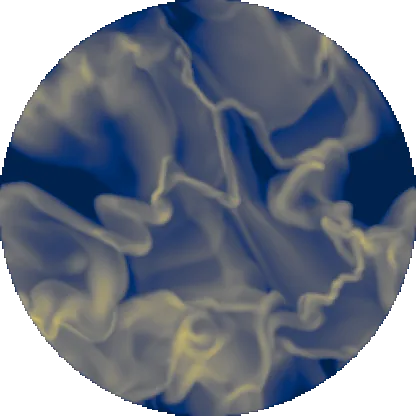
A boiling cauldron: steam rises, water churns, and the temperature varies from point to point. So it is in space: the gas clouds around young stars are not smooth spheres but a seething mixture with vortices and density fluctuations. Astronomers long treated such clouds as homogeneous, but this simplification can skew conclusions.
Scientists built a computer model of a cloud around a single hot star — with and without turbulence. They found that vortices directly affect the brightness of emission lines: the nitrogen line [N II] becomes brighter, while the oxygen line [O III] becomes fainter. This throws off estimates of metallicity (how many heavy elements are in the gas) and other properties. The error reaches 0.1 dex, as if you were weighing sugar on a scale that always lies by 20%.
The difference is also visible in density: infrared, optical, and ultraviolet indicators give different numbers for the same cloud. It's like measuring a person's height with different rulers: each shows something different. For precise conclusions, we need large tables of models with turbulence that cover conditions in both nearby and distant galaxies.
Turbulence in interstellar gas can be triggered by supernova explosions — shock waves stir the gas like a spoon stirring sugar into tea.