A turbid medium is a material that scatters and absorbs light, making it difficult for signals to pass through clearly. Examples include biological tissue, fog, milk, and even the interstellar medium. In such media, photons undergo multiple scattering events, randomizing their directions and causing images to become blurry or completely obscured. This poses a major challenge for applications like medical imaging, optical communication, and astronomy, where one needs to see through or transmit information across such materials.
History
The study of light scattering in turbid media began in the 19th century with Lord Rayleigh's explanation of why the sky is blue, and John Tyndall's experiments on colloidal suspensions. The modern theory of multiple scattering was developed in the mid-20th century, with contributions from Hendrik van de Hulst and others.
How it works
When light enters a turbid medium, it interacts with particles or density fluctuations that have a different refractive index than the surrounding material. Each interaction scatters the photon in a new direction, and the cumulative effect is a random walk. The mean free path—the average distance a photon travels between scattering events—determines how quickly the light becomes diffuse. For thick media, the light can be modeled as a diffusion process, where the intensity spreads out like heat. However, recent advances in wavefront shaping and adaptive optics allow one to pre-compensate for the scattering, focusing light through or even inside the medium.
In practice
Turbid media are central to biomedical optics, where techniques like diffuse optical tomography use scattered light to image tissue, and in atmospheric science for understanding light propagation throughclouds and aerosols.
Fun fact
The opacity of a turbid medium can sometimes be overcome by using 'scattering lens' techniques, where the random speckle pattern is measured and then inverted to create a focus—effectively turning the scattering material into a lens.
Light from the very beginning of the cosmos has been traveling toward us for 13.8 billion years. During that time, its polarization, the direction of its oscillations, might have been twisted, like a compass needle that someone quietly nudged. Physicists call this phenomenon cosmic birefringence.
A beam of light enters frosted glass and fades — nothing unusual. But physicists have long known how to make light pass through without losing a single photon. This trick is called electromagnetically induced transparency: two light waves cancel each other at the right point, and absorption disappears. Now a similar feat has been pulled off with atoms.
A candle flame flickers in a draft but doesn't go out — the tongue of fire briefly changes shape and then returns. Optical skyrmions behave much the same way — tiny vortices in a light beam, reminiscent of swirling eddies. Until recently, they were created only in the perfect, smooth light of a laser.
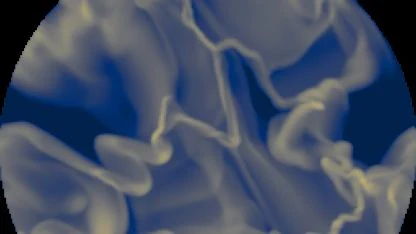
A boiling cauldron: steam rises, water churns, and the temperature varies from point to point. So it is in space: the gas clouds around young stars are not smooth spheres but a seething mixture with vortices and density fluctuations. Astronomers long treated such clouds as homogeneous, but this simplification can skew conclusions.
A quantum computer is like an orchestra that can only perform in complete silence. The slightest noise, and the delicate melody falls apart. For quantum devices, heat is that noise: even faint infrared radiation from nearby components heats up the qubits and erases their quantum states.
When light passes through biological tissue or frosted glass, it scatters and loses the image. Researchers at the Paris Institute of Nanosciences have shown that a scattering medium can be tuned to transmit images encoded in the correlations of entangled photons while remaining opaque to classical light.