Cosmic Rays as a Thermometer and Magnetic Compass express
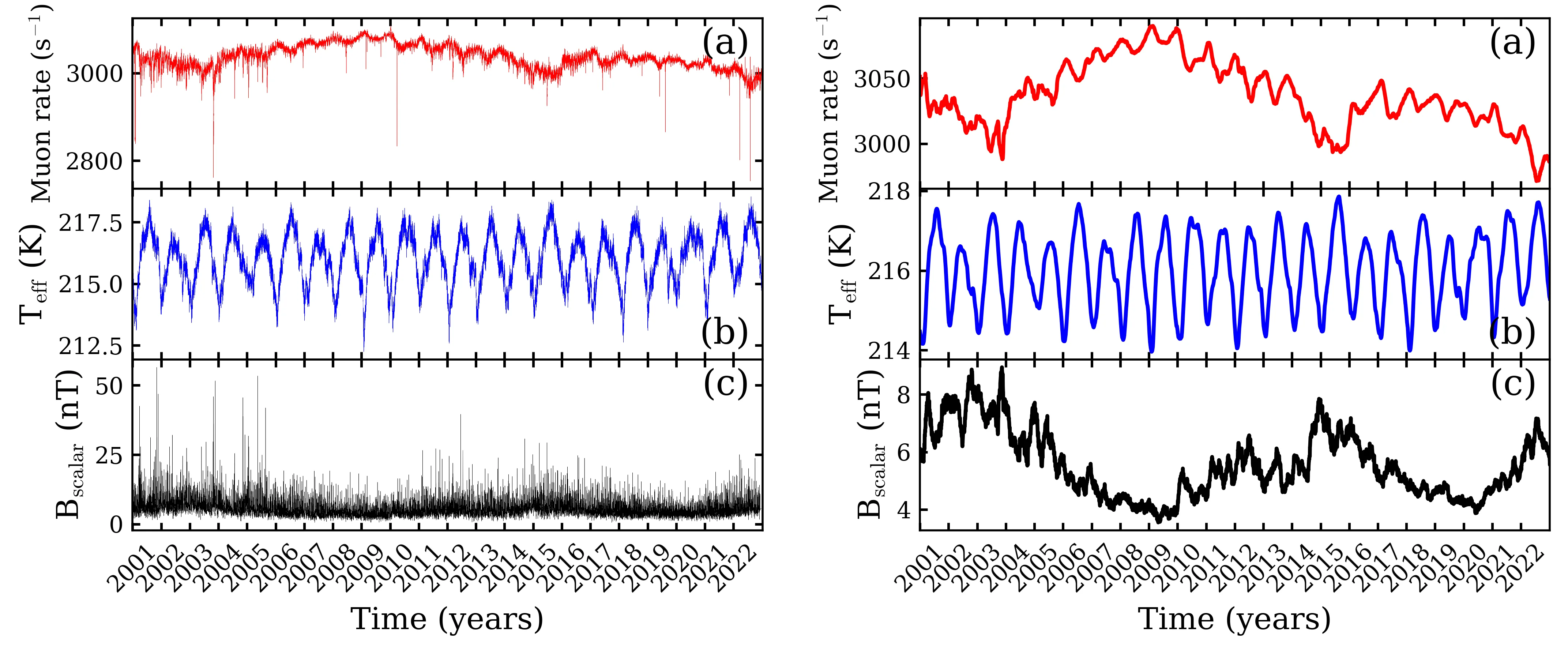
Every second, invisible particles from space, cosmic rays, strike Earth's atmosphere. Colliding with air molecules, they produce showers of secondary particles, among which muons are especially abundant. A muon is a heavy cousin of the electron that lives only a couple of microseconds but still manages to reach the ground. At the GRAPES-3 observatory in southern India, a giant telescope covering 560 square meters counts these muons around the clock. In a single day, it tallies about four billion particles — statistics so precise that hourly variations in the flux are visible at the level of hundredths of a percent.
It turns out muons are excellent thermometers. When the upper atmosphere (above 20 kilometers) warms, the air expands, and muons have to plow through more material. Some of them decay along the way, so the flux at ground level weakens. Conversely, a cold stratosphere contracts, allowing more muons to reach the surface. Over 22 years of observations — from 2001 to 2022—scientists compared the muon flux with temperature data from the MERRA-2 meteorological database. They found that a one-degree warming of the upper atmosphere reduces the muon flux by 0.22 percent.
The second factor is the interplanetary magnetic field, generated by the solar wind. The ACE and WIND satellites, positioned at the L1 Lagrange point between Earth and the Sun, continuously measure this field. It turns out that an increase of one nanotesla (roughly a hundred thousand times weaker than a refrigerator magnet) reduces the muon flux by 0.57 percent. It's as if a giant invisible shield alternately appeared and vanished in front of Earth, changing the number of particles that get through.
The practical benefit is clear: instead of expensive satellites for stratospheric and space weather monitoring, ground-based muon telescopes can be used. They operate continuously, are unaffected by clouds, and deliver data every few minutes. Thus particle physics becomes a weather service, but for weather at 30 kilometers altitude and millions of kilometers from Earth.
Original abstract
as written by the authors arXiv:2602.11847
We study the influence of variations in the upper atmospheric temperature and interplanetary magnetic field on the cosmic ray induced atmospheric muon flux measured by the GRAPES-3 experiment over 22 years (2001--2022) of data; spanning three solar cycles: the declining phase of Solar Cycle 23, the full Cycle 24, and the rising and maximum phases of Cycle 25. Located in Ooty- India, the GRAPES-3 large area (560\,$$m^2$$) muon telescope detects $$\sim$$4 billion muons daily above 1\,GeV, with an angular resolution of $$\sim$$4$$^\circ$$, enabling a statistical precision $$<$$0.01\% on the hourly muon rate. After accounting for the effect of atmospheric pressure variations, we compare this data with the upper atmospheric temperature inferred from NASA's MERRA-2 dataset as well as magnetic field data from the ACE and WIND spacecraft at Lagrange point L1. A simultaneous iterative fitting method employing Fast Fourier Transforms and a narrow band-pass filter reveals the temperature and magnetic field coefficients to be $$\alpha_T=-\,0.2241\,\pm\,0.04\, (stat.)\,\pm\,0.0220\, (syst.)\,\%\,K^{-1}$$ and $$\gamma_{M}=-\,0.574\,\pm\,0.027\, (stat.)\,\pm\,0.011\, (syst.)\,\%\,\text{nT}^{-1}$$, respectively, for an assumed hadronic attenuation length $$\lambda$$=120 g cm$$^{-2}$$, underscoring the potential of the GRAPES-3 muon telescope to serve as a real time monitor of the upper atmospheric temperature or interplanetary magnetic field.
Muons are born at about 15 kilometers altitude, but thanks to relativistic time dilation they manage to reach the surface, whereas without this effect they would decay within 600 meters.