Magnetic Reconnection: From Gentle Flow to Explosion express
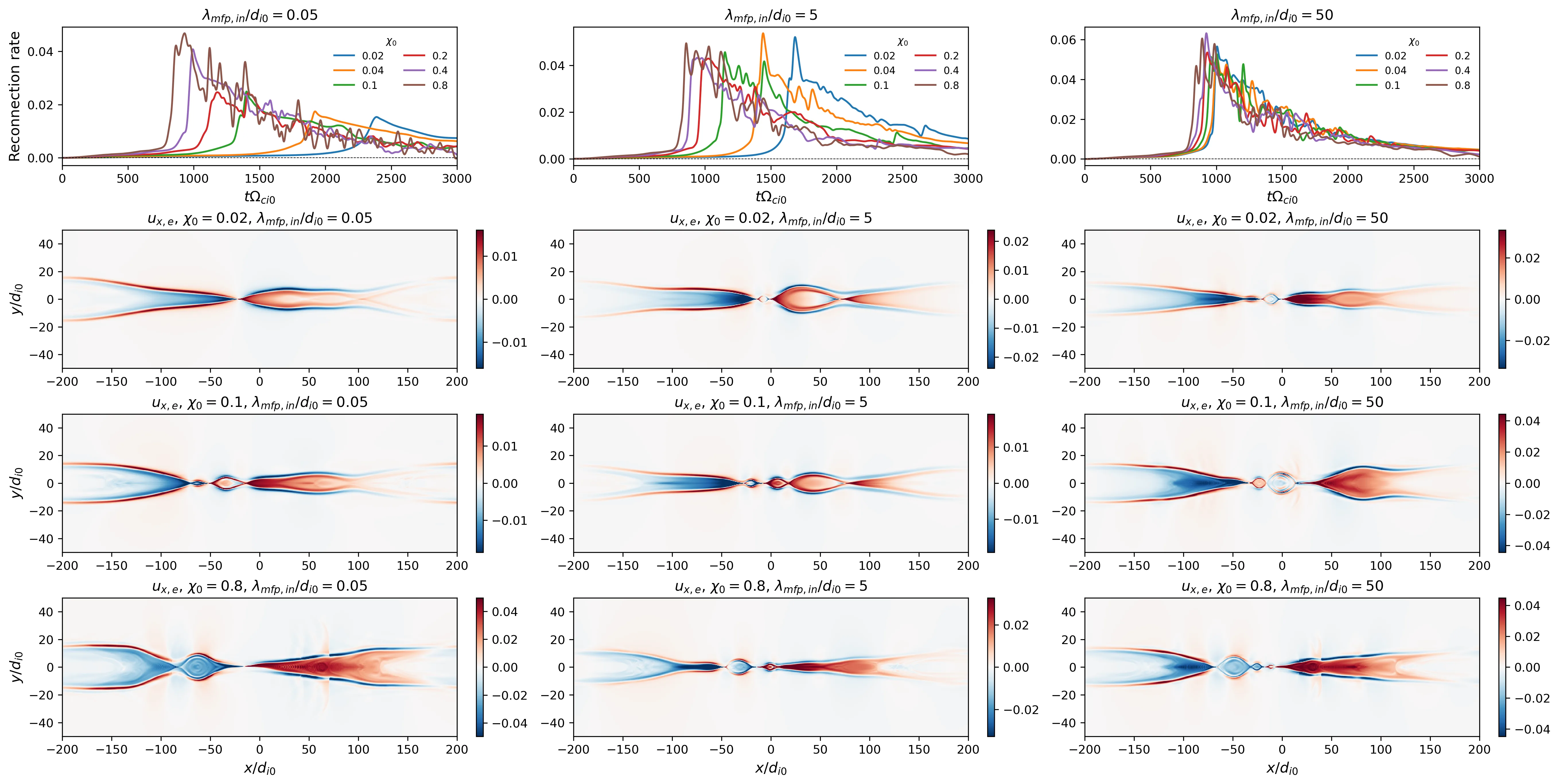
In plasma where some atoms remain neutral, magnetic field lines can rearrange at different speeds. This is like two rubber bands that are initially stuck together, then suddenly snap apart and contract, releasing energy. In the new work, physicists for the first time scanned two parameters simultaneously: the fraction of ionized particles and the collision frequency between ions and neutrals.
It turned out that when ions are strongly coupled to neutrals, the reconnection rate grows as the fourth root of the ion fraction. But as soon as the coupling weakens, the system transitions to a fast regime where the rate no longer depends on the ion fraction. The current sheet becomes very thin, on the order of the ion inertial length, rather than inflating to the hybrid scale as old models predicted.
These results agree with recent kinetic simulations and laboratory experiments. Understanding the transition from slow to fast reconnection helps explain why solar flares occur so suddenly.
Original abstract
as written by the authors arXiv:2602.23683
Magnetic reconnection in partially ionized plasmas plays a crucial role in a wide range of solar, astrophysical, and laboratory environments. While reconnection in such plasmas is commonly characterized by the ion-neutral coupling strength and the ionization fraction $$\chi=n_{i}/(n_{i}+n_{n})$$, most previous studies have focused primarily on the former. A systematic exploration of the ionization fraction, particularly in combination with ion-neutral coupling, is still lacking. This study presents the first systematic scan of the two-dimensional parameter space defined by ion-neutral collisionality and ionization fraction, enabling investigation of the transition from strongly coupled reconnection to faster, decoupled reconnection. To achieve this, we employ a new three-fluid, five-moment numerical model that treats electrons, ions, and neutrals as separate species on an equal footing. We find that in the strongly coupled regime, the reconnection rate is consistent with a $$\chi^{1/4}$$ scaling. As collisionality decreases, the system transitions to a fast, ionization-independent regime. On the other hand, in the weakly coupled and fast-reconnection regimes, the current sheet approaches an ion-inertial-scale thickness rather than the expanded hybrid scale $$d_{i}\chi^{-1/2}$$ predicted by fully coupled analytic fluid theories. The identified critical thickness and the resulting onset of fast reconnection agree reasonably well with recent fully kinetic simulations and laboratory experiments. In addition, we show that, over a wide range of coupling strengths, the ion outflow velocities remain Alfv\'enic, scaling with the appropriate ion or hybrid Alfv\'en speed, while the hybrid outflow velocity scales as $$\chi^{1/2}$$ when normalized by ion Alfv\'en speed.
The outflow speed of plasma from the reconnection region remains on the order of the Alfvén speed even under weak ionization, provided one chooses the appropriate characteristic speed for the ion-neutral mixture.
In science fiction, magnetic reconnection is sometimes mentioned as the mechanism behind solar storms that threaten spacecraft — for example, in Arthur C. Clarke's novel 'Solar Wind'.