Invisible Particles in a Head-On Collision of Light express
In the kitchen, two flashlight beams pass through each other without noticing. Light barely interacts with light. But if you accelerate particles to enormous energies, two photons can collide and give birth to something new. It is precisely this process — light-by-light scattering — that the authors of the paper consider for the future FCC-hh collider, which will accelerate protons and nuclei to energies of 100 TeV.
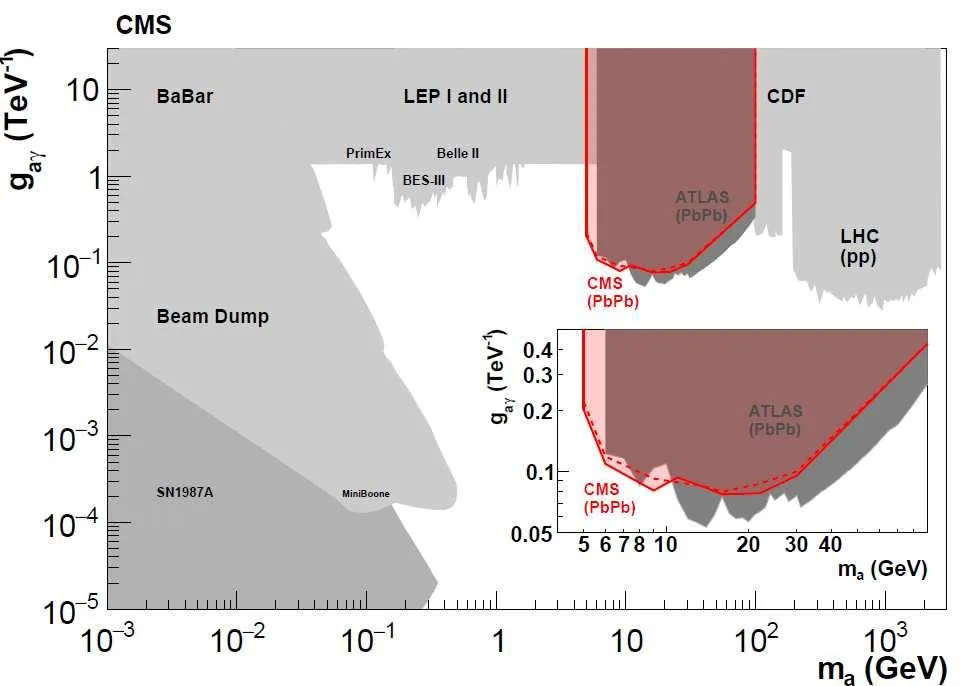
In such collisions, an axion-like particle (ALP) could momentarily appear — a hypothetical cousin of the axion, very weakly coupled to ordinary matter. This particle leaves no trace in the detector, but its presence can be inferred from missing energy or characteristic signals. The authors calculated how many such particles could be produced in proton-proton, proton-nucleus, and nucleus-nucleus collisions. It turns out that the strongest constraints on the ALP-photon coupling would come from masses around 250 GeV for lead-lead collisions and around 1 TeV for proton-proton collisions.
Comparison with current LHC data shows that the future FCC-hh could probe a region of parameter space that is inaccessible today. It's like going from binoculars to a telescope with a mirror tens of meters across — you see farther and sharper. The calculations are based on virtual particle production: they exist only for an instant, like ripples on water from a thrown stone, but that instant can be captured through indirect signatures.
So, by colliding light with light, we hope to see what does not shine itself.
Light usually passes through light without noticing, but at extreme energies two photons can merge into a particle with a mass comparable to that of an atomic nucleus.
In Liu Cixin's novel "The Three-Body Problem," aliens use invisible particles for surveillance — axions also leave almost no trace.