Invisible Galaxies: 70 Candidates for Dark Worlds express
The FAST radio telescope in China is a giant dish half a kilometer in diameter, nestled in a natural sinkhole among mountains. It catches radio waves from space, and in a fresh sky survey it picked up 70 strange objects: they emit a radio signal characteristic of hydrogen clouds, but through an ordinary optical telescope almost nothing is visible at their location. Such objects are called dark galaxy candidates.
A dark galaxy is a gas cloud, mostly hydrogen, too diffuse for stars to ignite. Stars are born when gas collapses under its own gravity, but if the cloud is too fluffy or something heats it up, it remains dark. Hydrogen, however, can faintly glow in radio at a wavelength of 21 centimeters — a kind of atomic radio whisper. FAST can hear this whisper from distances up to 50 megaparsecs (about 163 million light-years).
The authors compared the found dark galaxies with normal, star-bearing ones. It turned out that at the same hydrogen mass, dark galaxies rotate faster: their radio lines are broader. This hints that they contain more dark matter, which keeps the gas spinning faster. In the nearby vicinity up to 11 megaparsecs, no such objects were found at all: perhaps near us they have already been 'eaten' by larger neighbors.
The catalog of 70 candidates is a first step. Next, astronomers will point more sensitive optical telescopes at them to definitively confirm: these are truly galaxies without stars, not measurement errors. If confirmed, it will change our understanding of how galaxies are born and die.
Original abstract
as written by the authors arXiv:2604.14699
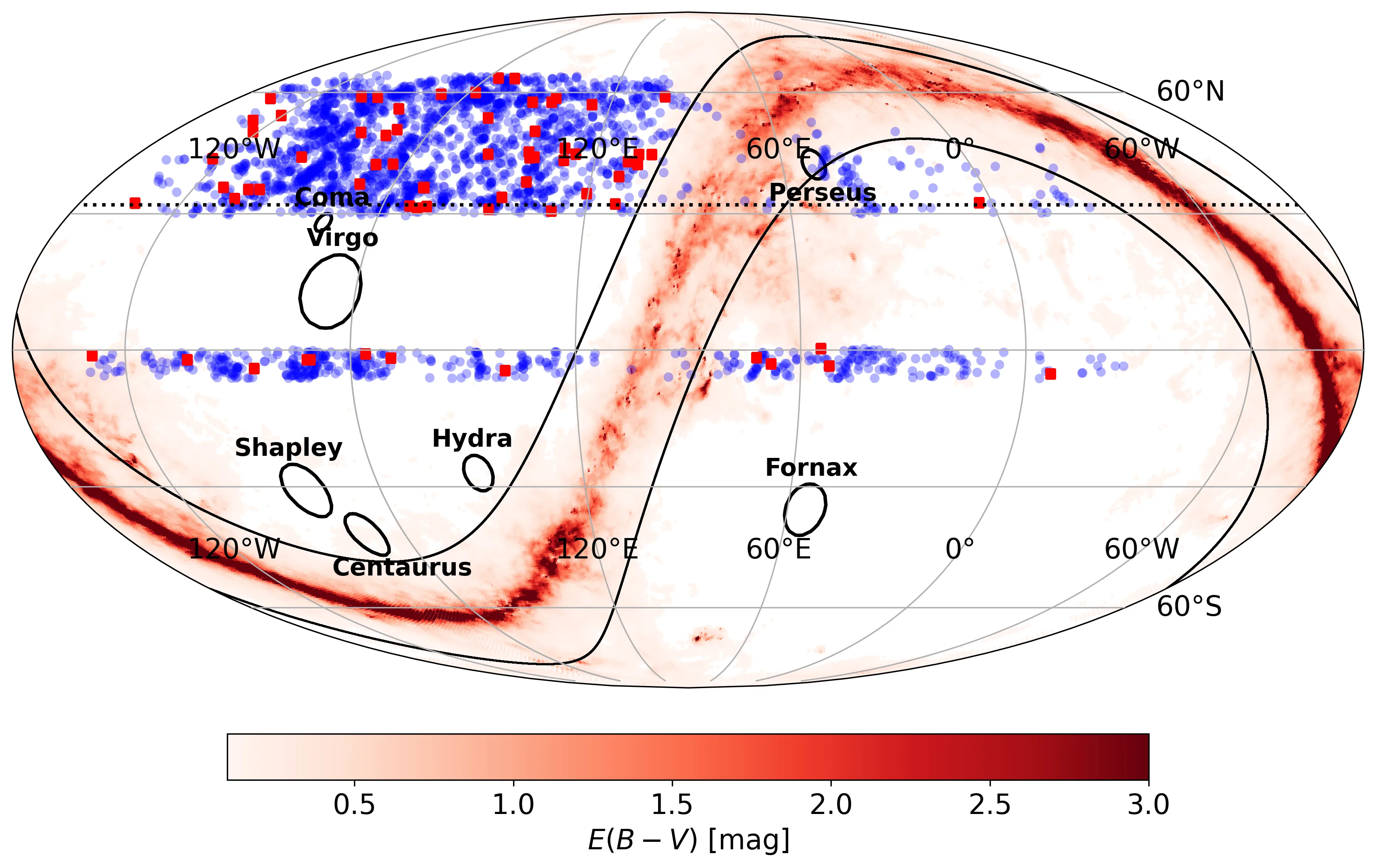
Using the first data release of the Five-hundred-meter Aperture Spherical radio Telescope (FAST) All-Sky HI survey (FASHI), we compile a catalogue of 70 dark galaxy candidates (DGCs) within 50 Mpc. We select DGCs without an identified optical counterpart at a limiting g-band magnitude of ~ 28 mag arcsec^-2 in the DESI Legacy Survey, using both automatic cross-checking with optical catalogues and visual inspection of the colour images. After validating our DGCs, excluding potential spurious detections, issues in the registered position of the HI sources, and possible Radio Frequency Interferences (RFIs), we analyse their distribution over the surveyed sky, HI mass, linewidths, and inferred distance. They appear evenly distributed across the surveyed area, with no apparent bias to isolation. We did not find any DGC within the Local Volume (11 Mpc) in the sky surveyed by this first release of FASHI. We compare the observed properties of DGCs with those of galaxies with optical counterparts, finding that DGCs tend to have higher linewidths for a given HI mass. We discuss our DGCs in light of theoretical works, and compare them with other observational samples from previous HI surveys. This work presents a catalogue of dark galaxy candidates, which can serve as a basis for follow-up studies.
The FAST radio telescope is so sensitive that it could detect a cell phone signal on the Moon, if one were there.
In 'Star Trek', dark galaxies sometimes serve as hiding places for ships because they are hard to spot from a distance.