Light Echo Flips Chemistry express
In an empty hall, sound bounces between walls, turning into a booming echo.
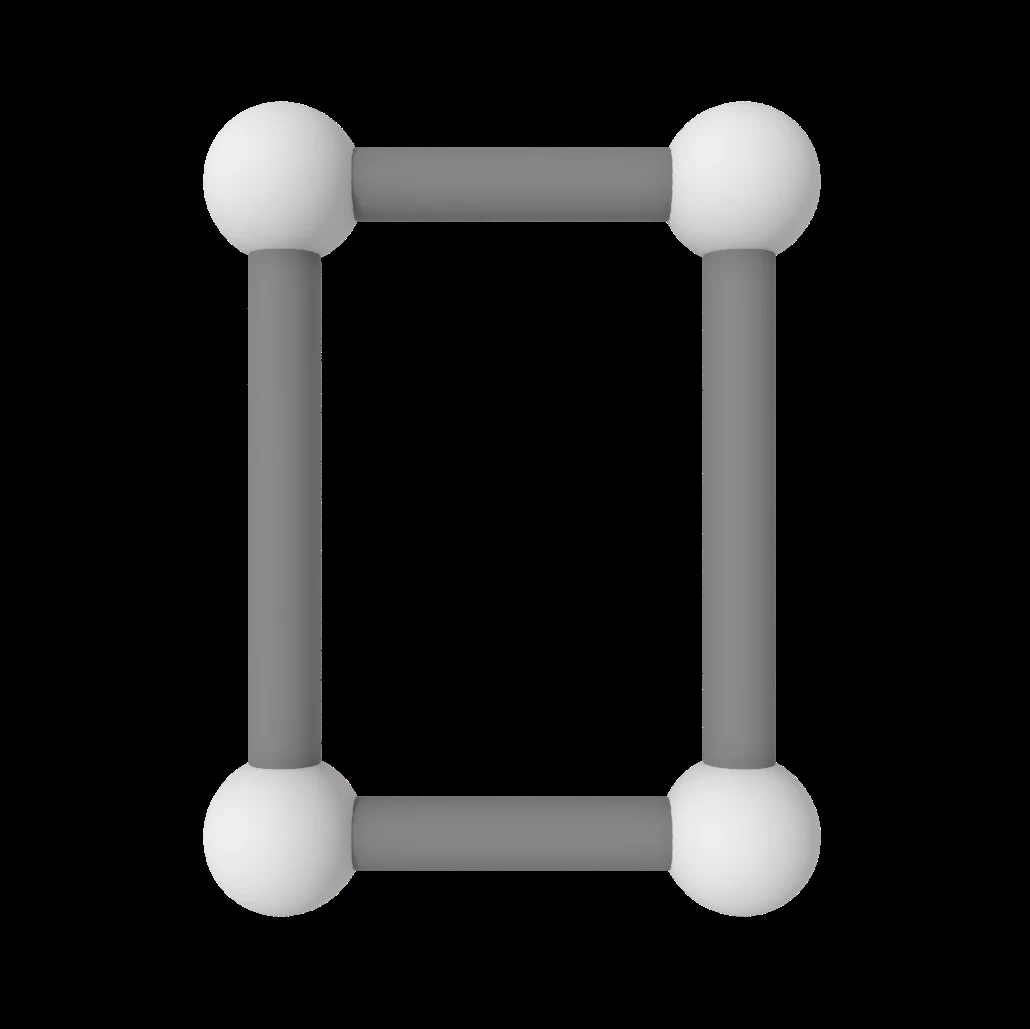
For hydrogen (H₂), stability and excitation swap roles, as if the seesaw has flipped. Ring-shaped molecules like H₄ or C₄H₄ (carbon and hydrogen) usually bend to survive. But the echo chamber straightens them out to perfect symmetry.
The more molecules inside, the stronger the effect — the crowd doesn't dampen the anomaly, it fuels it.
Spectroscopy — analyzing the outgoing light — lets us see these metamorphoses. So light echo teaches us to sculpt molecules with unimaginable properties — from ultrasensitive sensors to world-changing materials.
Original abstract
as written by the authors arXiv:2604.20969
We investigate the effects of coupling a quantum-magnetic cavity field to molecules. Our high-precision auxiliary-field quantum Monte Carlo calculations capture the effect of the cavity field in the presence of electron correlations, and their interplay and competition. In H$$_2$$, we find that a strong enough cavity coupling makes the original bound ground state metastable, along with inverting the singlet-triplet gap. In ring molecules (e.g., H$$_n$$), the magnetic cavity coupling stabilizes symmetric geometries. As a consequence, open-shell rings such as H$$_4$$, H$$_8$$, or C$$_4$$H$$_4$$, which would undergo Jahn-Teller distortions outside of the cavity, obtain exotic spin or ring-current polarized, antiaromatic ground states. These effects are enhanced by increasing the molecule concentration inside the cavity. Our results suggest cavity quantum electrodynamics beyond the long-wavelength approximation as a promising avenue for cavity-altered chemistry.
Without the echo chamber, H₄ or C₄H₄ rings distort chaotically. Inside, they freeze into a perfect shape, and a current runs endlessly around them — you get a magnet with no wires or batteries.
Like sci-fi force fields, light echo reassembles molecules to order — birthing materials with unprecedented traits.