The Bicycle Dynamo in Space: How Collapsar Jets Are Born express
A massive star collapses, and a black hole is born, surrounded by a disk of incandescent plasma. For narrow jets to burst out of this disk, an ordered magnetic field is needed. But inside the star, it's tangled. Supercomputer calculations showed: the disk works like a bicycle dynamo hub — rotation itself brings order to the magnetic field.
At first, the field twists into rings, and then, like a self-exciting dynamo, it generates giant magnetic loops. They are pulled toward the hole and shoot out oscillating jets at nearly the speed of light. This mechanism doesn't need an inherited field from a proto-neutron star: it's universal for various collapsars, one of the types of supernovae.
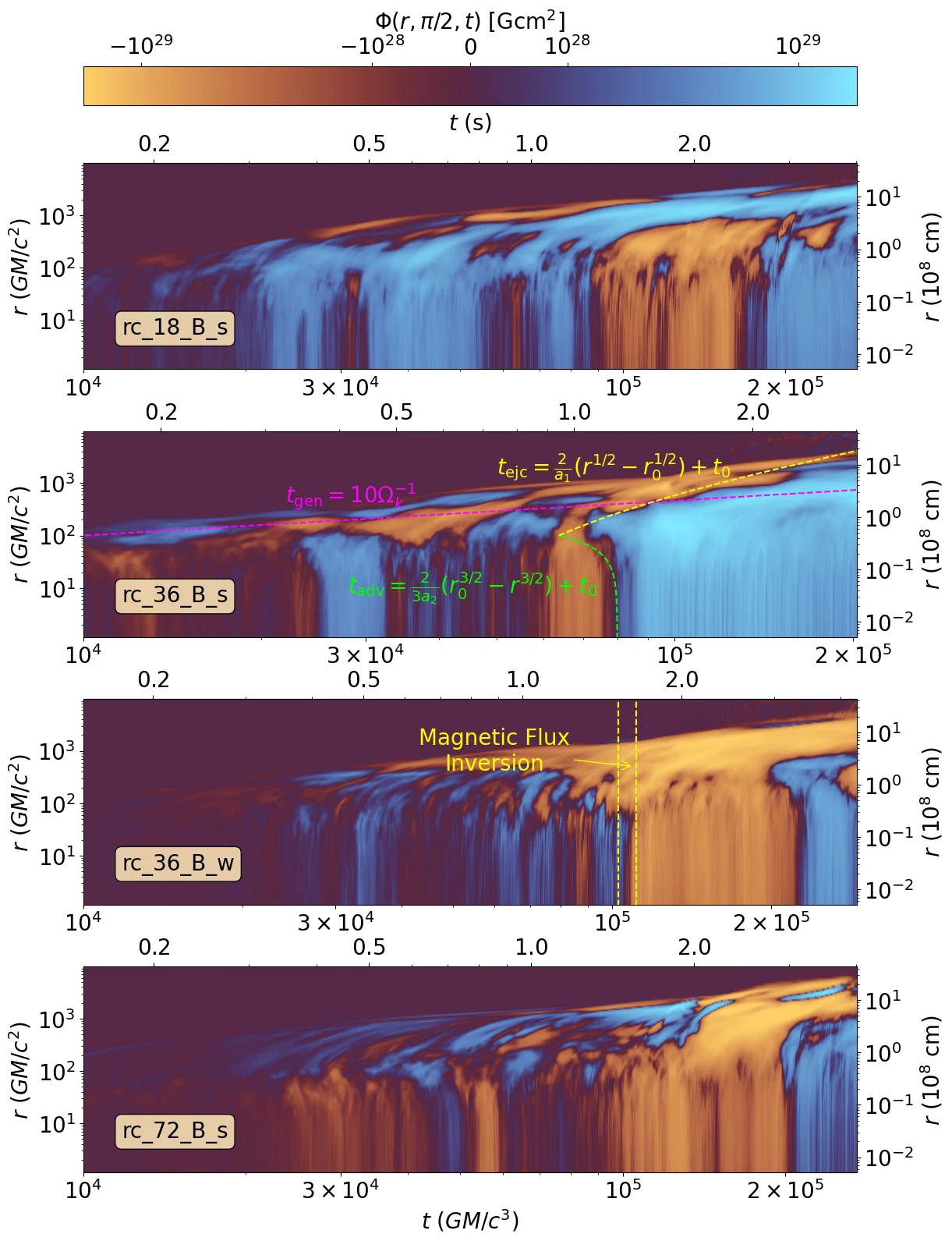
An unexpected result: the jets turned out to be striped — the magnetic field in them periodically flips. These stripes will be imprinted in the brightness curve of the gamma-ray burst, becoming the signature of the dynamo. So an unremarkable effect turned out to be a simple recipe for the most powerful explosions in the universe. Even Kip Thorne pondered how black holes launch jets, and Fritz Zwicky was the first to suggest that neutron stars are born in supernova explosions — now new work ties these phenomena together.
Original abstract
as written by the authors arXiv:2605.12931
The origin of the large-scale poloidal magnetic field required to power relativistic jets in collapsars remains uncertain. While such a field may be inherited during PNS collapse, the efficiency of this process is unclear, motivating an in situ mechanism to generate poloidal fields out of the predominantly toroidal fields produced by stellar differential rotation. We present the first 3D general-relativistic magnetohydrodynamic collapsar simulations initialized with toroidal magnetic field profiles that closely follows those of pre-collapse stellar models. As the toroidal field in the disk becomes dynamically important, it seeds the dynamo, producing coherent poloidal magnetic loops that appear at $$\sim \mathcal{O}(100)$$ gravitational radii and are then advected inward along paths that may deviate from the disk midplane. The resulting poloidal fields thread the black hole (BH) and launch highly variable, wobbling relativistic jets on timescales of order seconds, with the onset depending on the initial magnetic field and the plasma circularization radius. Although the jets are highly variable and misaligned with the BH spin axis, they sustain $$\gtrsim 10^{50}\,\mathrm{erg\,s^{-1}}$$, comparable to that inferred for long gamma-ray bursts (LGRB). We identify magnetic-flux inversions driven by the stochastic dynamo, leading to the formation of striped jets that could be imprinted in LGRB light curves. These results demonstrate that accretion-disk dynamos provide a robust pathway for jet production in collapsars across a broad range of progenitors.
Earth's magnetic field is also generated by a dynamo effect in the liquid core, but there it operates for billions of years, while in a collapsar the entire process takes seconds.
If sci-fi writers imagine starships with miracle engines, nature has already built its own accelerators — collapsar jets, ejecting matter at nearly the speed of light.