The Bicycle Dynamo in Space: How Collapsar Jets Are Born express
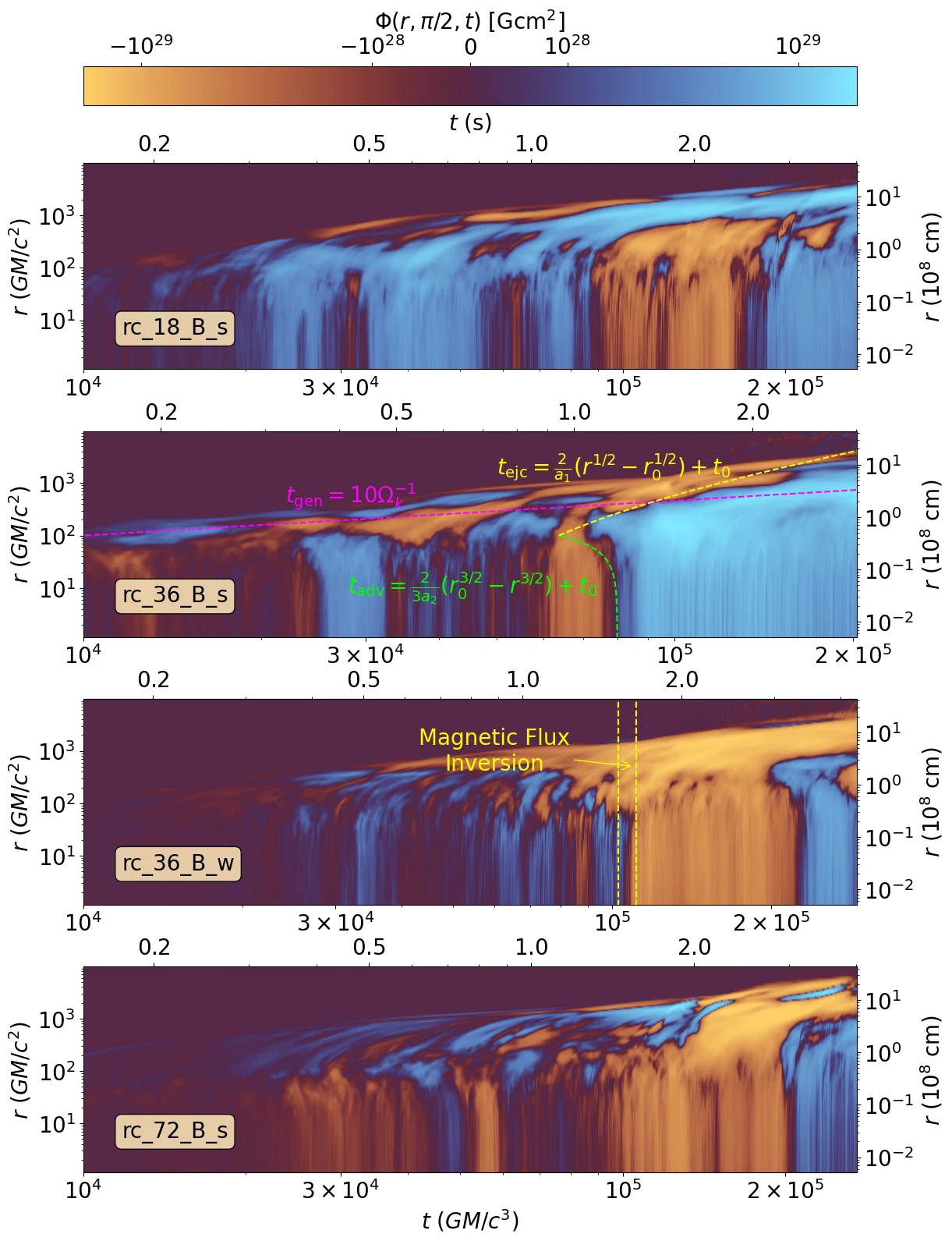
A massive star collapses, and a black hole is born, surrounded by a disk of incandescent plasma. For narrow jets to burst out of this disk, an ordered magnetic field is needed. But inside the star, it's tangled. Supercomputer calculations showed: the disk works like a bicycle dynamo hub — rotation itself brings order to the magnetic field.
At first, the field twists into rings, and then, like a self-exciting dynamo, it generates giant magnetic loops. They are pulled toward the hole and shoot out oscillating jets at nearly the speed of light. This mechanism doesn't need an inherited field from a proto-neutron star: it's universal for various collapsars, one of the types of supernovae.
An unexpected result: the jets turned out to be striped — the magnetic field in them periodically flips. These stripes will be imprinted in the brightness curve of the gamma-ray burst, becoming the signature of the dynamo. So an unremarkable effect turned out to be a simple recipe for the most powerful explosions in the universe. Even Kip Thorne pondered how black holes launch jets, and Fritz Zwicky was the first to suggest that neutron stars are born in supernova explosions — now new work ties these phenomena together.
Earth's magnetic field is also generated by a dynamo effect in the liquid core, but there it operates for billions of years, while in a collapsar the entire process takes seconds.
If sci-fi writers imagine starships with miracle engines, nature has already built its own accelerators — collapsar jets, ejecting matter at nearly the speed of light.