A Magnet Without a Magnet in a Star's Depths express
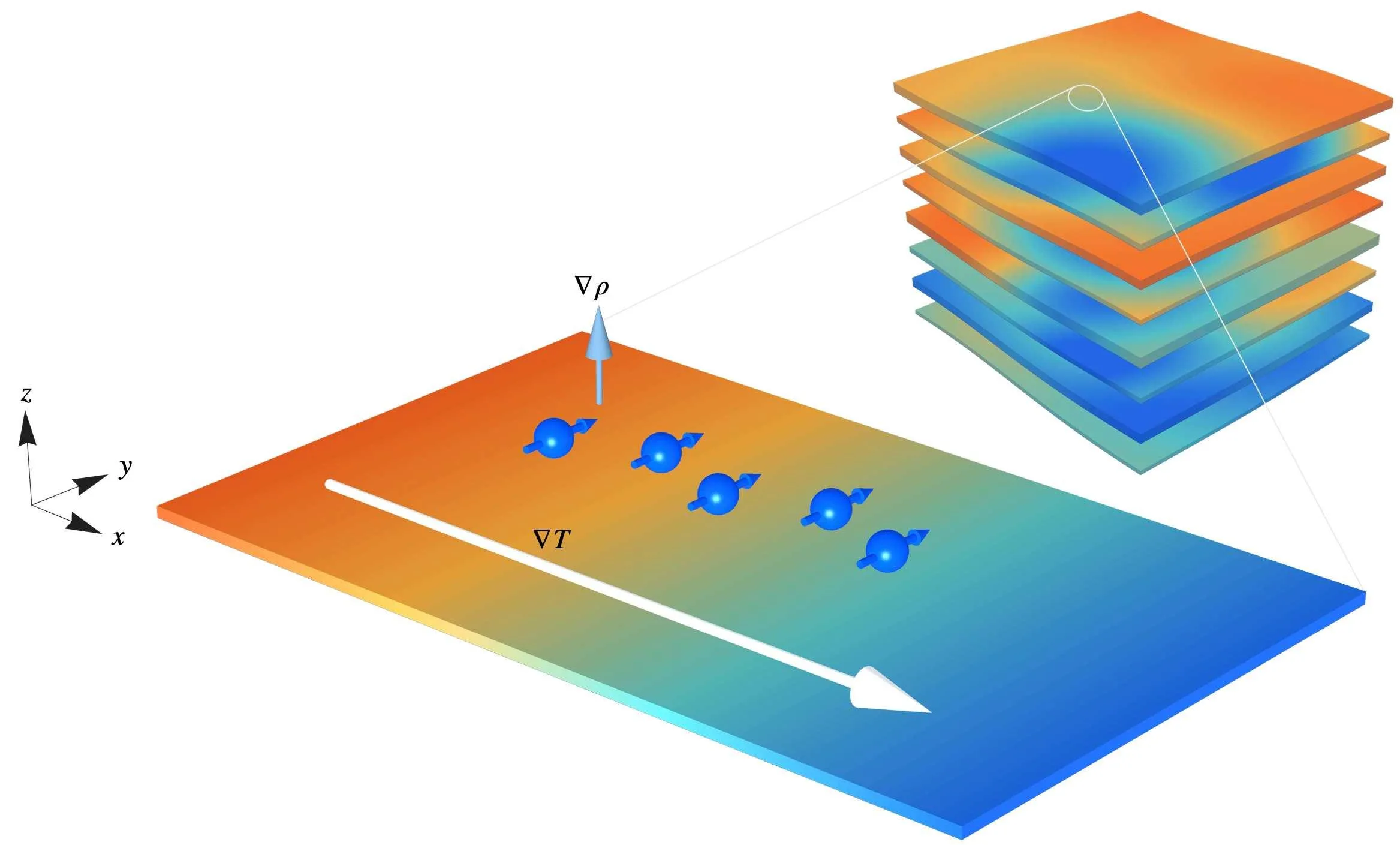
Inside a neutron star, matter is compressed so intensely that atomic nuclei fuse into long strands and flat sheets. Astrophysicists call these structures nuclear pasta. At their surface, the density of matter plummets to nearly zero, like diving out of thick jelly into thin air.
It's this sharp transition that creates the unusual effect. Neutrons sitting on the pasta's surface feel a special interaction — nuclear spin-orbit coupling. It's reminiscent of the force that, in an ordinary atom, ties an electron's spin to its orbit. But here, because of the steep density gradient, this force makes neutron spins line up in one direction. The result is spin polarization, as if a swarm of tiny tops suddenly started spinning the same way.
This mechanism is strikingly similar to the Rashba effect used in spintronics — a field of physics where electron spins are controlled with electric fields. The authors built a simple model: two energy levels for surface neutrons that mix due to spin-orbit interaction. Calculations showed that even at typical neutron star temperatures, polarization could be significant.
The connection between cosmic objects and lab physics here is direct. Understanding how neutron spins spontaneously order in a star's crust helps unravel how the strongest magnetic fields in the universe, those of magnetars, are born and evolve.
Original abstract
as written by the authors arXiv:2605.25067
We discuss anomalous spin polarization on the surface of nuclear pasta in a neutron star, driven by a nuclear spin-orbit interaction. We present an effective two-band model of surface-localized neutrons near the nuclear pasta. The central point is the emergence of a Rashba-type spin-orbit hybridization generated by the neutron--nucleus spin-orbit force in the presence of the strong density gradient normal to the pasta surface. Starting from a single-particle Hamiltonian with a central potential and a standard nuclear spin-orbit interaction, we show that the surface spin polarization occurs due to the thermal inhomogeneity even in the absence of a magnetic field. Our study links neutron-star physics and solid-state spintronics and would contribute to understanding the interplay between spin dynamics and strong magnetic fields.
Nuclear pasta is no joke: it's a real state of matter at densities a million billion times that of water. It got its name from its resemblance to Italian pasta: there are 'gnocchi,' 'spaghetti,' and 'lasagna' phases.
In Robert Forward's novel 'Dragon's Egg,' life is depicted on the surface of a neutron star, where monstrous gravity and magnetic fields create a world utterly alien to us.