Red Dots Turned Out to Be Stellar Eruptions ✛ ✦
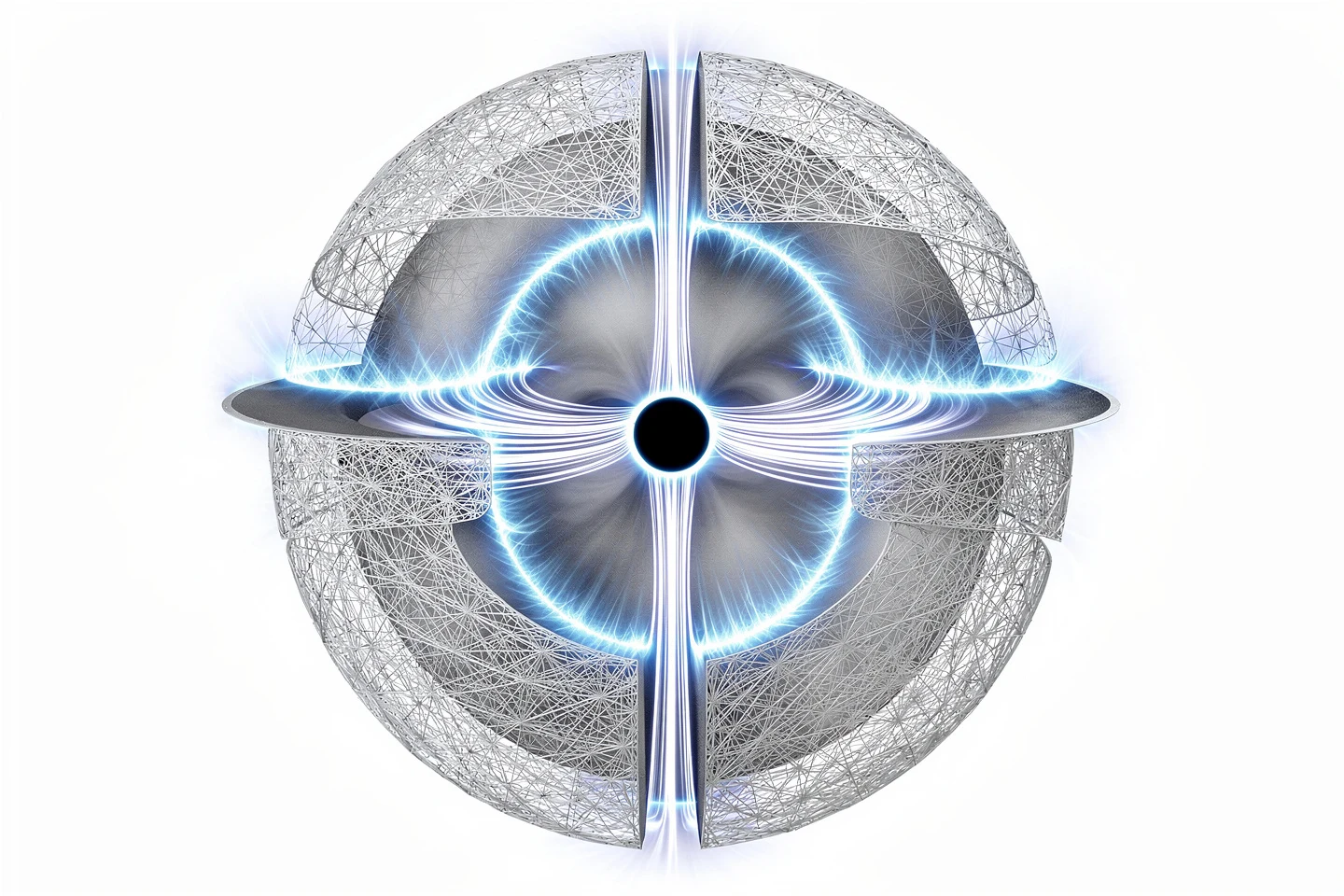
The James Webb Telescope peered into times when the universe was less than a billion years old and saw red dots. Their redshift (stretching of light by expanding space) revealed their immense age. At first, the dots were thought to be black holes with a billion solar masses, but their rapid growth contradicts current models.
In reality, these are glowing gas cocoons. Like a searchlight in fog, the central object is hidden, and only the red glow of the envelope is visible. Inside, fast and slow stellar winds collide, heating hydrogen. Spectra (the "rainbow" from splitting light) confirm: hydrogen lines are present, but direct radiation from the center is absent — similar to supernovae and the 1843 eruption of Eta Carinae. Fritz Zwicky was the first to explain this mechanism through wind collision. A fascinating detail: the cocoon's radius is calculated using the same law as for an incandescent light bulb: the brighter and cooler the glow, the larger the envelope.
The model eliminates the need for supermassive black holes: the central mass does not exceed a hundred thousand solar masses. These seeds of future galactic giants grow rapidly, ejecting dust and heavy elements. Hydrogen as the main component of stars was first recognized by Cecilia Payne-Gaposchkin. Thus, red dots have transformed from a mystery into a key to the early universe.
In 1843, after a powerful outburst, the star Eta Carinae became the second brightest in the sky. Local inhabitants in Australia were so impressed that they wove this event into their myths.