Red Cocoons of the Universe: How Supermassive Black Holes Are Born ✛ ✦
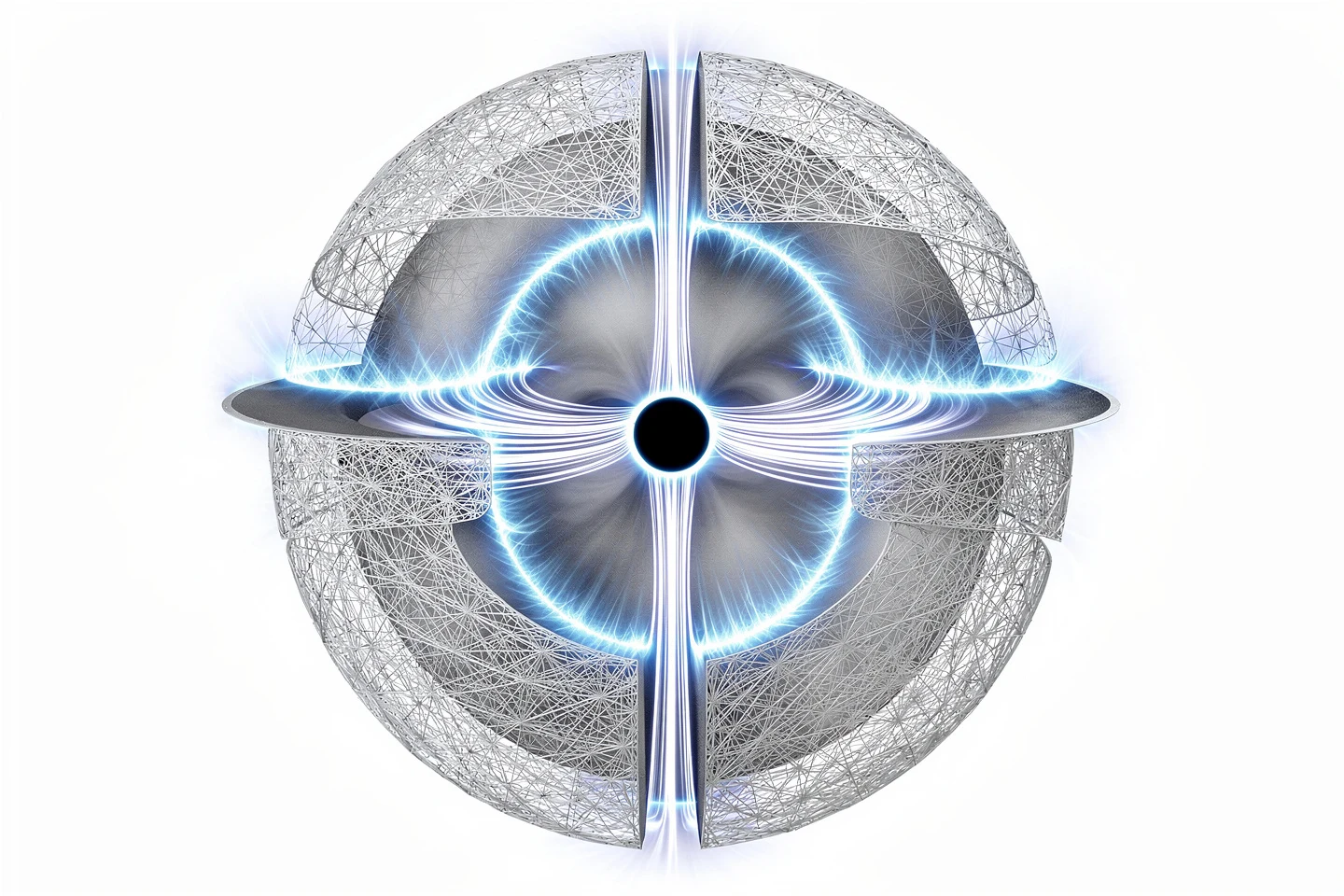
When JWST peered into the young universe at redshifts of 6–10, it revealed a scattering of mysterious 'little red dots' (LRDs). These objects combined features of galaxies and active nuclei, but their spectra refused to fit into familiar patterns. Compact, crimson, radiating with monstrous power: they seemed to break the laws of black hole growth. As if nature was cheating, creating monsters with billions of solar masses just 700 million years after the Big Bang.
But physics doesn't tolerate cheating. The solution came from an unexpected quarter — the astronomical 'herbarium' of the brightest stellar catastrophes. Imagine a cocoon: a caterpillar weaves a silky shell, inside which it dissolves its own body and reassembles it into a winged form. Similarly, a black hole in the LRD phase is shrouded in a dense, opaque gas cocoon — a powerful stellar wind or shed envelope. The central engine, whether an intermediate-mass black hole or a supermassive star, emits streams of radiation, but they can't escape directly. Instead, the light is absorbed and re-emitted at the inner boundary of the envelope — in the pseudophotosphere, heated to ~5000 K. It is this secondary, 'reprocessed' light that we see as a red dot.
The similarity to the Great Eruption of η Carinae, which in 1843 made that star the second brightest in the sky, challenges our perception of scale. Back then, Fritz Zwicky hadn't yet coined the term 'supernova,' but Australian aborigines had already recorded the event in their myths. Yet the physics of the eruption — reprocessing of radiation in a thick wind, broadening of hydrogen lines by electron scattering — turned out to be the key to LRDs. Spectroscopy by JWST showed that broad wings of Balmer lines and an anomalously high Hα/Hβ ratio directly indicate a boiling, turbulent cocoon. The mass of the central engine has been constrained from above: according to dynamical limits, it does not exceed $10^5$ solar masses. And the accretion disk (if already formed) operates in a super-Eddington regime — the black hole devours matter hundreds of times faster than the theoretical threshold.
But the cocoon is not eternal. As the black hole finishes consuming its internal reserves and disperses the outer shell through stellar wind, the red dot transforms into a classical active nucleus. The interstellar medium becomes ionized, cosmic dust is destroyed or pushed away, and in place of the crimson blob, a blue quasar ignites with a dusty torus and relativistic jets. Meanwhile, the spiral arms of the galaxy, according to Hubble's classification, are just beginning to wind up. This evolutionary chain is one of the answers to the origin of supermassive black holes. LRDs are not a pathology, but a necessary growth stage, when stellar evolution (or rather, the evolution of the embryo) hides from direct observation. Such cocoons were the main 'factories' of heavy elements and dust during the epoch of reionization.
In the end, an elegant lesson. Nature doesn't tolerate 'overmassive' black holes; it simply wraps them in a gas cloak and illuminates them from within, creating the illusion of incredible mass. Just as Cecilia Payne-Gaposchkin once showed that stars are mostly made of hydrogen, so too do new data teach us to read true scales from the shadows in the pseudophotosphere. And perhaps the next step is to peek under the cocoon using gravitational waves or long-term infrared monitoring to witness the transformation itself.
During the Great Eruption of η Carinae in 1843, the star became the second brightest in the sky, compelling Australian aborigines to alter the mythology of the Carina constellation, an event recorded in their oral traditions.