"Red Dots" as Super-Eddington Engines: Lessons from Great Eruptions and Supernovae ✛ ✦
Context
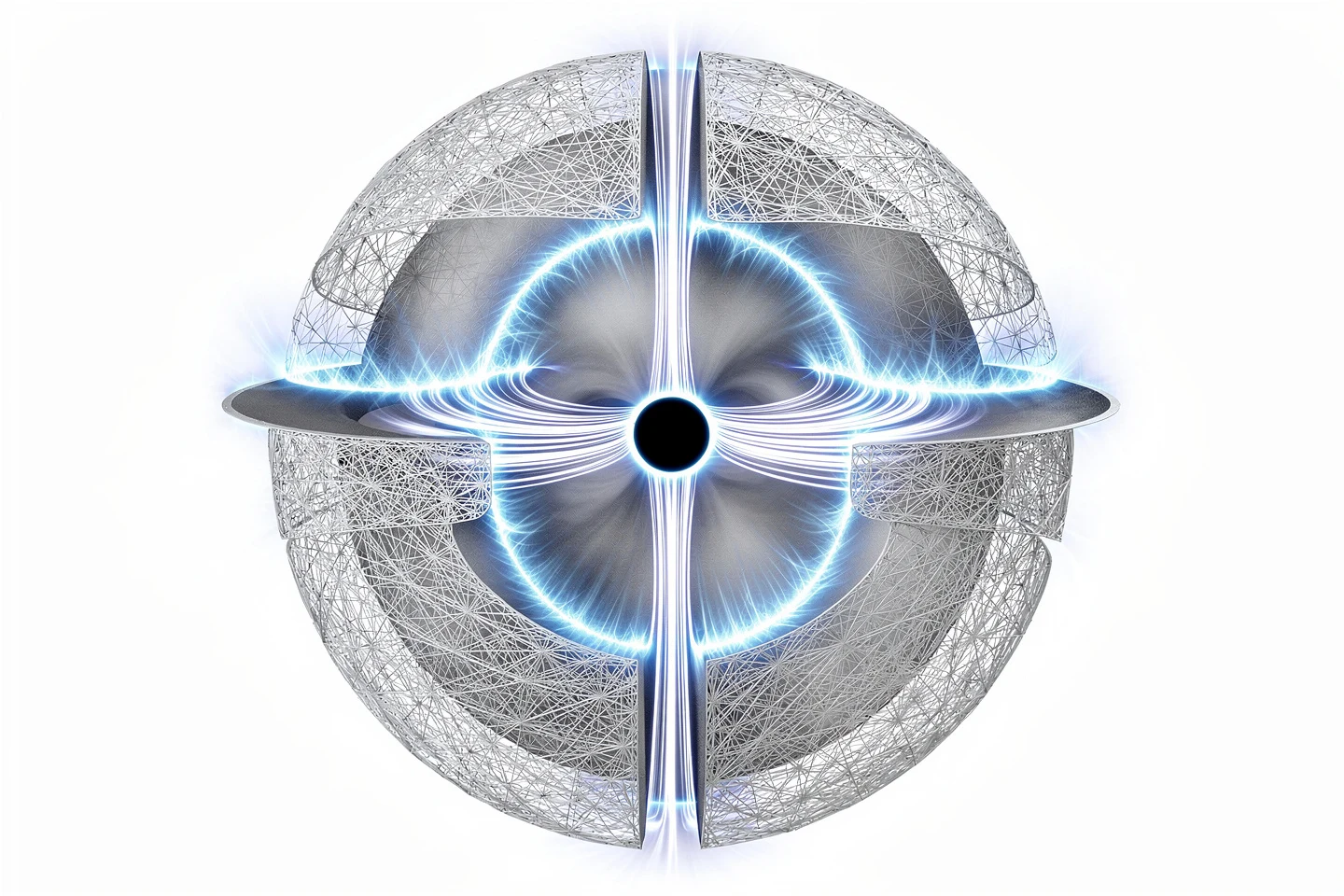
In recent years, the JWST has discovered enigmatic objects at high redshifts—"Little Red Dots" (LRDs)—that blend traits of galaxies and active nuclei but defy standard models. Their compact sizes, red colors, and unusual spectra spawned ideas of "overmassive" black holes, but fresh parallels with well-studied stellar events, like the Great Eruption of η Carinae and Type IIn supernovae, point to a more elegant explanation.
Methods
The authors conducted a detailed empirical comparison of LRD characteristics gathered from spectroscopy by JWST with data on Type IIn supernovae and the Great Eruption, including analysis of line profiles, continuum spectra, signs of interstellar medium and dust. Based on these analogies, a model was built where central source radiation is reprocessed in a dense wind, with numerical simulations and analytical estimates used to constrain masses, informed by stellar evolution.
Results
It turns out that LRDs bear striking resemblance to enshrouded eruptions: a thermal spectrum with ~5000 K temperature, formed by a pseudo-photosphere in the wind; broad wings on hydrogen lines due to electron scattering; an anomalously high Hα/Hβ ratio (>10); weakness of forbidden lines; and the presence of molecular bands. Based on gravity arguments (escape limit, dynamics, surface gravity), the central engine's mass is estimated at <$10^5$ M_⊙, with a bolometric-to-Eddington luminosity ratio >5.
Implications
This scenario resolves the "overmassive" black hole paradox by showing that LRDs are not monsters >$10^7$ M_⊙ but intermediate-mass systems in a super-Eddington accretion or wind-interaction phase. It links them to long-predicted supermassive black hole seeds and explains their prevalence in the early Universe. As demonstrated, hydrogen dominates stars, and now we see its key role in LRDs.
Future development
If LRDs are indeed shrouded black holes or superstars, then as their envelopes disperse, they should morph into classical active nuclei with accretion disks and dusty tori. Future X-ray and infrared observations, plus long-term variability monitoring, will help peer beneath the pseudo-photosphere and clarify the nature of the central engines.
Impact
The findings will reshape our understanding of supermassive black hole growth, galaxy evolution, and sources of cosmic dust in the early Universe.
Next steps
Detailed radiation transfer modeling in winds accounting for dust and non-equilibrium chemistry is needed, along with searches for transitional objects between LRDs and ordinary active nuclei.
Key open problems
The work directly tackles the origin of massive black holes, the role of super-Eddington accretion, and the riddle of dust sources in the reionization epoch.
The knowledge machine's view
This section is addressed to the author of the paper and their colleagues. Neighbouring works were found by meaning-based search across our archive, not by word overlap. We do not review: we show the field around the work.
What the work does
The study provides a detailed comparison of LRD with the Great Eruption of η Carinae and Type IIn supernovae. The authors show that the observed spectra and photometry are explained by reprocessing of radiation in a dense wind, not by the presence of a supermassive black hole. Mass estimates point to intermediate values (<10^5 M_⊙), which resolves the issue of 'overmassive' black holes.
Where its strength is
The strength of the work lies in combining JWST empirical data with well-studied stellar analogs, yielding a self-consistent model without exotic assumptions. This paves the way for testable predictions about the nature of LRD.
Where it could go next
- It might be interesting to see how the proposed wind scenario relates to quasi-star models, where supermassive black holes grow inside a dense envelope: in our archive, there is a review of such a mechanism nearby.based on: Quasi-stars: The Furnaces Where Supermassive Black Holes Are Born arXiv:2606.06575v1
- Nearby, there is an approach that accounts for the influence of dark matter on LRD formation: this could add constraints on masses and growth rates in the early universe.based on: Cradle for a Black Hole: Dark Matter and the Mystery of Red Dots arXiv:2606.02539v1
- Another direction is the connection with neutrino emission: if LRD are super-Eddington sources, they might be detectable in neutrino telescopes, and the archive has a quick review of this idea.based on: Red Dots: The Universe's Neutrino Cannons arXiv:2601.11203
Worth trying
- Test whether the wind model reproduces the observed Hα/Hβ ratio and line wing shapes for a sample of LRD.
- Compare predictions for the infrared excess from dust in the wind with MIRI data.
- Estimate the contribution of LRD to the neutrino background, using the analogy with Type IIn supernovae.
Why this may matter
If LRD are indeed super-Eddington intermediate-mass sources, this changes our understanding of black hole growth in the early universe and removes the need for exotic scenarios.
Nearby works in our archive
- Cradle for a Black Hole: Dark Matter and the Mystery of Red Dotssimilarity 0.73
- Red Lanterns of the Cosmos: What Compact Objects from the Early Universe Concealsimilarity 0.72
- Red Dots Are Not Twins of Dusty Quasarssimilarity 0.70
- Tiny Black Holes Build Giantssimilarity 0.70
- The Telescope's Red Dots Are Just the Tip of the Icebergsimilarity 0.70
- Quasi-stars: The Furnaces Where Supermassive Black Holes Are Bornsimilarity 0.69
- Red Dots: The Universe's Neutrino Cannonssimilarity 0.67
The archive is crowded around this work: 9 reviews nearby, closest at 0.73. This ground is well walked — and there is plenty to compare against.
Original abstract
as written by the authors arXiv:2606.30711
JWST's Little Red Dots (LRDs) display a unique constellation of features that do not occur simultaneously in any other class of galaxies or AGN. Here we observe that many of these features find parallels in the 19th century Great Eruption (GE) of $$\eta$$ Carinae and a sub-class of supernovae (Type IIn). Drawing on these stellar phenomena -- outflows trapped by dense circumstellar gas envelopes -- we sketch a possible scenario for LRDs. Outflows from the central engine produce an enshrouding envelope of gas that may be thought of as a slow wind. This dense wind and its enormous extent produce an opacity so high that a pseudo-photosphere forms within the wind, obscuring the central engine and manifesting as a blackbody-like continuum. Radiation from the buried engine powers the system. The engine may also launch fast winds that crash into the existing envelope to generate shocks. Lines form within the wind above the photosphere -- electron scattering and absorption in the clumpy (ionized + neutral) medium account for broad wings and P-Cygni cores. A key implication is that inferences of ``overmassive black holes" may be interpreting this wind-like physics as a virial broad-line region. We propose an escape velocity argument to constrain the mass of the engine, which yields $$M<10^{5} M_\odot$$ for the typical LRD. The lack of variability and low surface gravity of the photosphere provide further support for intermediate mass ($$M\approx10^{3-6} M_\odot$$), but very luminous super-Eddington ($$L_{\rm{bol}}/L_{\rm{edd}}\gtrsim5$$) systems harboring a supermassive star or intermediate mass black hole. Paralleling the evolution of IIn SNe, dust production in the envelope may mark the beginnings of classical AGN. This paper explores a possible self-consistent explanation for the entire life-cycle of LRDs, from their enshrouding in dense gas to their fates as seeds of massive black holes.
During η Carinae's Great Eruption in 1843, the star became the second brightest in the sky, prompting Australian Aboriginal peoples to alter the mythology of the Carina constellation, an event preserved in their oral traditions.
Key numbers
- Pseudo-photosphere temperature: ~5000 K
- Bolometric luminosity of a typical LRD: ~1044 erg/s
- Effective pseudo-photosphere radius: ~1300 AU
- Upper limit on central engine mass: <105 M_⊙
- Eddington ratio: >5