Irrefutable Evidence for Hierarchical Growth of Black Holes ✛ ✎
Context
The question of how stellar-mass black holes gain weight after formation remains one of the central puzzles of astrophysics. In recent years, gravitational-wave observatories LIGO, Virgo, and KAGRA have registered hundreds of mergers, and among them a group of massive objects with high intrinsic spin stands out. It was thought that such black holes could either be born in dense clusters, merging successively, or grow via accretion in isolated systems. Clear separation of these scenarios had been elusive—the signals are too blurred. The new work, based on the GWTC-5 catalog, provides the first direct evidence for hierarchical mergers by comparing the mass functions of different subpopulations.
Methods
The authors applied a Bayesian hierarchical analysis to 259 binary black hole merger events from the GWTC-5 catalog. A flexible mixture model (two subpopulations) was used, with separate descriptions of mass distributions, mass ratios, and spin parameters. Mass functions were modeled with splines, which revealed fine structures—peaks and dips. For each subpopulation, distributions of effective spin χeff, precessing spin χp, and merger rate were reconstructed independently. Then, for the low-spin subpopulation (interpreted as arising from stellar collapse), the distribution of remnant masses after mergers was computed (approximation $m_{fina}$l = 0.95(m1+m2)). The shape similarity between this distribution and the mass spectrum of high-spin black holes was assessed using the Bhattacharyya coefficient, Jensen–Shannon and Wasserstein distances.
Results
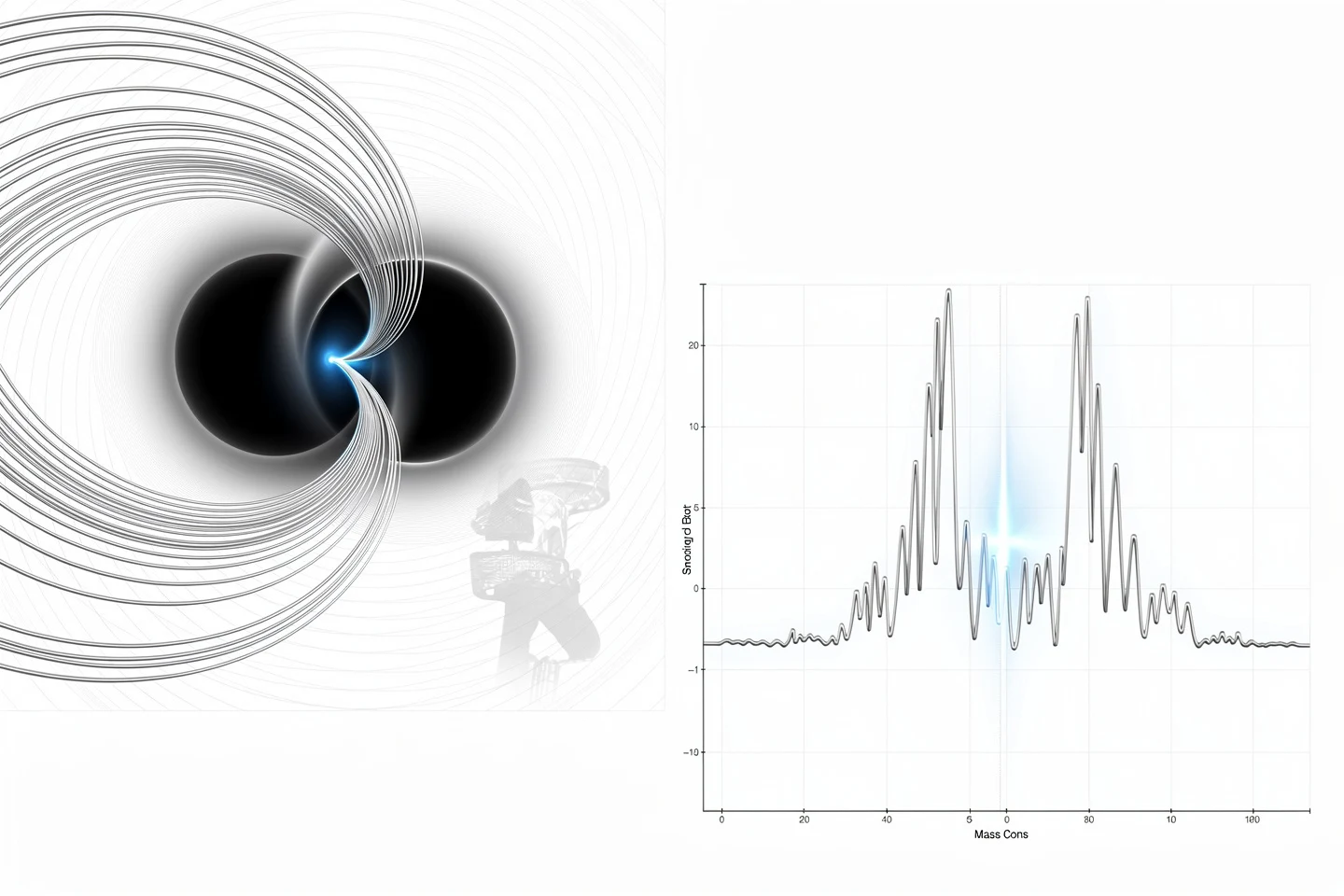
The main result is the nearly perfect match between the shape of the mass distribution of the high-spin subpopulation and the distribution of remnant masses from mergers of objects in the low-spin subpopulation, in the range from ~20 to ~80 M⊙. The Bhattacharyya coefficient reached ~0.95, and the similarity holds under different thresholds. This means that the peaks and dips of one spectrum mirror the other one-to-one. If high-spin black holes grew by accretion, their mass function would not be so morphologically tied to the first. Thus, this is direct evidence of hierarchical origin: massive rapidly rotating objects are descendants of previous mergers. Additionally, analysis of the mass cutoff of the low-spin subpopulation (mmax,1 = 54.2+7.7−7.2 M⊙) yielded a constraint on the astrophysical S-factor of the reaction 12C(α,γ)16O: S300 keV = 151+30−26 keV·barn. This value agrees beautifully with theoretical calculations and confirms that the cutoff relates to the upper threshold of stellar collapses due to (pulsational) pair-instability supernova. The derived fraction of hierarchical mergers is about 23%, and it increases for masses >30 M⊙.
Implications
The work closes a long-standing debate: high-spin black holes indeed are born from multiple mergers, not accretion. This fundamentally changes our understanding of black hole growth in galactic clusters and active nuclei. Moreover, the reliable isolation of the stellar-origin subpopulation provides a precise 'ruler' for nuclear astrophysics, allowing calibration of the carbon fusion reaction rate—the very 'Holy Grail' reaction that defines the evolution of massive stars and the chemical composition of the Universe. Finally, the analysis implies that primordial black holes as dark matter candidates are not needed to interpret the GWTC-5 data.
Future development
As gravitational-wave events accumulate, especially with next-generation detectors (such as the Einstein Telescope), it will become possible to directly detect descendants in second and even third generations of mergers. Detailed mass distribution maps up to ~100 M⊙ and beyond will emerge, enabling the study of multi-step hierarchical assembly in clusters and the search for seeds of intermediate-mass black holes. A more precise measurement of mmax,1 will narrow the uncertainty of the S-factor to a level comparable to that of laboratory experiments, uniting nuclear physics and gravitational-wave astronomy.
Impact
The results will impact the astrophysics of stellar populations, the physics of nuclear reactions in stars, and cosmology by constraining the contribution of primordial black holes to dark matter.
Next steps
A more precise measurement of the high-mass tail of the distribution is needed to confirm the existence of third-generation black holes, and to refine the connection between the shape of the 'dip' in masses and the parameters of pair-instability supernovae at different metallicities.
Key open problems
The work links unsolved problems of black hole growth, the origin of the upper mass cutoff (pair-instability gap), and the determination of the rate of the key reaction carbon burning—one of the main 'stumbling blocks' in the theory of massive star evolution.
The knowledge machine's view
This section is addressed to the author of the paper and their colleagues. Neighbouring works were found by meaning-based search across our archive, not by word overlap. We do not review: we show the field around the work.
What the work does
The study uses the GWTC-5 catalog and Bayesian hierarchical analysis to compare the mass functions of low-spin and high-spin black hole subpopulations. It shows that the mass distribution of high-spin objects nearly matches the distribution of remnant masses from low-spin mergers, which is interpreted as evidence for hierarchical growth. Additionally, a constraint on the 12C(α,γ)16O reaction rate is obtained from the mass gap.
Where its strength is
A key strength is the direct morphological comparison of mass functions, providing clear evidence for hierarchical mergers without modeling cluster dynamics. This opens the way to using the shape of the mass spectrum as an indicator of merger history.
Where it could go next
- One could compare the inferred fraction of hierarchical mergers with predictions from spin distribution analyses in binary systems to check consistency of formation scenarios.based on: Twin Black Holes: Why Light Ones Are Lazy and Heavy Ones Are Tops arXiv:2605.24281
- It would be interesting to examine how gravitational lensing might distort the observed masses and spins of catalog events, and to account for this when reconstructing subpopulations.based on: Gravitational Lenses Distort Black Hole Portraits arXiv:2606.30144
- The analysis could be extended to events including memory effects, which may influence parameter estimation for mergers, especially for massive systems.based on: The Black Hole's Information Backpack: How Memory Shifts the Tone of Gravitational Ringing arXiv:2607.03560
Worth trying
- Test whether the mass function match persists when using alternative remnant mass models, for example, those accounting for gravitational radiation losses.
- Apply the method to a subset of events with high-confidence spin measurements to reduce systematic errors.
- Compare the obtained S-factor constraint with results from other astrophysical sources, such as pulsars or white dwarfs.
Nearby works in our archive
- A Gravitational Census of Invisible Giantssimilarity 0.71
- The Acceleration of Invisible Pairs: What the Dance of Black Holes Revealssimilarity 0.70
- Black Holes Are Sorted by Weightsimilarity 0.69
- Cosmic Scales: How Black Holes Swap Rolessimilarity 0.69
- Dark Stars: Cradle of Giant Black Holessimilarity 0.68
- Gravitational Lenses Distort Black Hole Portraitssimilarity 0.67
- Twin Black Holes: Why Light Ones Are Lazy and Heavy Ones Are Topssimilarity 0.67
- The Black Hole's Information Backpack: How Memory Shifts the Tone of Gravitational Ringingsimilarity 0.67
The archive is crowded around this work: 9 reviews nearby, closest at 0.71. This ground is well walked — and there is plenty to compare against.
The Bhattacharyya coefficient is a measure of the overlap of two distributions, commonly used in signal processing. Here it was applied for the first time to prove that two types of black holes are 'ancestor' and 'descendant', and it reached a record value of 0.95!
Key numbers
- maximum mass of low-spin black holes: 54.2+7.7−7.2 M⊙
- S-factor 12C(α,γ)16O at 300 keV: 151+30−26 keV·barn
- Bhattacharyya coefficient of shape similarity: 0.95
- fraction of hierarchical mergers: 23% (+17%, −11%)
- number of analyzed events: 259