Simple

Neutrinos X-ray the Earth

Original: "High-Energy Neutrino Tomography of the Earth's Interior with IceCube"
· The IceCube Collaboration, R. Abbasi, M. Ackermann, J. Adams, J. A. Aguilar, M. Ahlers, J. M. Alameddine, S. Ali, N. M. Amin, K. Andeen, C. Argüelles, S. Athanasiadou, S. N. Axani, R. Babu, X. Bai, A. Balagopal V., S. W. Barwick, V. Basu, R. Bay, J. J. Beatty, J. Becker Tjus, P. Behrens, J. Beise, C. Bellenghi, S. Benkel, S. BenZvi, D. Berley, E. Bernardini, D. Z. Besson, E. Blaufuss, L. Bloom, S. Blot, F. Bontempo, J. Y. Book Motzkin, C. Boscolo Meneguolo, S. Böser, O. Botner, J. Böttcher, J. Braun, B. Brinson, Z. Brisson-Tsavoussis, L. Brusa, R. T. Burley, D. Butterfield, K. Carloni, J. Carpio, N. Chau, Y. C. Chen, Z. Chen, D. Chirkin, S. Choi, A. Chubarov, B. A. Clark, G. H. Collin, D. A. Coloma Borja, A. Connolly, J. M. Conrad, D. F. Cowen, C. De Clercq, J. J. DeLaunay, D. Delgado, T. Delmeulle, S. Deng, P. Desiati, K. D. de Vries, G. de Wasseige, T. DeYoung, J. C. Díaz-Vélez, S. DiKerby, T. Ding, M. Dittmer, A. Domi, L. Draper, L. Dueser, D. Durnford, K. Dutta, M. A. DuVernois, T. Ehrhardt, L. Eidenschink, A. Eimer, C. Eldridge, P. Eller, E. Ellinger, D. Elsässer, R. Engel, H. Erpenbeck, W. Esmail, S. Eulig, J. Evans, P. A. Evenson, K. L. Fan, K. Fang, K. Farrag, A. Fattorini, A. R. Fazely, A. Fedynitch, N. Feigl, C. Finley, D. Fox, A. Franckowiak, S. Fukami, P. Fürst, J. Gallagher, E. Ganster, A. Garcia, M. Garcia, E. Genton, L. Gerhardt, A. Ghadimi, C. Glaser, T. Glüsenkamp, J. G. Gonzalez, S. Goswami, A. Granados, D. Grant, S. J. Gray, S. Griffin, S. Griswold, K. M. Groth, D. Guevel, C. Günther, P. Gutjahr, C. Ha, A. Hallgren, L. Halve, F. Halzen, L. Hamacher, M. Handt, K. Hanson, J. Hardin, A. A. Harnisch, P. Hatch, A. Haungs, J. Häußler, K. Helbing, J. Hellrung, B. Henke, L. Hennig, F. Henningsen, L. Heuermann, R. Hewett, N. Heyer, S. Hickford, A. Hidvegi, C. Hill, G. C. Hill, R. Hmaid, K. D. Hoffman, A. Hollnagel, D. Hooper, S. Hori, K. Hoshina, M. Hostert, W. Hou, M. Hrywniak, T. Huber, K. Hultqvist, K. Hymon, A. Ishihara, W. Iwakiri, M. Jacquart, S. Jain, O. Janik, M. Jansson, M. Jin, N. Kamp, D. Kang, W. Kang, A. Kappes, L. Kardum, T. Karg, A. Karle, A. Katil, M. Kauer, J. L. Kelley, M. Khanal, A. Khatee Zathul, A. Kheirandish, T. Kim, H. Kimku, F. Kirchner, J. Kiryluk, C. Klein, S. R. Klein, Y. Kobayashi, S. Koch, A. Kochocki, R. Koirala, H. Kolanoski, T. Kontrimas, L. Köpke, C. Kopper, D. J. Koskinen, P. Koundal, M. Kowalski, T. Kozynets, A. Kravka, N. Krieger, T. Krishnan, K. Kruiswijk, E. Krupczak, E. Kun, N. Kurahashi, C. Lagunas Gualda, L. Lallement Arnaud, M. J. Larson, F. Lauber, J. P. Lazar, K. Leonard DeHolton, A. Leszczyńska, C. Li, J. Liao, C. Lin, Q. R. Liu, Y. T. Liu, M. Liubarska, C. Love, L. Lu, F. Lucarelli, W. Luszczak, Y. Lyu, M. Macdonald, E. Magnus, Y. Makino, E. Manao, S. Mancina, A. Mand, I. C. Mariş, S. Marka, Z. Marka, L. Marten, I. Martinez-Soler, R. Maruyama, J. Mauro, F. Mayhew, F. McNally, K. Meagher, A. Medina, M. Meier, Y. Merckx, L. Merten, S. Minji, J. Mitchell, L. Molchany, S. Mondal, T. Montaruli, R. W. Moore, Y. Morii, A. Mosbrugger, D. Mousadi, E. Moyaux, T. Mukherjee, M. Nakos, U. Naumann, R. Neshat, L. Neste, M. Neumann, H. Niederhausen, M. U. Nisa, K. Noda, A. Noell, A. Novikov, A. Obertacke, V. O'Dell, A. Olivas, R. Orsoe, J. Osborn, E. O'Sullivan, B. Owens, V. Palusova, H. Pandya, A. Parenti, C. Parisel, N. Park, V. Parrish, E. N. Paudel, L. Paul, C. Pérez de los Heros, T. Pernice, T. C. Petersen, J. Peterson, S. Pick, M. Plum, A. Pontén, V. Poojyam, B. Pries, R. Procter-Murphy, G. T. Przybylski, L. Pyras, C. Raab, J. Rack-Helleis, N. Rad, M. Ravn, K. Rawlins, Z. Rechav, A. Rehman, I. Reistroffer, E. Resconi, C. D. Rho, W. Rhode, L. Ricca, B. Riedel, A. Rifaie, E. J. Roberts, S. Rodan, M. Rongen, A. Rosted, C. Rott, T. Ruhe, L. Ruohan, D. Ryckbosch, J. Saffer, D. Salazar-Gallegos, P. Sampathkumar, A. Sandrock, G. Sanger-Johnson, M. Santander, S. Sarkar, M. Scarnera, M. Schaufel, H. Schieler, S. Schindler, L. Schlickmann, B. Schlüter, F. Schlüter, N. Schmeisser, T. Schmidt, A. Scholz, F. G. Schröder, S. Schwirn, S. Sclafani, D. Seckel, L. Seen, M. Seikh, S. Seunarine, P. A. Sevle Myhr, R. Shah, S. Shah, S. Shefali, N. Shimizu, B. Skrzypek, R. Snihur, J. Soedingrekso, D. Soldin, P. Soldin, G. Sommani, D. Song, C. Spannfellner, G. M. Spiczak, C. Spiering, J. Stachurska, M. Stamatikos, T. Stanev, T. Stezelberger, T. Stürwald, T. Stuttard, G. W. Sullivan, I. Taboada, S. Ter-Antonyan, A. Terliuk, A. Thakuri, M. Thiesmeyer, W. G. Thompson, J. Thwaites, S. Tilav, K. Tollefson, J. A. Torres, S. Toscano, D. Tosi, K. Upshaw, A. Vaidyanathan, N. Valtonen-Mattila, J. Valverde, J. Vandenbroucke, T. Van Eeden, N. van Eijndhoven, L. Van Rootselaar, J. van Santen, J. Vara, F. Varsi, M. Velazquez, M. Venugopal, M. Vereecken, S. Vergara Carrasco, S. Verpoest, D. Veske, A. Vijai, J. Villarreal, C. Walck, A. Wang, E. H. S. Warrick, C. Weaver, P. Weigel, A. Weindl, J. Weldert, A. Y. Wen, C. Wendt, J. Werthebach, M. Weyrauch, N. Whitehorn, C. H. Wiebusch, D. R. Williams, L. Witthaus, G. Wrede, X. W. Xu, J. P. Yanez, Y. Yao, E. Yildizci, S. Yoshida, F. Yu, S. Yu, T. Yuan, S. Yun-Cárcamo, A. Zander Jurowitzki, A. Zegarelli, S. Zhang, Z. Zhang, P. Zhelnin, P. Zilberman, C. Zilleruelo Cañas
For the first time, Earth's density was measured using neutrinos—particles that pass through the planet almost unhindered.
Abstract

Scientists used neutrinos—particles that barely interact with matter—to X-ray the Earth from side to side. Like a medical scan, this let them measure the planet’s density and, for the first time, determine its mass and moment of inertia (how mass is distributed as it spins). The results matched previous data. Could neutrinos one day peer into the hearts of other worlds?

Links in the knowledge graph 1

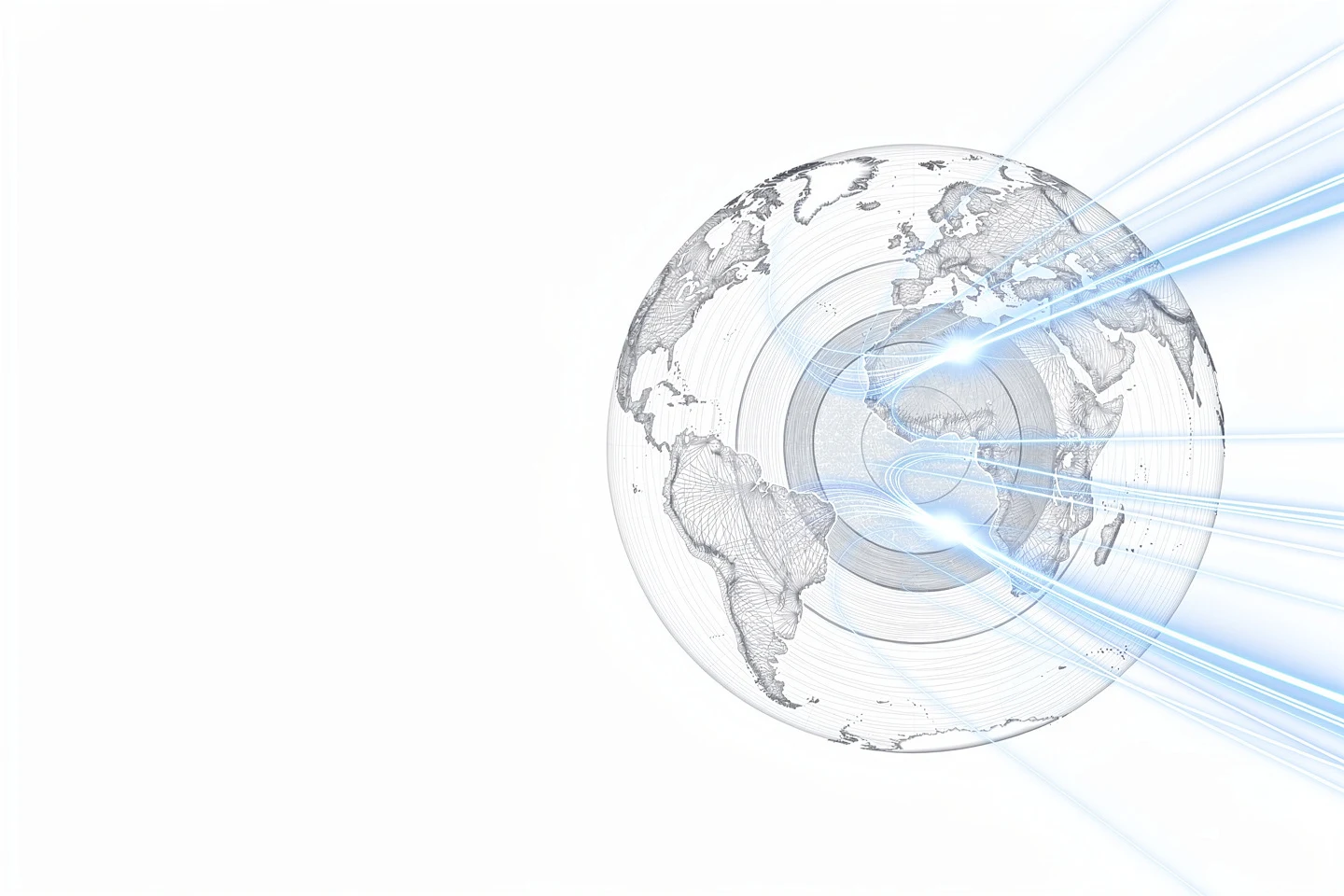
The Earth was X-rayed through and through, like a medical scan — except the rays were neutrinos, ghostly particles that matter barely holds back. They were predicted by Pauli and woven into the Standard Model by Fermi — our best theory of the subatomic world, where mass is given by the Higgs boson (discovered by Higgs). Neutrinos are born in collisions of cosmic rays with the atmosphere, and every second trillions of them pass through your palm — without a trace.

The IceCube detector, frozen into a cubic kilometer of Antarctic ice, spent ten years catching the bluish flashes from neutrinos that shot clear through the planet. The ice there is so transparent that sensors can see faint flashes from hundreds of meters away — like a string of Christmas lights deep in a glacier. By comparing the number of these events with the expected flux from computer simulations and energy analysis, scientists built a density map from crust to core — a true quantum tomogram.

The result was stunning in its ordinariness: Earth's mass turned out to be 7.25×10²⁴ kg, exactly as seismic data had said. No hollow spaces, no hidden oceans — just scorching iron. The hollow-Earth hypothesis shattered against neutrino statistics. Thus, for the first time, we independently 'weighed' our home and gained a tool that can peer into the depths of distant worlds.

🎯 Neutrinos pass through Earth almost unimpeded: out of a trillion, only a handful are absorbed — that's what makes them so tricky to catch.

🎬 Sci-fi has long cast neutrinos as the ultimate all-seeing particles. Now reality is catching up: we're using them to peer inside Earth, and soon, perhaps, into other worlds.

\Phi = \Phi_0 e^{-\sigma(E) N_A X}, \quad X = \int_0^L \rho(l) dl
The neutrino beam weakens exponentially with traversed mass. X is the column density, the sum of all mass along the beam’s path. The more massive the planet in transparency, the fewer neutrinos will make it through.
I = \frac{8\pi}{3} \int_0^R \rho(r) r^4 dr
The polar moment of inertia is a measure of how mass is distributed radially. This formula turns the obtained density profile ρ(r) into a number that can be compared with gravitational measurements. The agreement confirms the entire neutrino chain.
Scientists
Christian DopplerD. B. McLaughlinDidier QuelozMichel MayorR. A. RossiterPaul Dirac
Tags
neutrino Standard Model cosmic rays Higgs boson spectroscopy numerical simulation electromagnetism Quantum Field
Laws
Doppler effectDirac equationNoether's theoremMaxwell's equationsPlanck's lawPlanck–Einstein relation
Original: arXiv:2607.02644 · CC BY 4.0 · bridge42worlds