Are you one of the authors of this paper? Email us from your institutional or work email address mentioning this article's arXiv ID and we'll verify you and give you edit access to this page.
Are you an author who sees something we missed or got wrong? Write to us — the subject line already carries the paper id. We read every note and correct the write-up.
For the first time, Earth’s layered density is reconstructed from neutrino attenuation: IceCube unveils neutrino tomography of planets.
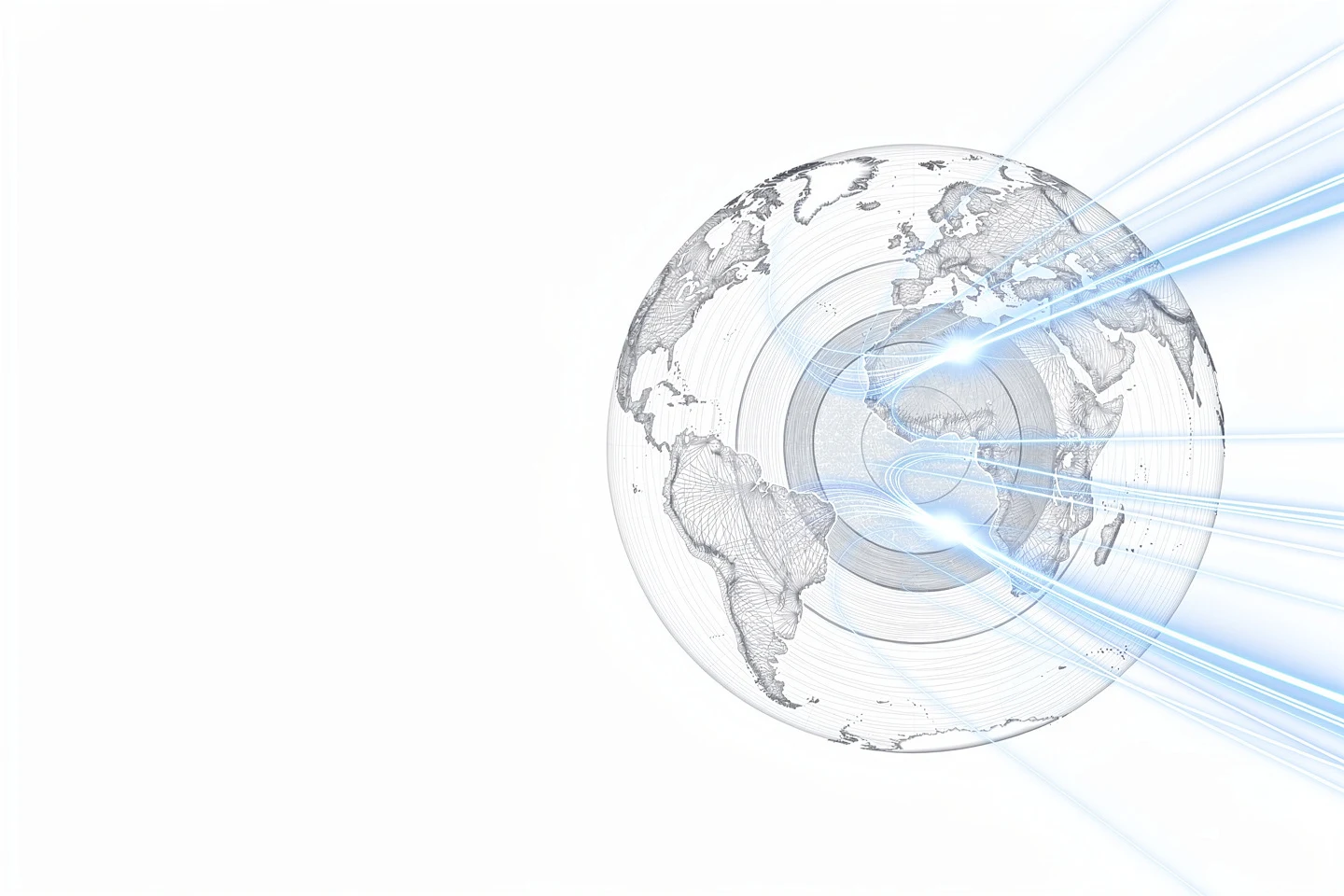
Earth is a closed book for those accustomed to leafing through pages with light. But to neutrinos, the invisible particles born in cosmic rays and barely remembering the prediction of Pauli, our planet is a braille script: each kilometer of depth presses its relief into their stream, and a sensitive detector can read this unseen narrative by touch. IceCube, a cubic-kilometer array of optical eyes in the Antarctic ice, became the first instrument to read the Earth tactilely — through the microscopic losses of neutrinos piercing the entire bulk of the planet.
In the depths of Antarctic ice, clearer than rock crystal, each neutrino carves a flash of Cherenkov light. IceCube catches these echoes, even if the particle has traversed Earth’s iron core — compressed to monstrous densities where atoms no longer belong to themselves.
The method is deceptively simple: when a high-energy neutrino (from 500 GeV to 100 TeV) collides with an atomic nucleus, a muon is born. This muon, racing faster than light in ice, leaves an electromagnetic Cherenkov track, captured by IceCube’s 5160 digital eyes. The longer the path and the higher the density, the more collisions, the rarer the victorious flash. This probability has a clear mathematical face:
Φ = Φ₀ × exp(−σ(E) × $N_A$ × X)
Here, X is the column density along the ray, the sum of all grams per square centimeter from horizon to horizon. Simply put, each neutrino ray weighs an entire column of terrestrial matter, and from the attenuation, we can reconstruct how much material lay in its way.
Scientists of the IceCube collaboration selected 368,071 muon tracks over 10.7 years: each carrying energy and direction. Using numerical Monte Carlo simulations, relying on the standard model of particle physics (including the quantum-field description of weak interactions, first described by Fermi, and the Higgs mechanism (Higgs), as well as spectroscopy of parton distribution functions) they built the expected picture for various density profiles. By varying the layers (inner and outer core, mantle) a Bayesian analysis fitted the model to the data. The planet emerged, layer by layer, like a photographic image in invisible rays.
The hollow Earth hypothesis crumbled to dust: the measured mass of 7.25×10²⁴ kg leaves no room for intraplanetary voids. And the moment of inertia of 1.05×10³⁸ kg·m², computed via the integral I = (8π/3)∫₀ᴿ ρ(r) r⁴ dr, matched gravitational data — a rare moment when the weak interaction nods in agreement with gravity through the planet’s depths. But the most intriguing part: by accumulating statistics, we may perhaps hear in these data the echo of ancient catastrophes — reverberations of colossal collisions frozen in the mantle, or whispers of undiscovered layering at the core boundary.
This success is not just a tick mark for geophysicists. We have gained a third eye for planetology — neutrino tomography, probing interiors with a force immune to seismic waves or gravity maps. Next-generation telescopes, IceCube-Gen2 and KM3NeT, will increase statistics and resolution, promising three-dimensional density maps, searches for mantle variations, and perhaps direct chemistry of the outer core where the geodynamo is forged. And beyond — Mars, Europa, Titan? Phantom particles are ready to become routine, reading the innards of worlds that humanity won’t drill into for centuries.
Thus, the weak interaction, once a quirk of the microcosm, turns into a macroscopic probe. Earth has been read in braille: its history confirmed twice, but this time in the language of particles that themselves barely speak to anything.
Antarctic ice is the most transparent solid on Earth. If you stood at the depth of IceCube, you would see a ghostly flash from a neutrino that pierced the whole planet and your body along with it. But your eyes are not adapted to Cherenkov light: it is born only in the slowed-down light universe of an ultracold crystal.
In science fiction, neutrinos are the ideal postmen: they pierce stars and planets, carrying interstellar letters. Here, they become not senders, but the whisper of the Earth itself: we are not transmitting information through the planet, but reading its deep confession.
The neutrino beam weakens exponentially with traversed mass. X is the column density, the sum of all mass along the beam’s path. The more massive the planet in transparency, the fewer neutrinos will make it through.
I = \frac{8\pi}{3} \int_0^R \rho(r) r^4 dr
The polar moment of inertia is a measure of how mass is distributed radially. This formula turns the obtained density profile ρ(r) into a number that can be compared with gravitational measurements. The agreement confirms the entire neutrino chain.