Gravity Looks Sideways express
A lead sphere hangs above another lead sphere. According to the usual laws of gravitation, they attract each other exactly along the vertical — along the line connecting their centers. But some theories, devised to explain galaxy motion without dark matter, predict an unexpected twist: the force between bodies depends on what happens outside. This is called the external field effect.
The authors considered the simplest case — two identical spheres whose symmetry axis is either parallel or perpendicular to the local gravitational field. It turns out that in the perpendicular orientation, the attraction is no longer strictly central: a tiny sideways component appears. The reason is that in modified gravity, the field can curl like a whirlpool rather than just spreading out in straight lines.
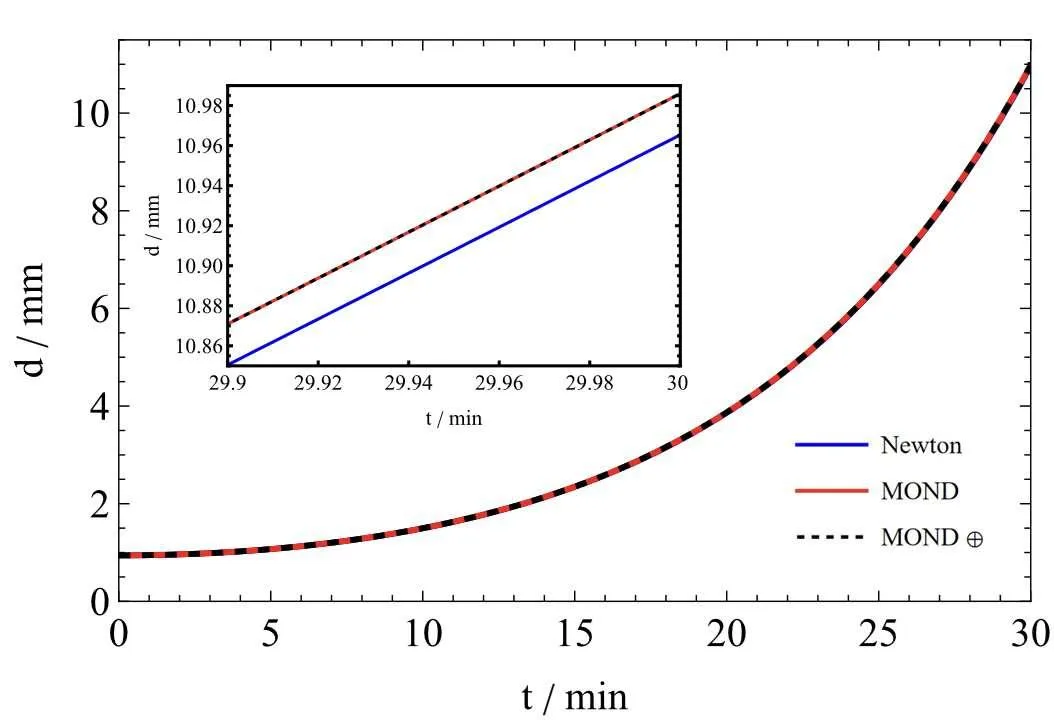
Such sensitivity sounds fantastic, but physicists haven't lost hope. Small particles suspended in vacuum using lasers or magnetic fields can float almost undisturbed for about half an hour. In space, where there are no vibrations or air currents, the experiment becomes even cleaner. Even less precise experiments will be useful: they will test the very principle — whether the fundamental rule of equivalence of all reference frames is violated.
A femtometer (10⁻¹⁵ m) is the scale of an atomic nucleus. And 0.1 femtometer is already ten times smaller than a proton. Measuring such displacements is like noticing that a needle tip has shifted by one millionth of a human hair's thickness.
In Liu Cixin's novel "The Dark Forest," droplet probes violate familiar laws of motion — possibly using exactly that "non-centrality" of forces that such experiments seek.