How to See Electron Topology in the Zeros of Charge express
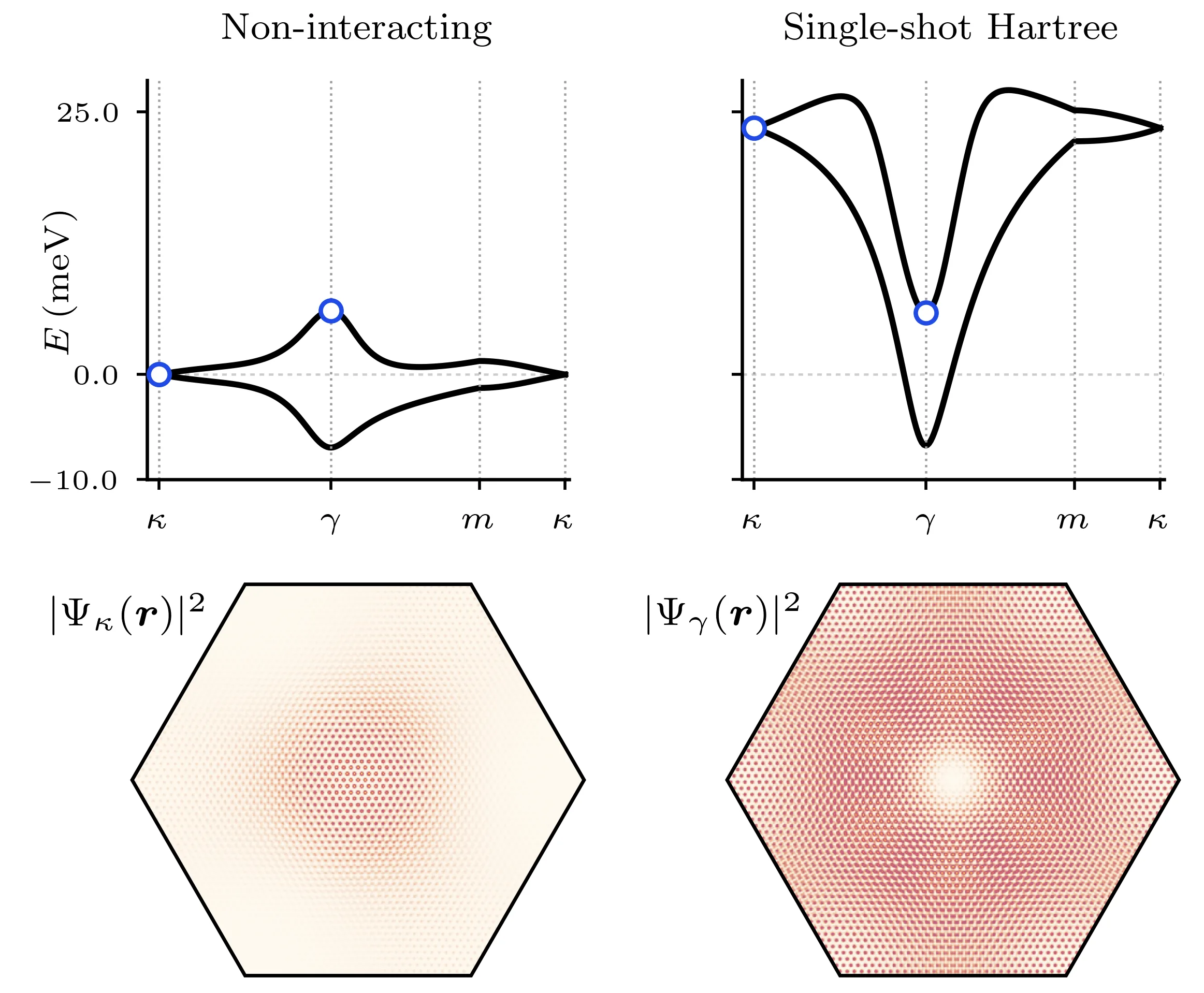
In a crystal, electrons are not distributed randomly. Their waves obey the lattice symmetry, like ripples on water taking the shape of a hoop thrown into it. The new work shows that at high-symmetry points, this ripple must have nodes — places where electron density is strictly zero.
The authors constructed a mathematical invariant (an unchanging characteristic) based on symmetry representations. It precisely indicates the coordinates of such zeros in the unit cell. The idea is like spectroscopy of topology: instead of computing complex indices, you can simply look at where charge disappears.
Tests on real systems confirmed the method's power. In tungsten diselenide, the zeros revealed a "forbidden atomic limit"—a situation where electrons cannot be assigned to specific atoms. In the Haldane model, the positions of zeros determined the Chern number (topological charge of the band) modulo three. And in twisted bilayer graphene, the same zeros explained why electron interactions so strongly reshape the flat bands.
The takeaway is simple: emptiness can be more eloquent than presence. Where charge vanishes, the geometry of the quantum world emerges.
Original abstract
as written by the authors arXiv:2607.21699
We prove that the wavefunction of a crystal at a high-symmetry momentum, $$\Psi_{\boldsymbol{k}_*}(\boldsymbol{r})$$, has symmetry-enforced zeros at certain positions in the unit cell, using a new invariant fixed uniquely by the symmorphic symmetry representation of the wavefunction. This allows one to infer the topology of an electronic band by probing zeros of the charge density, and in turn to connect scanning tunnelling microscopy to the group representation theory of bandstructure. We apply the theorem to 1H transition metal dichalcogenides, where it detects the obstructed atomic limit of WSe$$_2$$, the Haldane model, where it detects the Chern number modulo three, and the Bernevig-Hughes-Zhang model, where it detects the $$\mathbb{Z}_2$$ index. In addition, the zeros have important consequences for interaction effects: in kagome metals, they fix the sublattice structure of Van Hove wavefunctions, and in twisted bilayer graphene, they explain the qualitative interaction-induced reshaping of the flat bands.
The zeros of electron density predicted by the theorem are not just "few electrons" but a strict mathematical zero. Even a tiny impurity or thermal vibration of the lattice cannot fill them as long as symmetry holds.