Neon Backlight of the Solar System express
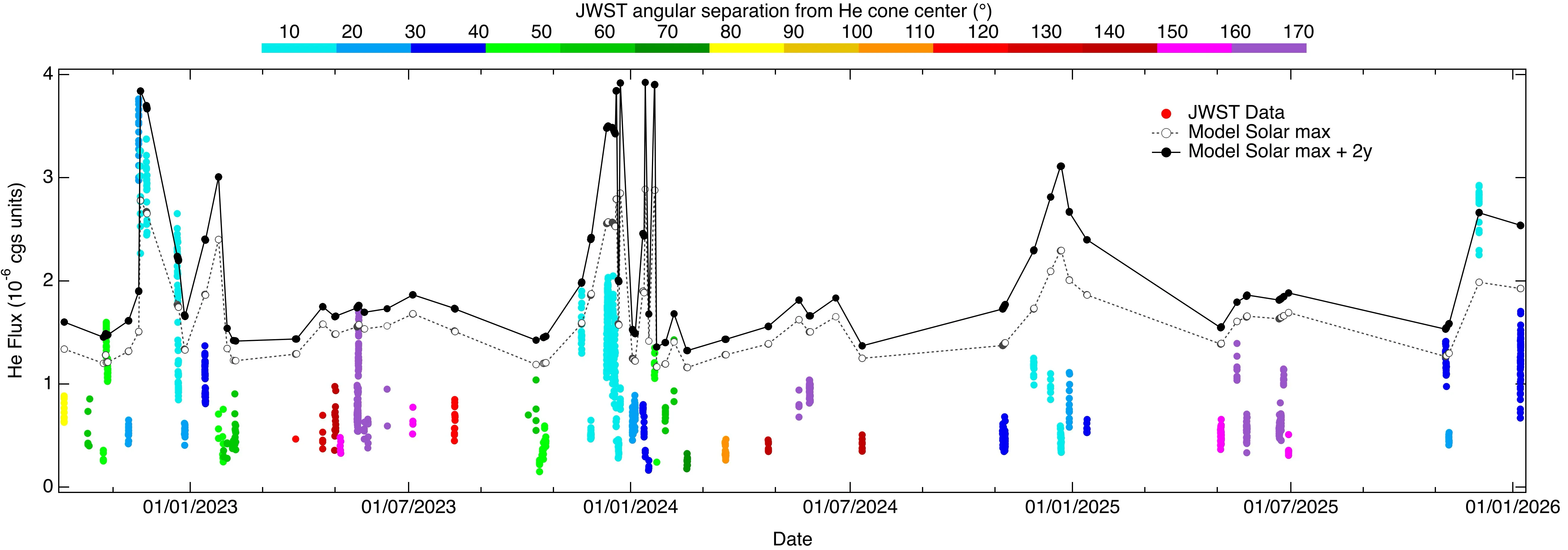
Every morning, a janitor sweeps leaves into a pile. The Sun, as it travels through the galaxy, does something similar: its gravity gathers diffuse interstellar gas into an invisible cone — a giant funnel. Every now and then, the James Webb Space Telescope looks into this funnel, and its instruments register a bright flash — the emission line of neutral helium.
This line, with a wavelength of 1.0833 microns (infrared light, invisible to the eye), turned out to be almost ubiquitous. Astronomers analyzed 22 days of observations from the public archive and saw it in 80 percent of all sessions. But the most intriguing part is its variability. In a single day, the line's brightness can change by a factor of several, as if someone is playing with a dimmer switch.
When Webb crosses that gravitational cone, the glow's intensity spikes. Moreover, the calmer the Sun (fewer sunspots and flares), the brighter the line. This suggests that the radiation originates in cold gas of the Milky Way that slowly flows through our system. Previously, such rapid variability, from hours to days, had gone unnoticed.
In essence, Webb has become a tool for studying the interstellar "air" that the Solar System breathes. And this air, it turns out, is far from calm: it flickers and shimmers, responding to solar gravity and activity. Now we have a chance to discern the fine structure of this gas and understand how it mixes with our own "backyard."
Original abstract
as written by the authors arXiv:2608.09587v1
We report the discovery of ubiquitous neutral helium emission in sky spectra taken with JWST's NIRSpec instrument. The emission, with a wavelength of 1.0833 micron, resembles one of the "sky lines" that are seen by ground-based observatories. We examine this emission in all suitable NIRSpec spectra in the public archive, totaling 22 days of exposure time. We find that this He I emission is almost always present: it is well-detected in 80 percent of the observations, and in 53 percent of the individual exposures. The emission is highly time-variable: at a given pointing, the line intensity can vary by factors of several over the course of a day. The He I emission is strongest when JWST crosses through the cone of interstellar neutral helium that is gravitationally focused by the sun; intensity during the cone crossing is anti-correlated with solar activity. The low redshift and narrow velocity width of the He I line, and the elevated intensity when JWST crosses through the focusing cone, together indicate that origin of the He I emission is cold Milky Way gas passing through our solar system. JWST provides a new way to study this interstellar gas, revealing new insights such as extreme variability on timescales of hours to days, which has not been previously reported.
The helium line that Webb caught is in the infrared range and invisible to the human eye, but you could compare it to the color of a glowing electric stove coil — only much colder.
In Stanislaw Lem's novel "Solaris," the planet's ocean shimmered and changed in response to human presence — much like the helium cloud behaves under Webb's gaze.