A Laser Light Switch for Magnetic Storms ✛
Context
Magnetic reconnection explains solar flares, gamma-ray bursts, and coronal heating. In laboratories, it is reproduced by colliding plasma blobs with oppositely directed magnetic fields generated by the laser radiation itself. However, until now, reconnection has been passive: researchers merely observed how it unfolds. Our work joins a series of high-energy-density plasma experiments where reconnection is studied on nanosecond and micrometer scales. Neighboring studies investigate spontaneous plasmoid formation and particle acceleration, but no one had attempted to actively intervene in the process.
Methods
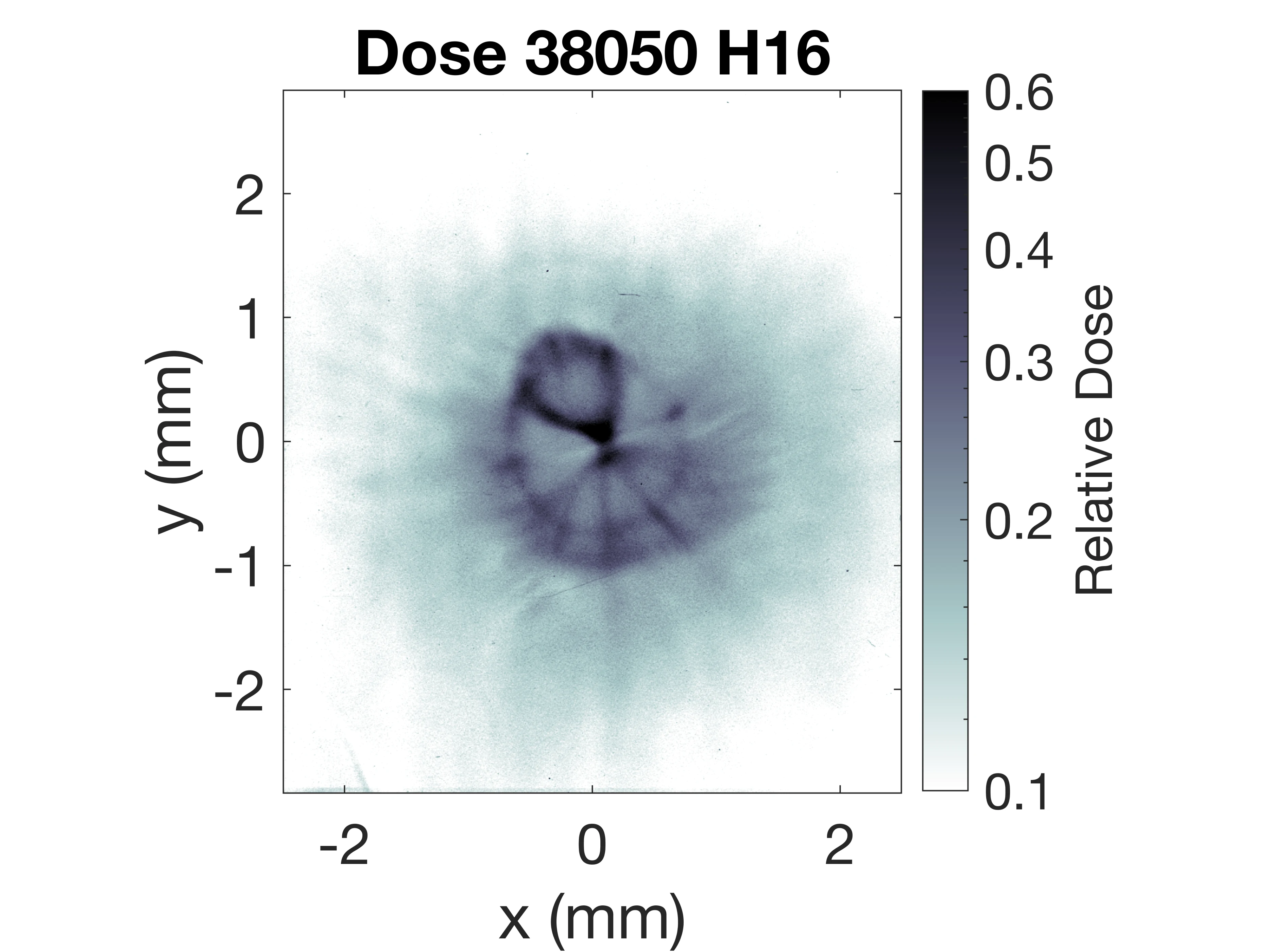
Two long-pulse lasers (2.5 ns) ablated a plastic target, creating two plasma blobs with self-generated magnetic fields. When they collided, a current sheet formed where reconnection occurred. A third laser pulse, 10 ps long with an intensity of $10^{19}$ W/cm², struck precisely this sheet. It accelerated electrons that generated a magnetic field with the same polarity as the fields on either side of the sheet. The process was tracked using proton radiography: a proton beam passed through the plasma, and its deflection reconstructed the magnetic field structure with picosecond resolution. For modeling, a hybrid approach was used: first, the radiation-magnetohydrodynamic code GORGON calculated the plasma formation, then its results were fed into the fully three-dimensional particle-in-cell code OSIRIS.
Results
When the relativistic pulse arrived after the current sheet had formed, it injected an electron beam that spawned multiple current filaments. These filaments destroyed the sheet within tens of picoseconds—an order of magnitude faster than in control shots without the short pulse. When the pulse arrived before the plasma blobs collided, its magnetic field was compressed by the incoming fields, creating a region of enhanced magnetic pressure. This pressure repelled the plasma and prevented the current sheet from forming, completely suppressing reconnection. The key number is the difference in pulse arrival time: 300 ps versus 900 ps after the start of target irradiation. In the first case, reconnection was suppressed; in the second, it was accelerated.
Implications
This work differs from neighboring experiments in that it demonstrates active control of reconnection, not just observation. Neighboring studies examine spontaneous development; we showed that an external pulse can act as a switch. This turns reconnection from an uncontrollable phenomenon into a tunable laboratory system.
Future development
The next step is to reconstruct the full three-dimensional structure of the magnetic fields. Tomographic proton radiography or optical probes based on the Faraday effect would be suitable. One could also change the polarity of the injected electron beam to reverse the effect: accelerate reconnection where it was previously suppressed, and vice versa.
Impact
The results are important for fusion, where uncontrolled reconnection can disrupt magnetic confinement of plasma. They also expand the capabilities of laboratory astrophysics, allowing us to reproduce conditions previously inaccessible.
Next steps
Conduct experiments with reversed polarity of the injected current to test the reversibility of the effect. Develop diagnostics for three-dimensional field reconstruction.
Key open problems
An open question in plasma physics is the role of kinetic instabilities in the rapid disruption of current sheets. Our results suggest that current filamentation may be a key dissipation mechanism, but its connection to microscopic processes requires further study.
The knowledge machine's view
This section is addressed to the author of the paper and their colleagues. Neighbouring works were found by meaning-based search across our archive, not by word overlap. We do not review: we show the field around the work.
What the work does
In the experiment on the OMEGA-EP facility, two long-pulse lasers created colliding plasma plumes with magnetic fields, while a third relativistic pulse injected an electron beam into the reconnection region. The pulse arriving after 300 ps suppressed reconnection, while after 900 ps it accelerated it tenfold. Diagnostics using proton radiography and simulations with the GORGON and OSIRIS codes confirmed control over the process.
Where its strength is
For the first time, active control of magnetic reconnection by an external laser pulse has been demonstrated, turning the process from something observed into something tunable. This opens up the possibility of controlling the release of magnetic energy in laboratory conditions.
Where it could go next
- It might be interesting to compare controlled reconnection with the regimes of spontaneous transition from smooth flow to explosive reconnection discussed in the neighboring work on smooth flow and explosion.based on: Magnetic Reconnection: From Gentle Flow to Explosion arXiv:2602.23683
- Nearby is a study on magnetic fields heating plasma in space; perhaps your method of injecting an electron beam could be used to mimic such heating in the laboratory.based on: Möbius Strip in Space: How Magnetic Fields Heat Plasma arXiv:2604.02901
- The archive contains research on tuning thermonuclear ignition with multiple pulses; your approach with a single control pulse could be extended for finer tuning in similar schemes.based on: How to Tune a Thermonuclear Explosion: An Impulse from 500 Knobs arXiv:2606.08827
Worth trying
- Test how changing the energy or duration of the control pulse affects the threshold between suppression and acceleration of reconnection.
- Use multiple pulses with different delays to control the process sequentially, similar to the work on thermonuclear ignition.
- Compare the dynamics of filamentation in your experiment with models of spontaneous plasmoid formation from the neighboring work on the transition to explosion.
Nearby works in our archive
- Möbius Strip in Space: How Magnetic Fields Heat Plasmasimilarity 0.65
- Magnetic Reconnection: From Gentle Flow to Explosionsimilarity 0.64
- Spin, Mirror, Spin: A Shortcut to Fusion Energysimilarity 0.63
- Magnetars as Gravitational Echoessimilarity 0.63
- Twisted Solar Loop Reveals the Secret of Magnetic Explosionssimilarity 0.63
- How to Tune a Thermonuclear Explosion: An Impulse from 500 Knobssimilarity 0.63
The closest work in the archive sits at 0.65 by meaning — the usual level for our corpus.
Original abstract
as written by the authors arXiv:2608.17839v1
Magnetic reconnection governs the explosive release of magnetic energy in systems from the solar corona to fusion plasmas, yet controlling it in the laboratory has remained out of reach. Here we demonstrate active control of reconnection in high-power laser-driven plasmas using a third, relativistic-intensity laser pulse that injects filaments of electron current into the reconnecting system. Two moderate-intensity lasers drive colliding magnetized plumes that reconnect, forming plasmoids in the current sheet as seen in proton deflectometry. The relativistic laser generates magnetic fields matching the polarity on either side of the layer, and, depending on its arrival time, either accelerates the breakup of the current sheet or suppresses reconnection. Arriving early, before the plumes strongly interact, it builds a pocket of magnetic pressure that repels them via flux pileup; arriving after the current sheet forms, it accelerates electrons that extend current filamentation instabilities into the upstream, causing rapid dissipation of the reconnecting magnetic field. This approach opens a route to steering magnetic energy flow in fusion plasmas and broadens the range of systems accessible to laboratory astrophysics.
The short laser pulse was 250 times shorter than the long pulses that created the plasma, yet its energy sufficed to completely alter the course of the process.
Key numbers
- short pulse duration: 10 ps
- short pulse intensity: 1019 W/cm²
- dissipation acceleration: 10 times
- arrival time difference: 300 ps vs 900 ps
- long pulse energy: 1400 J and 2600 J