Triangles vs. Stripes: Two Patterns in One Quantum Gas ✛
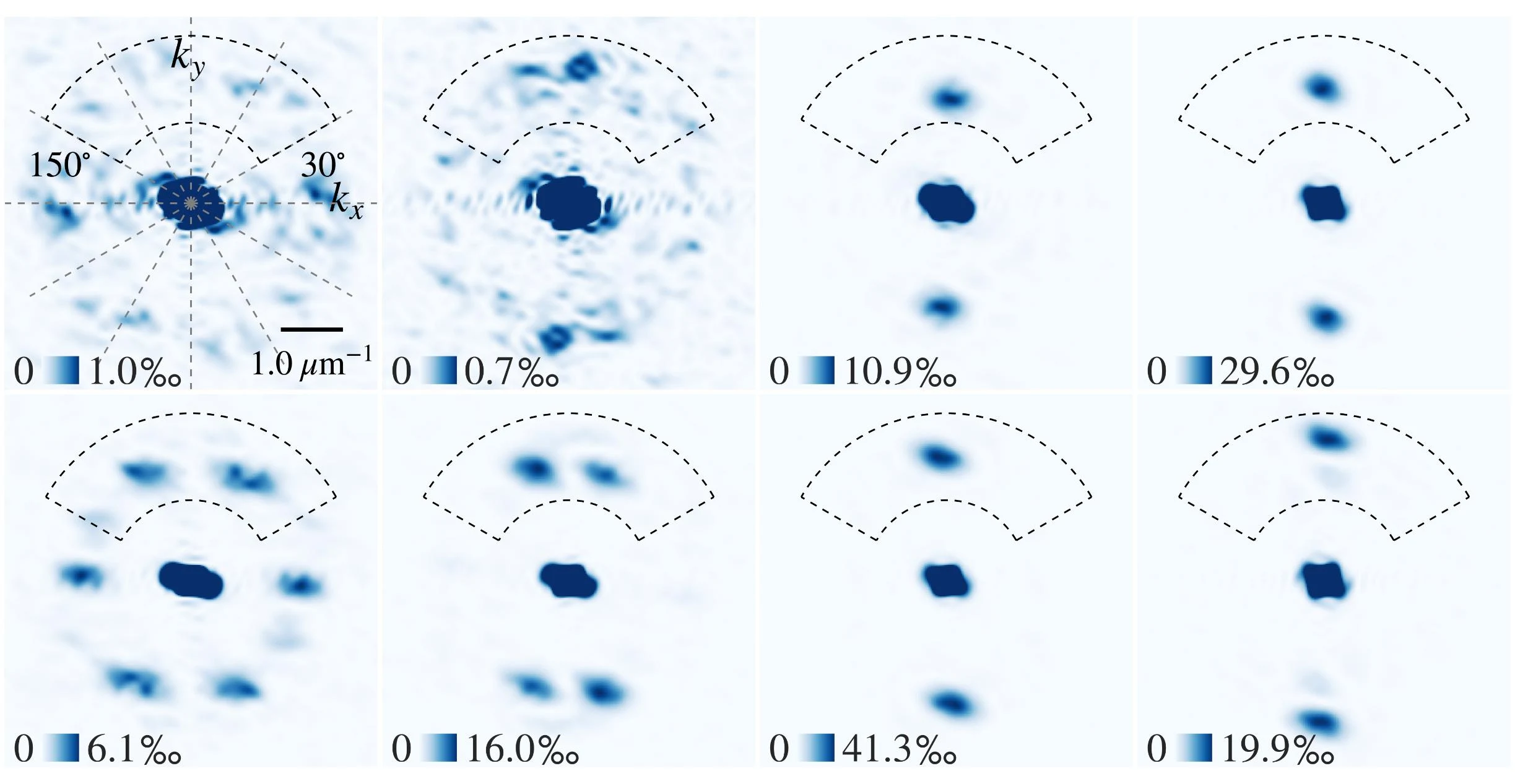
Picture two teams of builders laying bricks in different ways: one makes a triangular pattern, the other long stripes. In a quantum gas of dysprosium atoms cooled to 62 nanokelvin, physicists have for the first time seen these two patterns competing. Dysprosium atoms are among the most magnetic in the periodic table, so they sense each other from a distance, like tiny magnets. This long-range interaction is what drives them to line up into ordered structures.
The scientists varied two parameters: the strength of atomic interactions, controlled by the magnetic field, and the tilt of the magnetic moments, rotating them from 0 to 70 degrees. At small tilt angles, the droplets gathered into a triangular lattice, like bubbles on the surface of water. When the dipoles were tilted more, the droplets stretched into stripes running along the tilt direction. The transition between patterns was not abrupt: in the intermediate region, the order parameter that indicates which pattern dominates fluctuated strongly. The statistics of these fluctuations were unusual: they pointed to critical behavior familiar from phase transitions, such as when water turns into steam.
Both patterns existed both in the supersolid regime, where atoms move coherently, and in the insulating regime, where that coherence is lost. This was verified by releasing the gas from the trap and observing interference fringes: they reproduced from run to run, like fingerprints. Previously, theory predicted many different patterns, but experiments lagged behind. Now the two main competitors have met in the same trap, opening the way to studying how superfluidity intertwines with the rearrangement of crystalline order. The next step is to listen to how these structures oscillate: triangular and striped supersolids should sound different.
Dysprosium atoms are among the most magnetic in the periodic table: their magnetic moment is 10 times larger than that of alkali atoms, so dipole–dipole interactions play the dominant role. The surfboard-shaped trap is a flattened harmonic potential with frequencies of 39 Hz in the plane and 97 Hz vertically.
The competition between triangular and stripe orders resembles the struggle of crystal structures in fictional worlds with unusual physics, but there is no direct reference to a known work.