Triangles vs. Stripes: Competing Orders in a Dipolar Quantum Gas ✛
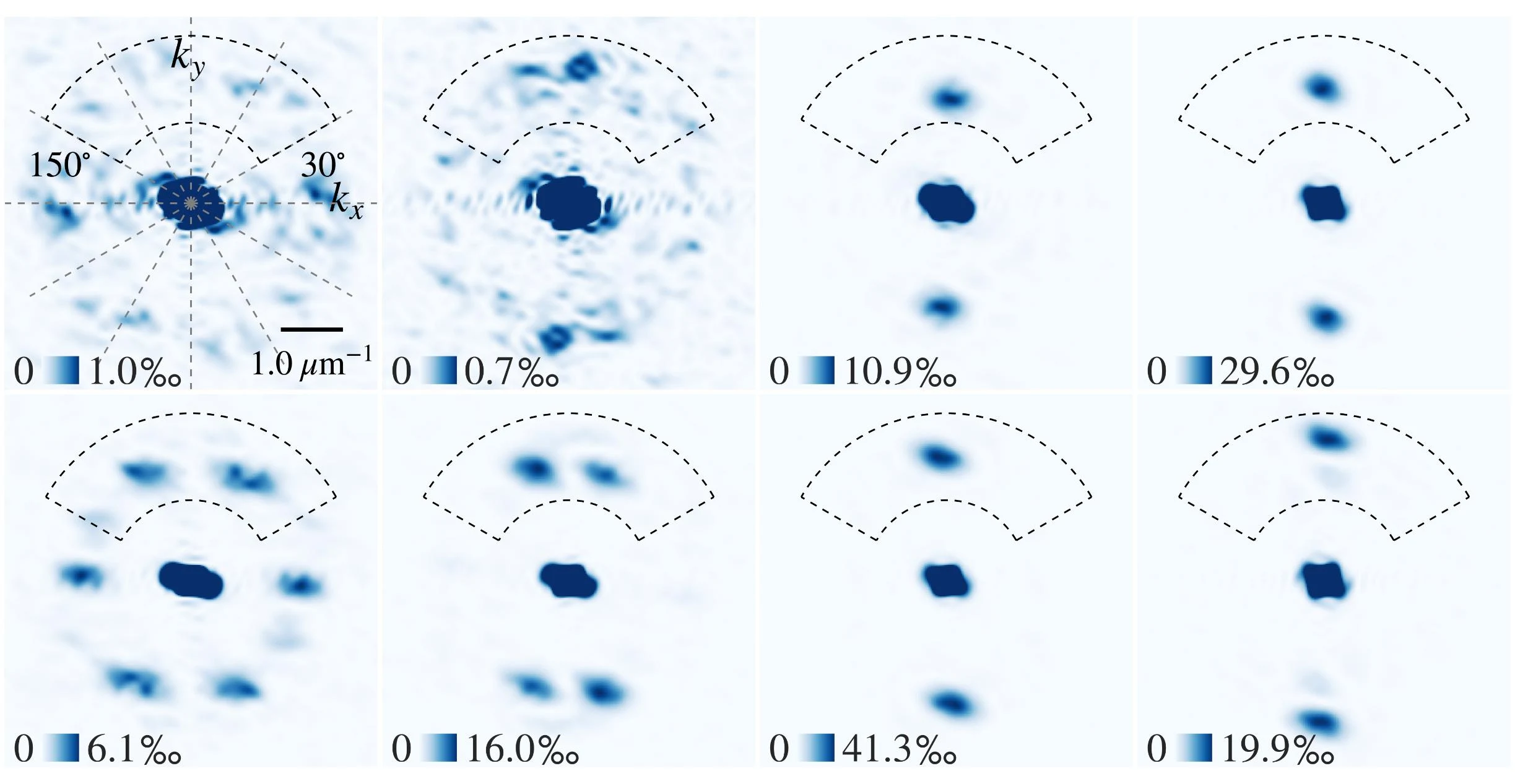
Two dancers on one stage: the triangle and the stripe. In a quantum gas of dysprosium atoms cooled to 62 nanokelvin, these two spatial structures have met for the first time in a single experiment. The gas is held in a trap shaped like a surfboard, and its atoms are among the most magnetic in the periodic table. Their magnetic moments are ten times stronger than those of typical alkali atoms, so the atoms sense each other at a distance, like tiny magnets. This long-range interaction is what gives rise to order.
The physicists varied two parameters: the strength of the contact interaction, by tuning the magnetic field across a Feshbach resonance, and the tilt of the dipoles, rotating them from 0 to 70 degrees. At small tilt angles, the atoms gathered into a triangular lattice of droplets, like bubbles on the surface of water. When the dipoles were tilted more strongly, the pattern changed: the droplets stretched into stripes running along the tilt direction. The transition between the two patterns was not sharp. In the intermediate region, the order parameter R, the ratio of the amplitudes of the two main peaks in the power spectrum, showed enhanced fluctuations. The statistics of these fluctuations deviated from Gaussian, indicating critical behavior familiar from phase transitions in other systems.
Both structures existed in the supersolid regime, where the phases of the atoms are aligned, and in the insulating regime, where coherence is lost. The range of phase coherence in terms of scattering length was about five Bohr radii — the distance over which the atoms still 'feel' the common quantum wave. Images after free expansion showed interference fringes that were reproducible from run to run, confirming that superfluidity did not disappear when the pattern changed. Previously, theory predicted a rich phase diagram with honeycomb and other structures, but experiment lagged behind. Now, the two main competitors have met in the same trap.
The two dancers on stage no longer dance alone. Their rivalry opens the way to studying how superfluid properties intertwine with the rearrangement of crystalline order. The next step is to listen to the music of their collective excitations: triangular and striped supersolids should sound different. Perhaps in these differences lies the key to understanding competing orders in quantum fluids and complex materials.
Dysprosium atoms are among the most magnetic in the periodic table: their magnetic moment is 10 times larger than that of alkali atoms, so dipole–dipole interactions play the dominant role. The surfboard-shaped trap is a flattened harmonic potential with frequencies of 39 Hz in the plane and 97 Hz vertically.
The competition between triangular and stripe orders resembles the struggle of crystal structures in fictional worlds with unusual physics, but there is no direct reference to a known work.