Triangles versus stripes: competing orders in a dipolar quantum gas ✛
Context
Two-dimensional dipolar supersolids are a new frontier: previously, only triangular droplet lattices had been seen. Theory predicted a rich phase diagram with stripes, honeycombs, and other structures, but experiments lagged behind. This work stands alongside studies of supersolidity in dipolar gases and quantum simulators: neighbors explored one-dimensional structures, superfluid–supersolid transitions, and phase coherence. Here, competing two-dimensional orders and the transition between them are realized for the first time.
Methods
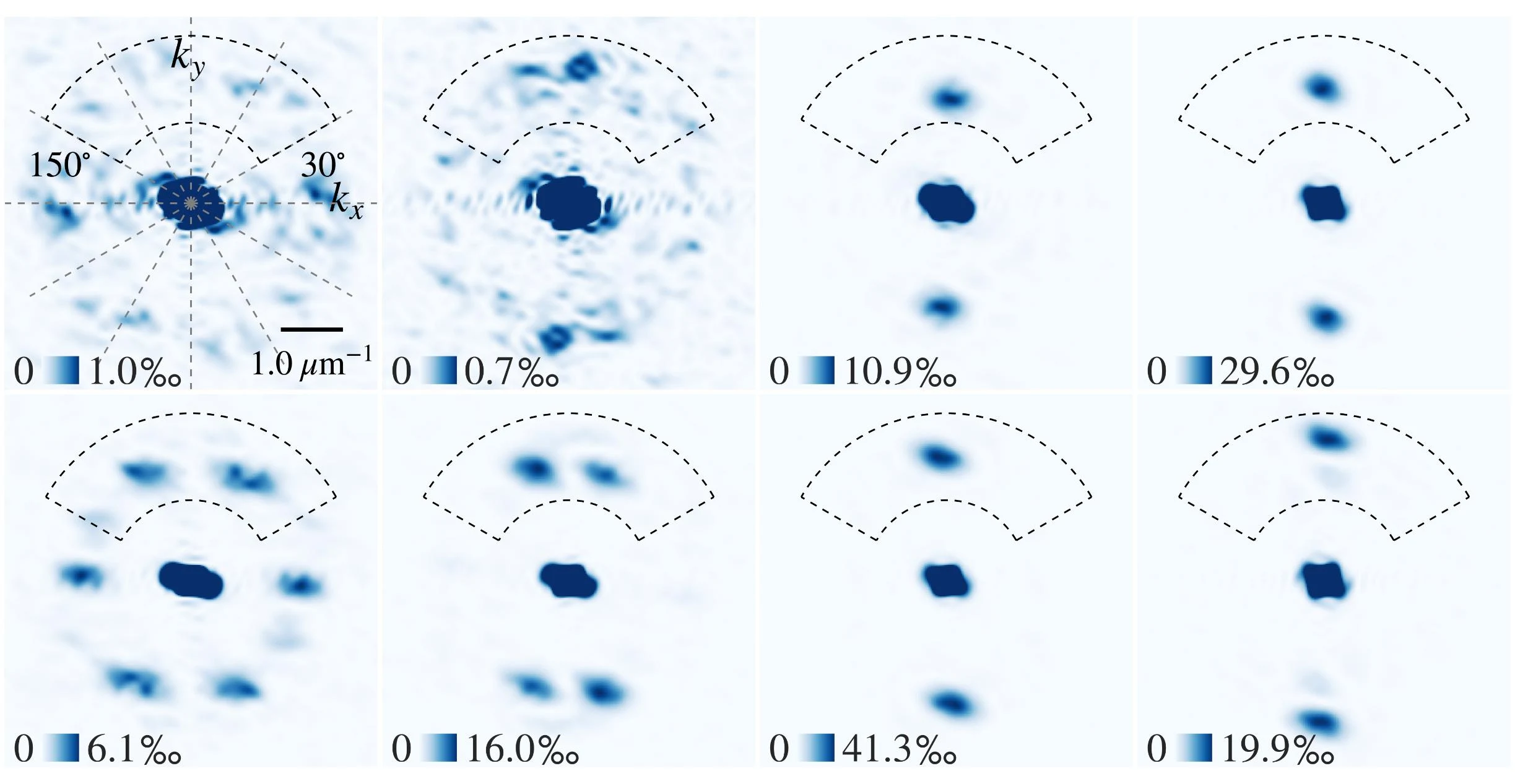
Experiment on a quantum gas of 1.4×10⁵ dysprosium-164 atoms in an anisotropic, surfboard-shaped trap. The contact interaction strength was varied via a Feshbach resonance (magnetic field 2.36–2.59 G) and the dipole tilt by angle α from 0° to 70°. After slowly ramping the parameters over 100 ms and a 30 ms hold time, density images were taken in situ and after 50 ms of free expansion. For structure analysis, the power spectrum was computed and an order parameter R was introduced as the ratio of the amplitudes of the two main peaks. Phase coherence was assessed from the reproducibility of interference patterns upon expansion.
Results
At small dipole tilt angles (α < 35°), triangular droplet arrays formed; at large angles (α > 55°), stripes elongated along the tilt direction appeared. In the intermediate region (α ≈ 30–45°), the order parameter R showed enhanced fluctuations and non-Gaussian cumulants—a signature of critical behavior at the structural transition. Both structures were observed both in the phase-coherent (supersolid) regime near the modulation threshold and in the phase-incoherent (insulating) regime far from it. The coherence range in scattering length was about 5 a₀ for both structures.
Implications
Unlike neighboring works, where supersolidity was studied in one-dimensional structures or only triangular lattices, here competing two-dimensional orders and the structural transition between them are realized experimentally for the first time. This opens the way to studying how superfluid properties intertwine with the rearrangement of crystalline order and provides a platform for exploring intertwined symmetry breakings.
Future development
One could investigate collective excitations and hydrodynamic response of the different structures—they should differ and serve as an additional probe of crystalline order. The dipole tilt also introduces superfluidity anisotropy, which could be revealed in excitation spectra or vortex dynamics. Larger statistical samples and dedicated parameter ramping protocols would allow determining the order of the transitions (first or second) and their criticality.
Impact
The results will impact the physics of ultracold quantum gases, quantum simulation of many-body systems, and the understanding of competing orders in condensed matter.
Next steps
Study collective modes and hydrodynamics of triangular and stripe supersolids. Perform statistical analysis of phase coherence near the structural transition.
Key open problems
This work directly addresses an open problem in ultracold-gas physics: how superfluidity and crystalline order coexist and compete in two-dimensional systems. It also touches on the nature of structural transitions in quantum fluids with long-range interactions.
The knowledge machine's view
This section is addressed to the author of the paper and their colleagues. Neighbouring works were found by meaning-based search across our archive, not by word overlap. We do not review: we show the field around the work.
What the work does
The paper experimentally investigates a two-dimensional dipolar quantum gas of dysprosium-164. By tuning the contact interaction and the tilt of the dipoles, the authors observed a transition between a triangular droplet lattice and a stripe structure. Statistical analysis revealed enhanced non-Gaussian fluctuations of the order parameter in the critical region, and phase coherence measurements showed that both structures exist in both supersolid and insulating states.
Where its strength is
For the first time, competing two-dimensional orders and a structural transition between them have been experimentally realized in a dipolar supersolid. This provides a platform for studying the interplay between superfluidity and the rearrangement of crystalline order.
Where it could go next
- It might be interesting to compare the observed structural transition with the dynamics of quantum droplets studied in the work on breathing droplets. That work examined a collective oscillation mode, and a similar analysis could reveal how low-energy excitations change when going from the triangular lattice to stripes.based on: The Pulse of Quantum Matter: Breathing Droplets and Their Rhythmic Formula arXiv:2606.29370
- A related work on superfluid strings considered coherent oscillations in quasi-one-dimensional structures. Similar approaches might help describe the dynamics of stripes as one-dimensional supersolid objects and their collective modes.based on: Quantum Pendulum: Why Superfluid Strings Tremble in Unison arXiv:2608.08124v1
Worth trying
- Check whether the enhancement of non-Gaussian fluctuations near the transition persists when the sweep rate through the critical region is varied.
- Investigate low-energy excitations (e.g., the compression mode) separately for the triangular and stripe phases and compare them with predictions for breathing droplets.
- Study how the phase coherence along and across the stripes changes across the transition, possibly using spatially resolved interference measurements.
Nearby works in our archive
- The Pulse of Quantum Matter: Breathing Droplets and Their Rhythmic Formulasimilarity 0.61
- Quantum Pendulum: Why Superfluid Strings Tremble in Unisonsimilarity 0.59
- Pair Tango Inside the Protonsimilarity 0.58
- Almost Orthogonal Worldssimilarity 0.57
- Neutrino Pairing Dance in a Dense Gassimilarity 0.57
- Shock Wave in Liquid Lightsimilarity 0.57
The archive is sparse around this work: the closest review is only 0.61, against a usual 0.64. It looks like few have drilled nearby.
Original abstract
as written by the authors arXiv:2608.20327v1
Supersolids are exotic quantum states in which long-range phase coherence coexists, and may interplay, with emergent spatial orders. A particularly rich phase diagram featuring several competing spatial orders is predicted for dipolar supersolids with two-dimensional crystals, yet the experimental observation of this structural variety has remained limited. Here we experimentally form competing triangular and stripe density-modulated states in a quantum gas of highly magnetic atoms confined in a surfboard-shaped trap by tuning contact interaction strength and dipole orientation. We define a structural order parameter and study its statistical behavior. Thereby, we identify both the triangular and stripe phases and the transition between them, the associated critical behavior being marked by enhanced non-Gaussian fluctuations. Furthermore, we observe each spatial structure in both the phase-coherent supersolid regime and the phase-incoherent insulating one, near and far from the unmodulated-to-modulated transition, respectively. Our results establish a versatile platform in which multiple phases of the two-dimensional-supersolid phase diagram, and more generally, intertwined symmetry-breaking phenomena, can be investigated.
Dysprosium atoms are among the most magnetic in the periodic table: their magnetic moment is 10 times larger than that of alkali atoms, so dipole–dipole interactions play the dominant role. The surfboard-shaped trap is a flattened harmonic potential with frequencies of 39 Hz in the plane and 97 Hz vertically.
The competition between triangular and stripe orders resembles the struggle of crystal structures in fictional worlds with unusual physics, but there is no direct reference to a known work.
Key numbers
- number of atoms: 1.4×10⁵
- scattering length: 89–109 a₀ (a₀ is the Bohr radius)
- dipole tilt angle: 0°–70°
- phase coherence range: about 5 a₀
- gas temperature: 62 nK