M. Sun

4 articles · 30 co-authors · latest: 2026-08-21
926 citations · h-index 15 · 31 papersData: Semantic Scholar

We have retold 4 papers by this author. most often about: quark, Standard Model, pulsar. 30 co-authors across our retellings.

Links in the knowledge graph
HEP Experiment2026-03-301 minarXiv:2603.28456express
Two-Charm Baryon Caught for the First Time
In proton collisions at the Large Hadron Collider, physicists have for the first time caught a particle with two charm quarks. It is called Ξcc+ (pronounced "ksi-ksi-plus") and resembles a bead with not one but two heavy nuclei.
High Energy2026-08-081 minarXiv:2608.07850express
The Pulsar Tail You Can See Through
Pulsar PSR J1740+1000 is a city-sized star spinning faster than a kitchen blender. After a supernova explosion, it left behind a dense core that accelerates particles to near-light speeds. These particles fly into space, and previously it was thought they scatter in all directions, like splashes from a stone thrown into water.
Galaxies2026-08-082 minarXiv:2608.08094express
X-ray Signatures of Iron in Galaxy Clusters
The hot gas in galaxy clusters shines in X-rays, and a significant portion of that light comes from iron atoms that have lost many electrons. These atoms leave characteristic bright lines in the spectrum, like fingerprints. Astronomers use them to determine the temperature, density, and motion of the gas.
HEP Experiment2026-08-211 minarXiv:2608.21082express
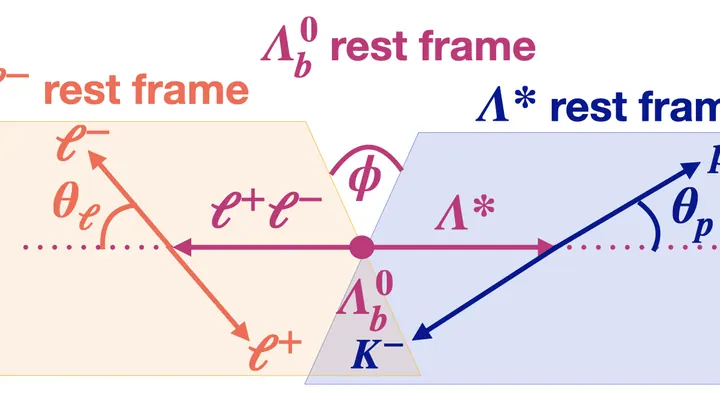
How a Heavyweight Particle Decays
At the Large Hadron Collider, protons are smashed together, and among the debris, a heavyweight particle, the lambda baryon, sometimes appears. It lives for a tiny fraction of a second before decaying into other particles.