Black holes could reveal hidden dimensions ✛ ✎ ✦
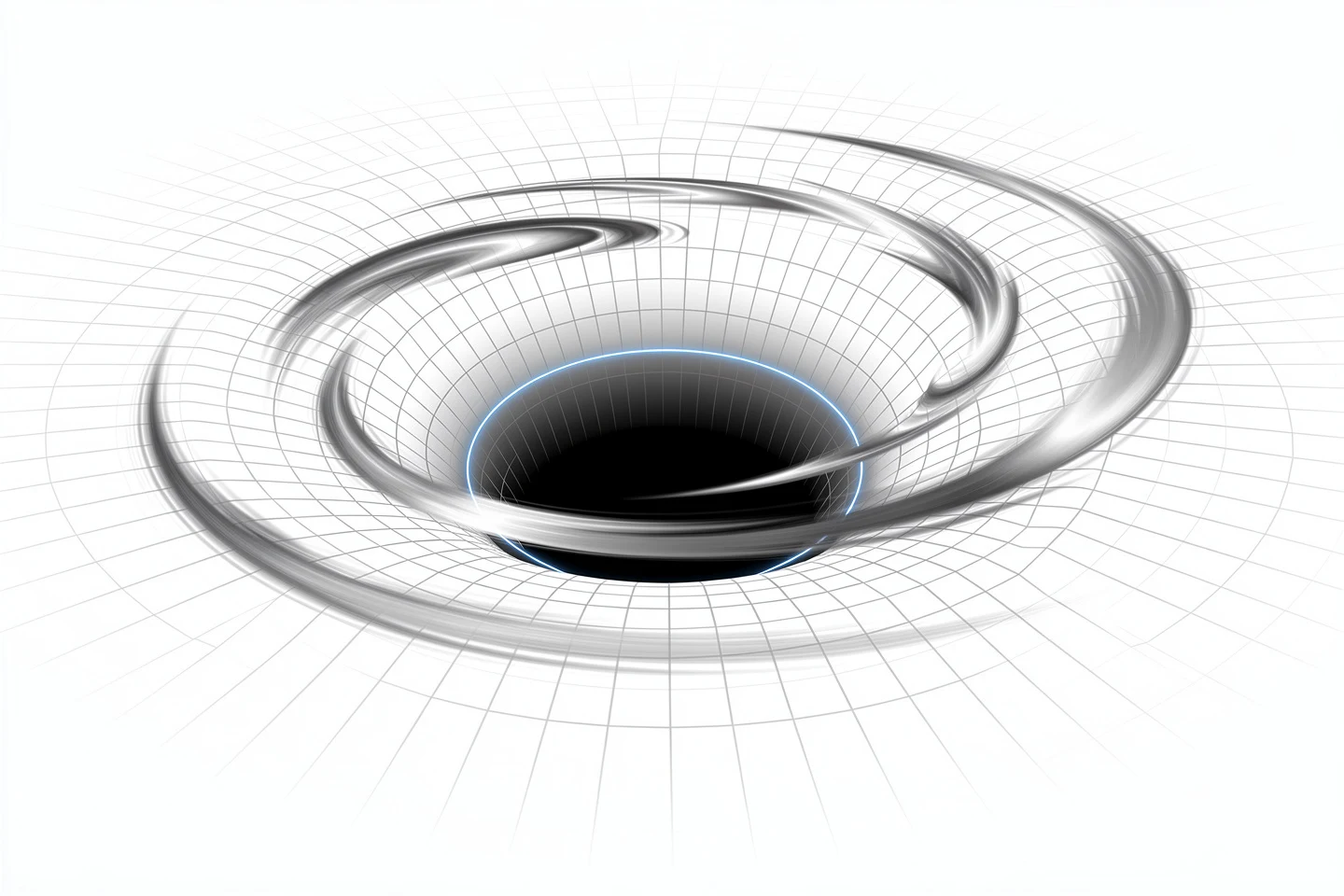
Our Universe could be like the surface of a pond: in one version of string theory, we live on an ultrathin brane, and gravity leaks into extra dimensions. Black holes in this picture are not dead ends but funnels plunging into hidden realms, and their behavior is almost indistinguishable from what was described by Einstein and Schwarzschild.
Using numerical simulations, researchers recreated such a hole with a spinning disk of superhot gas. Light bending around it under gravitational lensing creates a characteristic shadow. Comparison with radio astronomy data — the image of the M87 hole from the Event Horizon Telescope, which uses an array of antennas — showed a deviation of 0.1% (like the width of a hair over a kilometer).
But the most unexpected part: when the influence of hidden dimensions exceeds a threshold, the black hole turns into a wormhole — a traversable tunnel through space. At that point, its temperature, predicted by Hawking, drops to zero and evaporation stops. Next-generation telescopes like BHEX might see not just a shadow, but the imprint of other worlds.
If the influence of hidden dimensions exceeds the critical threshold, a black hole turns into a wormhole — a tunnel connecting different corners of the cosmos — and ceases to emit Hawking radiation.
In the movie Interstellar, a wormhole enables travel through space — and multidimensional theories do not rule out such tunnels in the Universe.