Black Holes on the Brane: Images and the Search for Hidden Dimensions ✛ ✎ ✦
Context
General relativity of Einstein remains unsurpassed, but faces problems of singularities and dark matter. Brane scenarios, originating from string theory, offer an elegant extension: our Universe is merely a three-dimensional surface in a multidimensional bulk, and only gravity can penetrate extra dimensions. The search for observational traces of such models is one of the key tasks of modern astrophysics, especially in the era of direct images of black holes obtained with radio astronomy and interferometry.
Methods
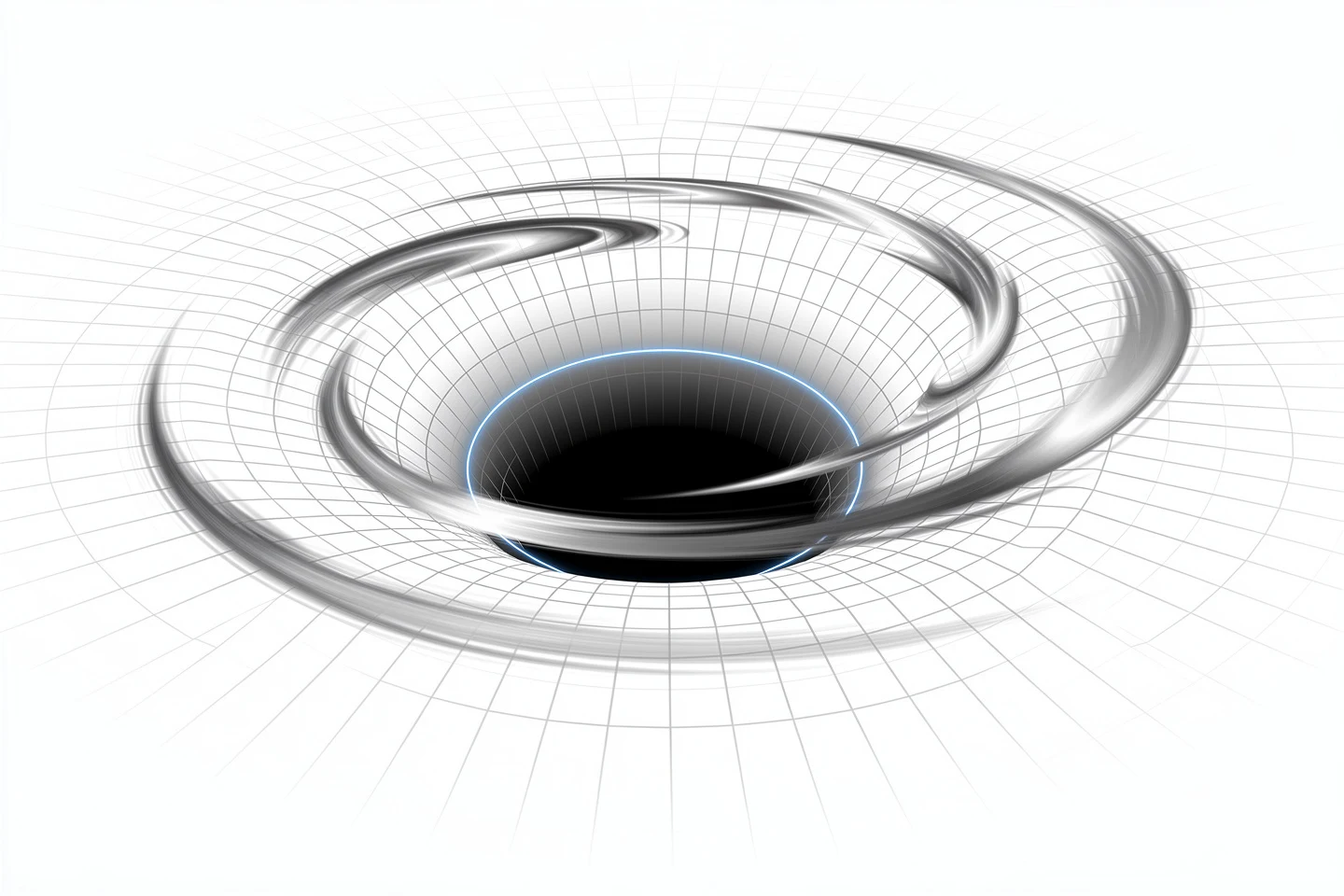
The authors built a semi-analytical model of a radiatively inefficient accretion disk, where hot plasma radiates synchrotron emission at 230 GHz, matching the operating parameters of the Event Horizon Telescope. Using numerical simulations of radiation transport in curved spacetime, synthetic images were generated for CFM brane black holes, whose metric generalizes the Schwarzschild solution via the tidal parameter γ. The plasma motion was interpolated between Keplerian rotation and free fall, and the electron temperature reached a hundred billion Kelvin. Dependence on disk thickness and inclination angle to the observer was also accounted for.
Results
It turned out that varying the tidal parameter γ causes non-monotonic changes in the morphology of gravitational lensing rings: peak brightnesses and profile widths depend differently on the viewing angle and disk thickness. Relativistic asymmetry, caused by the Doppler effect and gravitational lensing, is enhanced on the approaching side of the disk. Comparison with M87* data using nCCC and DSSIM metrics showed that the quantitative image discrepancy does not exceed a few thousandths — about 0.1%. Even considering ambitious projects like ngEHT and BHEX, capable of reaching 5 microarcsecond resolution, identifying the brane nature remains extremely challenging. Curiously, at extreme values of γ (above 4) the black hole turns into a wormhole, but within the studied range the Hawking temperature, described by the Hawking radiation law and the work of Hawking, drops all the way to zero as the critical value is approached.
Implications
The results underscore that direct images of black holes cannot yet reliably distinguish the brane model from standard GR, posing an ambitious task for future instruments. Nevertheless, the discovered sensitivity of the shadow to the tidal parameter opens a fundamental possibility for testing multidimensional theories without resorting to colliders.
Future development
Further development will require accounting for radiation polarization, full-scale MHD simulations, and likely combining with gravitational wave observations. If future telescopes like BHEX can resolve higher-order photon rings, the chances of spotting deviations will increase by orders of magnitude.
Impact
The work stimulates the development of strong-field gravity testing methods and also influences the interpretation of Event Horizon Telescope data and the planning of next-generation missions.
Next steps
The researchers plan to incorporate polarization effects into the model and perform a Bayesian analysis on the entire EHT dataset to set upper limits on the tidal parameter.
Key open problems
Brane black holes are directly linked to attempts to unify quantum mechanics and gravity, as well as to the nature of hidden mass — in some scenarios, extra dimensions mimic dark matter. Successful detection of the tidal parameter would be the first evidence of the existence of other dimensions.
The knowledge machine's view
This section is addressed to the author of the paper and their colleagues. Neighbouring works were found by meaning-based search across our archive, not by word overlap. We do not review: we show the field around the work.
What the work does
The authors built a semi-analytical model of a radiatively inefficient accretion disk and, using numerical radiation transfer simulations, obtained synthetic images of CFM brane black holes. They investigated how the ring morphology depends on the tidal parameter γ, the viewing angle, and the disk thickness, and compared the images with M87* data, finding a discrepancy of less than 0.1%.
Where its strength is
The work demonstrates that direct black hole images cannot yet reliably distinguish the brane model from general relativity, but the shadow's sensitivity to the tidal parameter opens up a fundamental possibility for testing higher-dimensional theories.
Where it could go next
- It might be interesting to see how gravitational waves from black hole mergers could complement constraints on brane models, since there is a paper in the archive on testing a new theory of gravity with gravitational waves.based on: Gravitational Waves to Put New Theory to the Test arXiv:2606.15295
- Nearby lies a study of black hole shadows with extra dimensions, which could offer alternative approaches to image analysis and signal hunting.based on: A Black Hole's Shadow with a Secret from Other Dimensions arXiv:2607.29121v1
- A possible development is the study of thermodynamics of brane black holes, especially near the transition to a wormhole, building on work on the thermodynamics of black branes without solving the equations.based on: Thermodynamics of Black Branes Without Solving Equations arXiv:2606.18344
Worth trying
- Test the comparison with ngEHT and BHEX data using finer metrics than nCCC and DSSIM to reveal subtle differences.
- Check how variations in the electron temperature profile affect the non-monotonicity of brightness at different γ.
- Consider polarization images, which may be more sensitive to brane effects.
Why this may matter
The study defines the limits of applicability of current and future radio interferometers for testing higher-dimensional gravity theories, which is important for planning observational programs.
Nearby works in our archive
- A Black Hole's Shadow with a Secret from Other Dimensionssimilarity 0.72
- Gravity in Five Dimensions: What the Waves Saysimilarity 0.69
- Shadow and Ring: How to Weigh a Black Hole More Preciselysimilarity 0.69
- Echoes of Black Holes: How Gravitational Sirens Reveal the Curvature of the Universesimilarity 0.68
- Roots from the Abyss: The Secret Growth of Supermassive Black Holessimilarity 0.68
- The Spectral Butterfly Effect in Thick Branessimilarity 0.68
- Gravitational Waves to Put New Theory to the Testsimilarity 0.67
- Thermodynamics of Black Branes Without Solving Equationssimilarity 0.67
The archive is crowded around this work: 10 reviews nearby, closest at 0.72. This ground is well walked — and there is plenty to compare against.
If the tidal parameter γ exceeds 4, the black hole turns into a traversable wormhole — an object capable of connecting distant regions of space, akin to those described in science fiction.
In the film Interstellar, a wormhole serves as a portal to planets in another galaxy; brane solutions allow such tunnels within the theory if tidal effects are large enough.
Key numbers
- mass of M87* black hole: 6.4×10⁹ M☉
- distance to M87*: 16.9 Mpc
- image discrepancy magnitude: ~10⁻³
- electron temperature in the disk: ~10¹¹ K
- observation frequency: 230 GHz