Brane Shadows: Searching for Hidden Dimensions on the Canvas of the Universe ✛ ✎ ✦
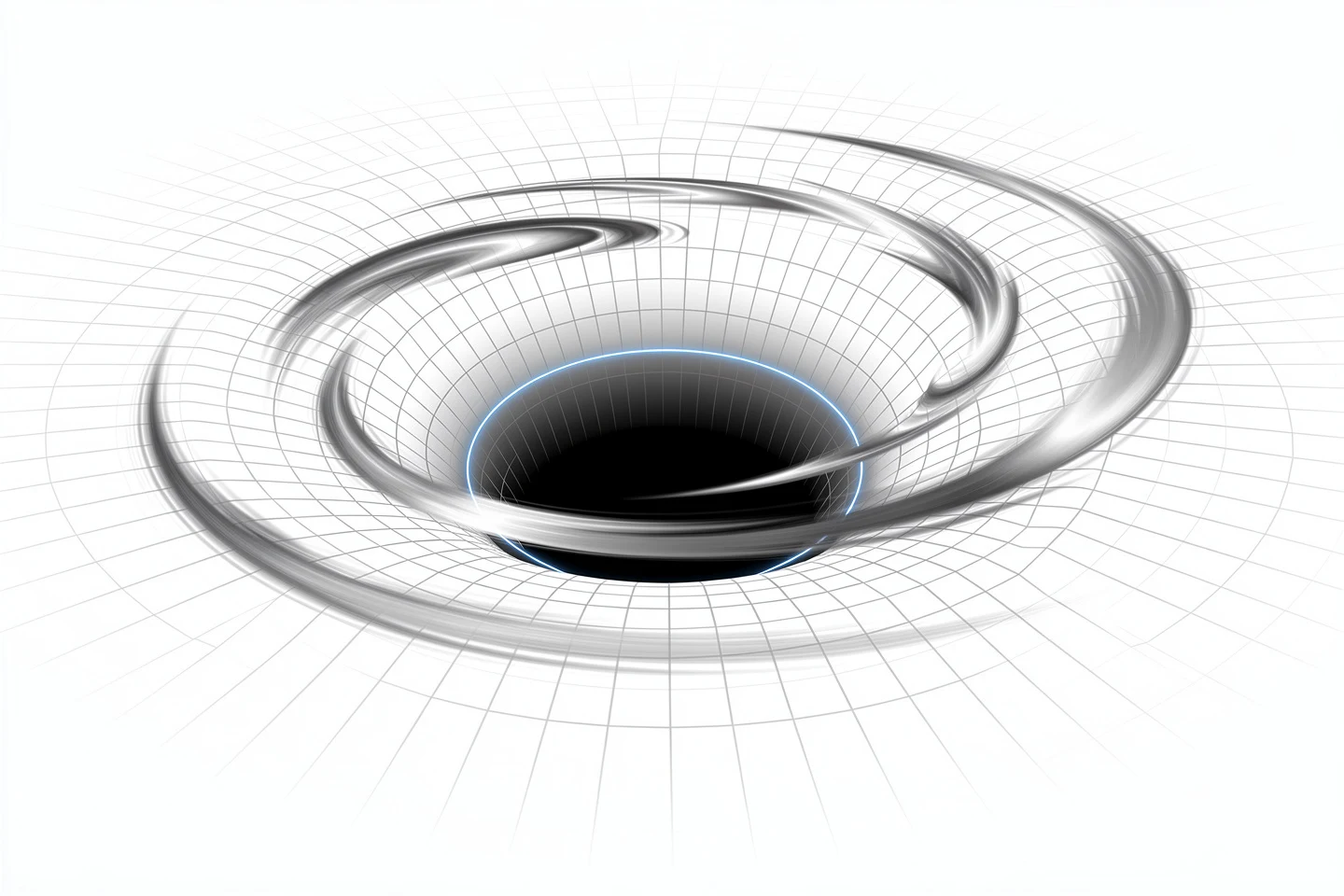
The universe as painted in Einstein’s textbooks is a smooth four-dimensional canvas. But string theory adds a frame of extra dimensions — invisible, yet tangible to gravity. Imagine our universe as a membrane that trembles under the pressure of hidden layers. When a black hole, a bottomless whirlpool of spacetime, appears on this canvas, the brane’s tension leaves a barely perceptible stroke on its shadow.
To discern this subtle signature, astrophysicists turned to numerical simulations — a digital portrait of a black hole. In their simulations, superheated plasma swirled in the accretion disk and, accelerated to nearly the speed of light, blazed at 230 GHz — the exact frequency the Event Horizon Telescope is tuned to. It turns the planet’s radio dishes into a giant interferometer, a virtual lens the size of Earth. The researchers took the Casadio–Fabbri–Mazzacurati metric — a generalization of Schwarzschild’s solution with a tidal parameter γ that encodes the brane’s influence. By varying γ, they generated synthetic images and compared them with the reference shadow of M87*. The difference is almost ghostly: no more than tenths of a percent.
These 0.1%—minuscule ripples — pose a challenge for next-generation instruments. Even ngEHT and BHEX, aiming for a resolution of five microarcseconds, teeter on the edge of sensitivity. Hunters of extra dimensions will set their sights on higher-order photon rings: those very light echoes where gravitational lensing acts as a natural magnifying glass, repeatedly amplifying the original signal. In the subtlest swirls of these rings, perhaps, lies the brane’s autograph. And the parameter γ serves as a dial, adjusting the transparency of the boundary: the stronger the tension, the more vividly the multidimensional landscape behind the canvas shines through.
But the theory leaves other clues. For instance, Hawking temperature, Hawking’s famous prediction of quantum evaporation of black holes, drops to zero in the brane model at a critical γ. The taut canvas seems to muffle the very quantum whisper, linking the microcosm and the fate of cosmic giants. Thus astronomy becomes a laboratory for quantum gravity. Perhaps we stand on the threshold when the texture of the invisible will emerge through the shadows of black holes, and the picture will prove immeasurably deeper than the sketch.
If the tidal parameter γ exceeds 4, a black hole becomes a traversable wormhole — a tunnel that, as in ‘Interstellar,’ could transport a traveler to another galaxy.
In the film ‘Interstellar,’ a wormhole serves as a portal to another galaxy; brane models show such tunnels are possible with strong brane tension.