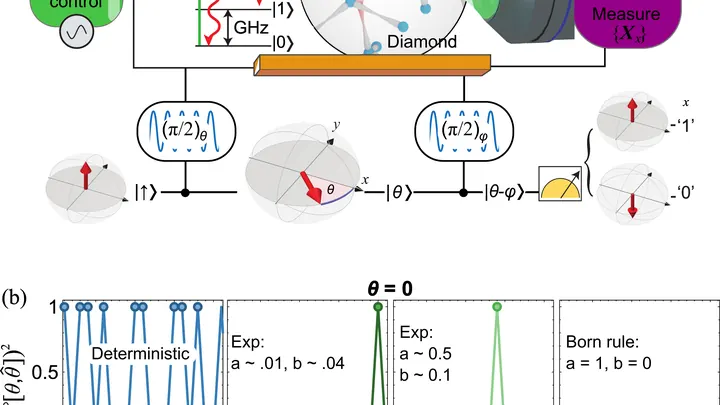
A black box is a system whose internal workings are hidden or opaque, providing outputs based on inputs without revealing the underlying mechanisms. In physics and engineering, black-box models are used to describe complex systems where detailed knowledge is impractical or impossible, focusing instead on observable input-output relationships. This concept is central to quantum cryptography, where devices must be trusted despite unknown internals, and to machine learning, where neural networks make decisions without explicit reasoning.
History
The term 'black box' was popularized in cybernetics and systems theory in the mid-20th century, though the concept of treating unknown systems as opaque is older, rooted in engineering and philosophy.
How it works
The black-box approach treats the system as a function: given an input, it produces an output, and the internal state remains inaccessible. In practice, one characterizes the system by probing it with various inputs and measuring outputs, building a model that predicts behavior without explaining causes. In quantum information, black-box assumptions are used to certify security without trusting the device's construction.
In practice
Black-box models are used in device-independent quantum cryptography, where security is guaranteed by observed correlations, and in artificial intelligence for image recognition and language processing.
Fun fact
In aviation, the 'black box' flight recorder is actually bright orange to be easily found after crashes, and it stores cockpit voice and flight data.
A drop of ink in a glass of water spreads in intricate swirls. Similarly, a quantum particle exchanging energy with its environment changes its state in a complex and entangled manner. Describing this dance between particle and environment has long baffled scientists.
If you clap your hands in an empty room, the echo will tell you about its size and shape. Every object (a chair, a book, a person) adds its own signature to this echo: sound reflects off it in a particular way. The authors of the paper have figured out how to completely rewrite this acoustic signature. They surrounded a region of space with a closed surface of microphones and loudspeakers.
Quantum computers in the cloud are like a post office: you send a letter, and someone else reads the address and the contents. In ordinary computing, the server sees your data and algorithm. Blind quantum computing is an unopenable envelope: the server does the work but doesn't know what it's doing.
You're trying a dish at a restaurant, but you haven't seen the menu. You ask the waiter questions — too salty? what spices?—and from the answers you try to guess what kind of chef prepared it.
In the kitchen, the sequence of actions is strictly dictated by the recipe: first chop, then fry, and nothing else. In quantum physics, the role of the recipe is played by causality — one event causes another, and they cannot be swapped. But in recent years, theorists have devised clever scenarios where the order of events seems to 'hang' in uncertainty.
A medicinal chemist is like a detective searching for the right compound among millions of suspects. Modern neural networks speed up the search but behave like a witness who says "it's him" and refuses to elaborate. In pharma, such secrecy is dangerous: a spurious correlation could send a toxic compound to the next stage of trials.
A coin toss seems random, but in reality, physics decides everything: the force of the throw, air resistance, the surface's elasticity. If you knew all the details, you could predict the outcome. True randomness lives deeper — in the quantum world.
Two people read the same book, but one turns the page first and then looks at the text, while the other does the opposite. It would seem the result is the same. But in the quantum world, the order of operations changes everything.
This work examines models that output sequences of symbols, like a ticket machine.
For years, an X-ray telescope in orbit recorded how binary systems shine, where an ordinary star orbits a black hole or a neutron star. Matter from the companion falls onto the compact object, heats up to millions of degrees, and emits X-rays.
The magnetic field you want to measure is like a melody played in a noisy hall. A quantum sensor is a microphone that can pick up the faintest notes, but it also hears more than just the music: rustles, creaks, the breathing of neighbors. All of that mixes into the signal and spoils the recording.