Horizontal gene transfer is a mechanism by which genetic information moves between organisms not through sexual reproduction or inheritance from parents. It is especially characteristic of prokaryotes (bacteria and archaea), but also influences the evolution of eukaryotes. Unlike slow mutations, horizontal transfer allows organisms to acquire ready-made genes, enabling rapid adaptation.
History
The concept emerged in the early 20th century. Frederick Griffith in 1928 described the transformation of pneumococci but did not know about DNA. Later, in 1944, the experiment by Avery, MacLeod, and McCarty proved that the transforming agent is DNA. The study of LGT intensified with the development of genomics, when it became clear that many bacteria have mosaic genomes with foreign regions.
How it works
At the molecular level, LGT includes several stages: exit of DNA from the donor (active secretion, cell lysis), existence of extracellular DNA (often in complex with proteins), penetration into the recipient (through membrane channels or receptors), and integration into the genome by homologous recombination or via site-specific recombinases. Many mobile genetic elements, such as transposons and integrons, play an intermediary role. The frequency and success of transfer depend on phylogenetic distance, ecological niche, and the restriction-modification systems of the host cell.
The human genome contains genes obtained from viruses and bacteria millions of years ago. About 8% of our DNA consists of remnants of ancient viruses that once integrated into the genome of our ancestors.
Two daughter cells receiving equal shares from the mother: that's the familiar picture of division. But what if one gets almost everything and the other just crumbs? Stochastic modeling shows that sometimes unequal division is more advantageous.
Each cell stores a protective reserve that helps it weather hardships. During division, this reserve is distributed between daughters.
A bacterium swims toward food. A chemical signal guides it forward, but with each movement the signal changes. A loop emerges: sensation, action, new sensation. The authors turned this loop into a measurable quantity.
Imagine a cookbook that gets rewritten from generation to generation. One day, the borscht recipe receives a secret ingredient from a pastry chef, and from that moment, the taste remembers not only ancestors but also a neighbor. In the Standard Model of evolution, genes behave the same way.
Neural networks trained on genetic text can 'read' the DNA of bacteria. Scientists took the powerful Evo 2 model and added a tiny, tunable sensor, a genetic probe, without touching the model itself. The probe picks up signals associated with dangerous genes, like antibiotic resistance.
A doctor doesn't make a diagnosis on a whim. They open a medical reference book and point to the article they're relying on. That's roughly how the new system KG-TRACE works.
The immune system is like a tireless editor, revising antibody drafts to make them stickier to viruses and bacteria. This process is called antibody maturation: random typos (mutations) arise in the genes, and natural selection keeps those that improve target capture.
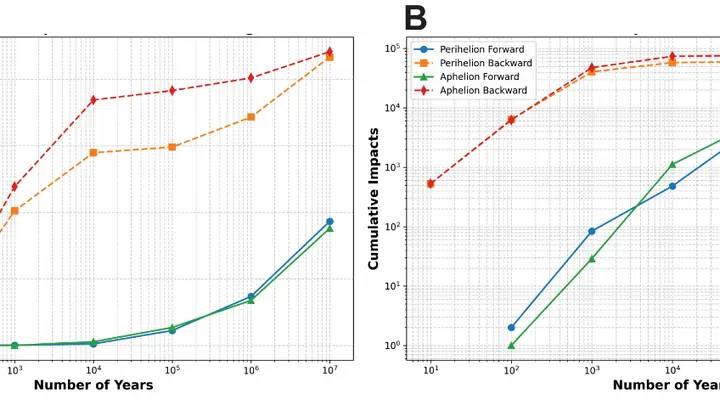
The idea of extraterrestrial origin of life has long excited minds. Fred Hoyle believed bacteria travel between stars. A new study tested a similar but closer route: from Mars to Earth. In ancient times, Mars had water, and asteroid impacts knocked rocks with microbes into space.
The microbial community in the gut is like an orchestra: what matters is not only the musicians but how they play together. When disease strikes, it's not just the lineup of microbes that changes: their interconnections shift too. Researchers built interaction networks of microbial genes in healthy and sick individuals.
A rock knocked off one planet by an asteroid impact hurtles through space and lands on another. If microbial spores are hiding inside, they might survive the cold, the radiation, and the rough landing. That's panspermia — the idea that life travels between worlds. But imagining such a journey is one thing; calculating every step is quite another.
In a thin film of water squeezed between two glass plates, bacteria live. Oxygen reaches them only through one wall, like air entering a room through a single window. When bacteria are few, they pay no attention to this: some stick to one wall, some to the other, and the picture is symmetric. But once they multiply, everything changes.
Bacteria don't just crawl across a surface: they collectively decide what shape their colony will take. Picture a crowd moving across a square: each person steps on their own, but together they form a flow. Bacteria are the same: each moves individually, but together they create patterns of branching trails.
Scientists took Enterobacter sp.
Two species of bacteria share a single Petri dish. Both eat the same food, and by all rules, one should outcompete the other. But in reality, they often live together for years. The secret lies in knowing when to leave.
Bacteria don't stay put. When a stranger appears nearby, they start moving faster.
Primary human cells, taken straight from the body, are the most honest material for studying diseases and testing drugs. But getting foreign genetic material into them is tricky: cells don't like intruders. Standard methods either damage the cell or work unevenly, especially when the sample is heterogeneous — which it almost always is.
The new platform tackles this with a vortex flow.