Hao Chen

6 articles · 30 co-authors · latest: 2026-08-08
0 citations · h-index 0 · 3 papersData: Semantic Scholar

We have retold 6 papers by this author. 1 of them with a full read. most often about: Fourier transform, transformers, Recurrent Neural Networks. 30 co-authors across our retellings.

Links in the knowledge graph
SFANet: a translator that hears both words and intonation
A translator at negotiations picks up not only the words but also the tone in which they are spoken. If they focus only on vocabulary, they might miss sarcasm or fatigue in the voice. If only on intonation, they could mistranslate the details of the contract.

Machine Learning2026-02-011 minarXiv:2602.01045express
Overlapping Features Speed Up Learning
A neural network can be compared to a dormitory where each resident gets their own room. Usually, each feature in the data occupies a separate neuron, and learning proceeds sequentially: first one feature, then another. This is slow and depends on which data you happen to get. But if you allow several features to share a room, overlap them, the picture changes.
Materials2026-03-221 minarXiv:2603.21207express
How a Seven-Metal Alloy Develops a Memory
A seven-metal alloy is like a team where every player is pulling the blanket their own way. Atoms of iron, cobalt, nickel, aluminum, titanium, tantalum, and vanadium can either fall into a strict pattern or scatter into random positions. This determines whether the material will be as strong as steel or as light as aluminum.
Materials2026-05-302 minarXiv:2606.00546express
Hidden Rules of Heat in Spiral Crystals
A tellurium crystal resembles a tiny spiral staircase: its atoms are twisted into a helix. When heat runs through such a crystal, it is carried not by electrons but by sound waves — vibrations of the lattice itself. These waves don't just push back and forth; they also rotate around their axis like a spinning top.
Superconductivity2026-06-071 minarXiv:2606.08643express
Magnetism and Superconductivity: An Unexpected Alliance
Using laser spectroscopy — a method akin to listening to the echo from a crystal — physicists examined the layered material. They found regions where electrons move freely (Fermi pockets) and noticed that each such region behaves in its own way.
Computer Vision2026-08-081 minarXiv:2608.08319express
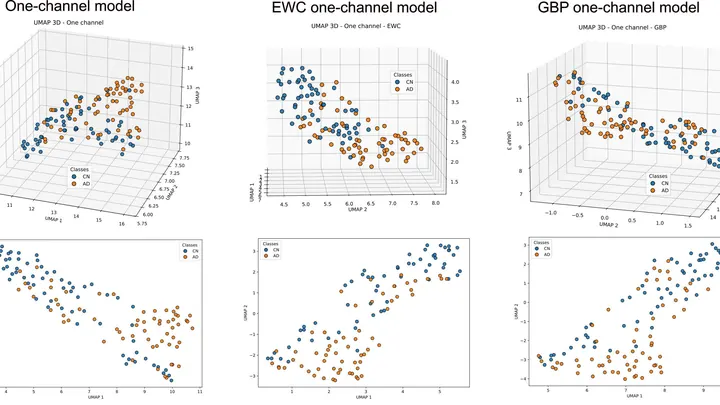
Brain MRI Learns Not to Forget
A doctor spends years learning to recognize diseases from brain scans. First, they excel at spotting signs of aging, then they master tumors, and suddenly they start confusing what they knew before. Many neural networks behave much the same way: new knowledge overwrites the old.