eess.AS eess.AS

23 articles

articles

eess.AS2026-02-211 minarXiv:2602.18899express
How Machines Learn to Tell Speech Sounds Apart
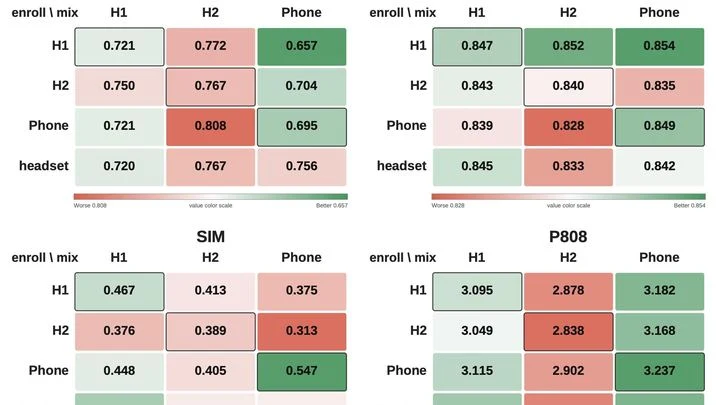
A teacher in class explains the difference between 'dog' and 'tog': put your hand on your throat and feel the vibration. A speech recognition machine does much the same thing, except inside it's not a throat but long lists of numbers. It turns out these numbers can be sorted onto shelves, like alphabet blocks in a child's room.

cs.SD2026-03-071 minarXiv:2603.07215express
A Stethoscope That Listens to Your Gut
The gut talks to the doctor, but very quietly. Gurgles and rumbles last fractions of a second and easily get lost among the sounds of the lungs and heart. A stethoscope catches only a fraction, so the diagnosis depends on the experience and hearing of the individual doctor.
Applied Physics2026-06-072 minarXiv:2606.08524express
Acoustic Masking: Sound Substitutes Reality
If you clap your hands in an empty room, the echo will tell you about its size and shape. Every object (a chair, a book, a person) adds its own signature to this echo: sound reflects off it in a particular way. The authors of the paper have figured out how to completely rewrite this acoustic signature. They surrounded a region of space with a closed surface of microphones and loudspeakers.
eess.AS2026-07-131 minarXiv:2607.11059express
Sound Sphere: How Microphones Stopped Making Mistakes
A typical cardioid microphone, like an ear, hears best from the front, but its readings blur when sound comes from the side. The solution is to gather several such 'ears' into a sphere. You get a sound ball that picks up signals from all directions. By comparing measurements, the system breaks down errors into simple components — much like spectroscopy splits light.
Computer Vision2026-07-131 minarXiv:2607.11120express
Doubt is Given Away by Silence: AI Reads the Pauses
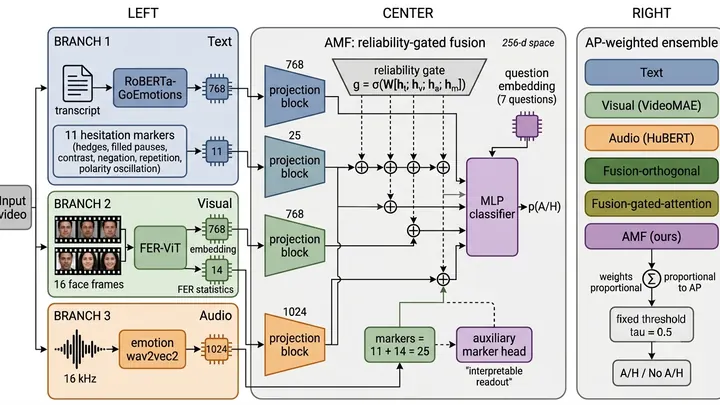
A new system analyzes a short interview to recognize human doubt by combining text, voice, and facial expressions. But the main key to uncertainty turned out to be the dark matter of speech — pauses and filler words that standard speech systems erase like a black hole.
eess.AS2026-07-131 minarXiv:2607.11157express
Clean Sound: Why Volume Matters More Than Phase
Cleaning speech from noise is like tuning an old TV: twist the contrast knob too far, and faces become unnatural. Researchers separately adjusted the 'volume' and 'time shift' for each frequency of sound, as if splitting it into a rainbow — a method known as spectroscopy. It turned out the key knob is volume, not phase synchronization.
Language Amnesia in Neural Networks: A Solution Exists!
A large neural network like Whisper masters hundreds of languages and resembles the standard model of the universe: everything is balanced. But training on a rare language disrupts this equilibrium — it turns into a black hole, pulling in all training resources. The network starts forgetting the other languages.
eess.AS2026-07-131 minarXiv:2607.11260express
Sound Concentrate: Transmitting Speech Without Redundant Bits
The standard way of digitizing speech: taking volume readings thousands of times per second. It's like tasting broth with a teaspoon: each sip is watery, with almost no detail. The data stream swells, though the substance is minuscule. Scientists proposed first "simmering down" the audio signal.
Machine Learning2026-07-142 minarXiv:2607.12417express
A Neural Network That Perceives Phase: From Hearing to Quantum Computing
A sound signal is conveniently represented as a complex number: its modulus (amplitude) reflects loudness, while its argument (phase) indicates the wave's position in time: its instantaneous shift.
eess.AS2026-07-141 minarXiv:2607.12496express
ZipL-Dialog: Speech Synthesis Becomes 11 Times More Efficient
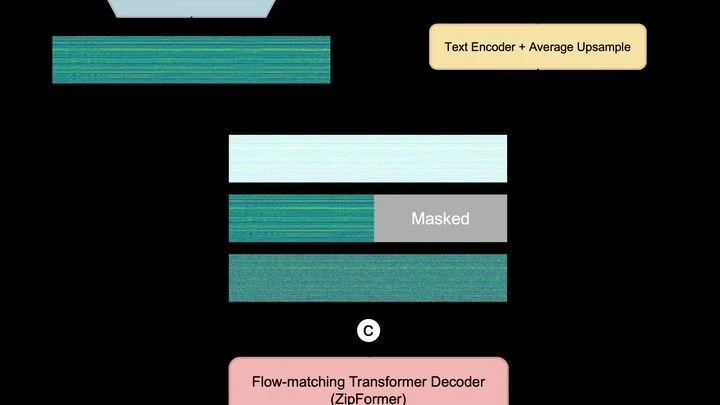
Narrating a long text, like an audiobook, used to require the computer to keep a detailed picture of every split second of sound in mind, as if for an hour-long conversation you had to draw a millimeter-accurate map of the entire route. These 'maps' were enormous, and even powerful machines choked, assembling speech piece by piece.
eess.AS2026-07-141 minarXiv:2607.12529express
Hearing Aids Learn to Taste Sound
Traditional hearing aids resemble a chef who cooks from a recipe blindly. They analyze the sound chaos from the microphone and amplify speech based on it. In a noisy café, this approach often errs. The new system behaves like an experienced cook: first processes the signal, then samples the result.
eess.AS2026-07-141 minarXiv:2607.12647express
How a Computer Learns to Hear Everyone in a Noisy Room
In a noisy room, a person picks out a desired voice thanks to two ears capturing the difference in sound arrival. A computer with several microphones does the same: it gets spatial cues — where each voice is coming from. Previously, these cues were used to focus on one direction, like a flashlight beam.
eess.AS2026-07-142 minarXiv:2607.12703express
Audio Diarization: How an Algorithm Catches Any Sound Event Without Prior Knowledge
Human hearing is wired so that the brain prioritizes familiar patterns — a friend's voice, the patter of rain, a car horn. But a new system works on a different principle: it registers any sound burst, even one never encountered before.
eess.AS2026-07-141 minarXiv:2607.12807express
How Headphones Learned to See the Source of Noise
Active noise cancellation creates 'anti-sound' to neutralize noise. But ordinary systems are blind: they don't know where the sound is coming from. In rooms with an echo, it's like boxing with a blindfold on — you're canceling blindly.
eess.AS2026-07-141 minarXiv:2607.13330express
How a Sound-Generating Neural Network Slimmed Down
A neural network that generates sounds from text is like a kitchen where dozens of chefs prepare each 'dish.' Many just get in the way — sending false signals and wasting resources.
eess.AS2026-07-151 minarXiv:2607.13408express
How AI Stopped Mixing Up Sounds in a Script
Models that turn text into audio are good at recreating single sounds, but get confused when the script has several in a row. For example, the script might call for a ring, then footsteps, then a door slam. The generator might shuffle events, so the listener hears footsteps before the ring.
Computer Vision2026-07-151 minarXiv:2607.13471express
The Musical Horizon: How a Song Gains Dimension
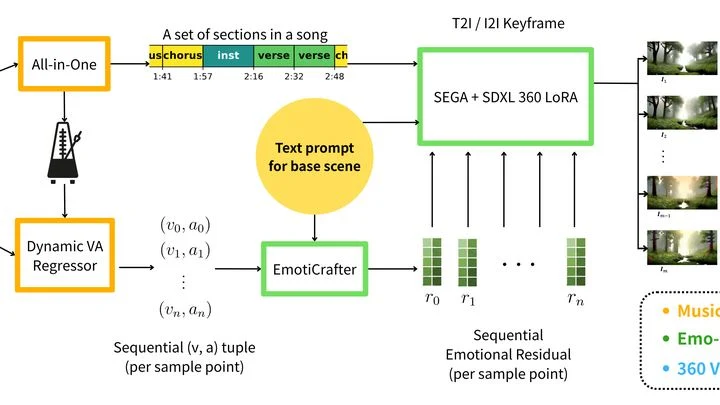
A conductor holds not a baton but a brush, and each stroke gives birth to color and form. New technology works the same way: it transforms a song's mood into a panoramic video that surrounds the listener. First, the algorithm decomposes the track into emotions, similar to how light is analyzed by spectrum.
cs.SD2026-07-151 minarXiv:2607.13477express
AI Judges Listen Not with Ears, but with Labels
Automatic speech judges are algorithms that evaluate pronunciation and emotions. However, they often work like a food critic who delivers a verdict after reading the menu but not tasting the dish.
Computer Evaluated Pronunciation Without Any Hints
Learning a foreign language is like tuning a musical instrument. The new technology works like a smart tuner: it takes your recording and a native speaker's reference speech, stretches or compresses them in time (like adjusting a string) to align them precisely, and evaluates three key parameters: clarity of sounds, rhythmic precision, and intonation.
eess.AS2026-07-151 minarXiv:2607.14310express
Cooking a Living Voice: The Russian Dataset That Teaches Assistants to Feel
Voice assistants often sound like a chef reading a recipe from a card with zero appetite. The new Russian dialogue archive, “Dialogues,” flips the script: three studio actors, like master chefs, blended 20 hours of live conversation with twelve emotional “spices.” Each line got tagged for style and emotion — creating a complete book of flavors.
eess.AS2026-07-161 minarXiv:2607.14749express
WanSong: Songs from Noise in One Step
WanSong creates music like a sculptor carving a statue: it starts with noise, akin to the roar of a waterfall, and gradually chisels away the excess until pure notes and voices emerge. This method, diffusion, turns chaos into order, like ink dispersing in water, only in reverse. The model doesn’t stitch sounds together from fragments; it births a complete song in one go.
eess.AS2026-07-161 minarXiv:2607.15198express
How to fish out a friend's voice from a noisy conversation
A human effortlessly picks out the desired voice from the clamor of a party. For a computer, the same task is still at the edge of its abilities. Previous programs trained on sterile recordings, free of echo or the clinking of appliances.
eess.AS2026-07-161 minarXiv:2607.15243express
The Illusion of Accuracy: How AI Testing in Acoustics Misleads
An AI predicting room acoustics is like a student taking an exam with a cheat sheet. If the test points are the same as the training ones, the model simply memorizes the acoustic 'fingerprint' of each position — like a student recognizing a question by the dog-eared corner.