Surfer Photons: How a Wave Guides a Particle ✛
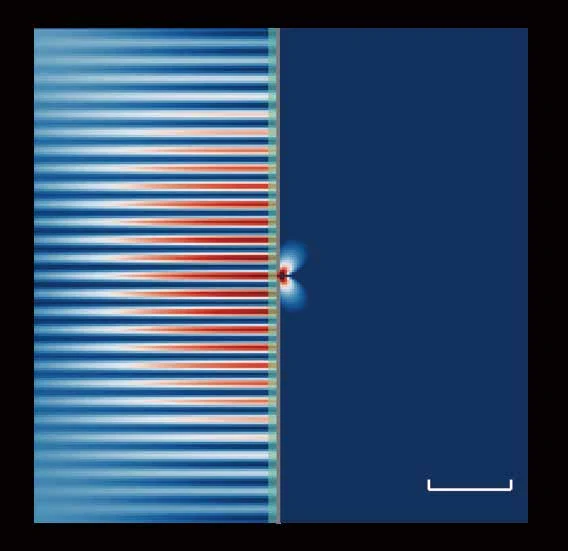
A photon can be compared to a surfer, and water to a guiding wave. This picture was proposed by Louis de Broglie and David Bohm: a particle always has a precise position, and the wave determines its trajectory. Unlike the standard approach, where probability reigns, here motion is predetermined by nonlocal connections. In the double-slit experiment, single photons moving at the speed of light pass through one slit, but their path is guided by a wave passing through both. Using ultra-precise measurements that don't destroy the quantum state, physicists reconstructed these trajectories. In the dark fringes, where waves cancel each other out, the photon behaved oddly: its mass became imaginary — like that of a hypothetical tachyon capable of outpacing light. This effect confirms that Bohmian mechanics agrees with relativity: energy is conserved, but particle number is not. So, in interference zones, the surfer photon momentarily turns into a superluminal sprinter, challenging conventional notions and even the standard model.
De Broglie proposed the pilot-wave idea in 1924, but after criticism at the Solvay Congress, he nearly abandoned it. Bohm revived the theory in the 1950s, adding nonlocality, and today it is receiving experimental confirmation.
Tachyons often appear in science fiction — for example, in the series 'Star Trek' they are used for faster-than-light communication. Now it turns out that something similar can happen with real photons under certain conditions.