equation

de Broglie formula

The de Broglie wavelength is the wavelength associated with a particle, given by λ = h/p.
10 related articles · 6 formulas · 1 who worked here

Description

Everything around us — not just light, but also matter particles, such as electrons — behaves like waves! Every moving particle has its own wavelength, calculated using the de Broglie formula. For large objects, this wavelength is vanishingly small, so we don't see a ball bending around corners. But for tiny particles, it is large enough to exhibit wave properties.

History

Louis de Broglie in 1924 suggested the universality of wave-particle duality, extrapolating the results of Planck and Einstein for light to all particles. In 1927, Clinton Davisson and Lester Germer experimentally discovered diffraction of slow electrons on nickel, and George Thomson in thin metal films. These experiments confirmed the hypothesis, and Erwin Schrödinger soon developed the mathematical apparatus to describe de Broglie waves.

How it works

The de Broglie formula is used to calculate diffraction gratings in electron and neutron optics, estimate quantum effects (tunneling, interference) during microparticle motion, and in scattering theories. In the macroscopic limit (m large), λ becomes negligibly small, consistent with classical mechanics. For ultra-relativistic particles, a relativistic expression for momentum is required.

Fun fact

If you throw a baseball, its de Broglie wavelength would be billions of times smaller than an atomic nucleus — no diffraction would be noticeable. But for a slowly moving electron, it can be the size of a molecule!

Concept graph →

Formulas

$$\lambda = \frac{h}{p}$$
Wavelength of a particle equals Planck's constant divided by momentum.
What is in the formula
\lambdavariablede Broglie wavelength of the particle — wavelength metre
pvariablemomentum of the particle — momentum kilogram metre per second
hconstantPlanck constant, the quantum of action — planck constant = 6.62607015e-34 joule second
λ=\frac{h}{p} · 2607.03465
\langle|{q}|^2\rangle\propto(n_e/ν) · 2607.08822
λ=\frac{h}{p}=\frac{h}{\sqrt{2me}} · 2607.10388
λ=\frac{h}{m_gc} · 2607.11764
$$d = \frac{0.61\lambda}{\sin\alpha}$$
Minimum resolvable distance depends on wavelength and aperture angle.
What is in the formula
dvariableMinimum resolvable distance between two point sources — distance metre
λvariableWavelength of the light — wavelength metre
αvariableHalf-angle of the aperture (angular radius) — angle radian
0.61constantConstant arising from the diffraction pattern of a circular aperture — airy disk factor = 0.61
d=\frac{0.61λ}{\sinα} · 2607.10388
$$\Box \varphi = -4\pi \rho$$
The wave equation for a scalar field with a source term.
What is in the formula
\varphivariablescalar field — scalar field
\rhovariablesource density — source density per cubic metre
\BoxoperatorLorentz-invariant second-order differential operator — d alembertian operator
\box\varphi^{(1)}=-4πdμ\int\frac{δ^{(4)}(x-y_p(τ))}{\sqrt{-g}}dτ · 2607.09310
$$\hat{H} \Psi = 0$$
The Hamiltonian constraint annihilates the wave function of the universe.
What is in the formula
ΨvariableWave function of the universe — wave function
ĤoperatorActs on the wave function to give total energy including gravitational and matter contributions — hamiltonian operator
\hat{h}\psi=0 · 2603.06481
\hat{h}|\psi\rangle=0 · 2605.06093v1
$$P = |\psi|^2$$
Probability equals the square of the wavefunction amplitude.
What is in the formula
Pvariableprobability density — probability density per metre cubed
ψvariablewavefunction — wave function per metre to the three halves
p=|ψ|^2 · 2604.07418
p=|ψ|^2 · 2605.16148
p(x)=|\langlex|ψ\rangle|^2 · 2606.28199
$$\Omega h^{3/2}$$
Combination of density parameter and Hubble constant.
What is in the formula
\OmegavariableDensity parameter (total energy density relative to critical) — density parameter
hvariableDimensionless Hubble constant (H0/100 km/s/Mpc) — hubble constant dimensionless
ω_mh^{3/2} · 2607.24694v1

Related articles · 24

Optics2026-08-012 minarXiv:2608.00618express
An Event Takes Shape
In the familiar picture of the world, an event is a point on the map of spacetime: 'here and now,' with no size or internal structure.
HEP Phenomenology2026-07-271 minarXiv:2607.24930express
Gravitational Waves Turn into Light
A thrown stone sends ripples across water. A gravitational wave is the same kind of ripple, but in spacetime. It is produced, for example, by the merger of two black holes. In classical physics, this ripple is eternal: once created, it travels through the Universe without fading.
Cosmology2026-07-222 minarXiv:2607.20614
Nuclear Theory2026-07-172 minarXiv:2607.15756express
The Shock Wave That Breaks Itself
A shock wave is like a steep wall of water rolling down a calm river. In physics, such waves arise when matter is compressed faster than the signal about that compression can spread sideways. In ordinary water or air, things are more or less clear.
Materials2026-07-032 minarXiv:2607.03465
Freezing Chaos: How Cubic Ice Builds Symmetry
In water cooled to –40°C, a paradoxical pause sets in: perfect hexagonal ice is in no hurry to form. Instead, a disordered structure with interspersed cubic layers emerges — a real cradle for future symmetry, brimming with disorder yet already charged with hidden architecture.
math.GM2026-06-292 minarXiv:2607.01265
λ∞: The Tuning Fork for Prime Numbers
Strike a tuning fork. The frequency is 440 Hz. That's the note A — the standard of sound. In the world of numbers, there's a standard too. It's tuned not to sound, but to prime numbers. Though their distribution seems random, it obeys strict laws. All primes resonate together. There's just one value: λ∞ ≈ 0,674036.
Quantum Physics2026-06-212 minarXiv:2606.22292express
Neutron Spiral Splits Two Entangled Quantities
A stone falls into water, and ripples spread in all directions. Throw a handful of stones at once, and the ripples overlap: you can no longer tell which ripple came from which stone. A neutron beam hitting a detector looks much the same: a bright spot blurred by many causes.
Strongly Correlated2026-06-192 minarXiv:2606.21648express
Quantum Geometry Lurks in the Current Jump
Toss a handful of phosphorus into silicon, and at a certain impurity concentration the material suddenly starts conducting electricity. This is a metal-insulator phase transition, and it happens abruptly. But what exactly changes in the electron wave functions when an insulator becomes a metal?
General Relativity2026-05-271 minarXiv:2605.28932express
Invisible Waves Make a Plate Ring
Gravitational waves are not vibrations of matter, but tremors of spacetime itself, predicted by Albert Einstein. They travel at the speed of light and pass through objects, stretching and squeezing them.
Optics2026-05-152 minarXiv:2605.15632express
Light Flipped in Time
A pebble tossed into a pond sends ripples spreading in all directions. Now imagine the pond itself suddenly turning into jelly — instantly, faster than the wave can complete a single crest. Some ripples would keep spreading but change their spacing, while others would unexpectedly turn around and run back toward the point of impact, as if time were flowing backward for them.
Materials2026-05-032 minarXiv:2605.01678express
How a Crystal Twists Heat
A hot spoon in a cup of tea — heat runs along the metal from the hot end to the cold one. Textbooks describe this process as atoms jiggling and passing on their jolts to each other. But atoms don't just jiggle: they also spin, like tiny tops. Until now, physicists had no common language to describe both motions at once. The authors of the work built such a language.
Materials2026-04-261 minarXiv:2604.23491express
Plutonium That Heals Itself
Plutonium is a metal with attitude. One form shrinks when cooled, another swells. But at room temperature, the alloy behaves strangely: the ruler says one thing, X-rays say another. The ruler shows the sample barely grows, while X-rays see atoms in the crystal lattice moving further apart.
General Relativity2026-04-192 minarXiv:2604.17524express
A Beam of Light as a Ruler for Gravity
In a dark room, a flashlight beam picks out only a narrow strip from the gloom. In much the same way, Roger Penrose proposed looking at gravitational waves — ripples in spacetime traveling at the speed of light.
Mesoscale2026-04-181 minarXiv:2604.16837express
One Strand, One Wave
An ordinary crystal is like an apartment building: electrons move through shared hallways and staircases, influencing each other through the walls. Now, imagine removing all the walls, leaving just a single line of apartments. How would the residents behave? Hydrogen has nothing to do with it, but the collective behavior of electrons takes center stage.
Cosmology2026-04-162 minarXiv:2604.15313express
Ripples of Space Through Invisible Lenses
A pebble drops into a pond, and neat circles spread across the water. But the pond's bottom is strewn with invisible glass shards: each one slightly delays the wave, scatters it here, or alters its pace. That's roughly how gravitational waves, the trembling of space itself, pass through distant galaxies and dark clumps of matter.
Atomic Physics2026-03-181 minarXiv:2603.17329express
Electrons Tell When They Were Born
When light knocks an electron out of an atom, it flies off like a ball thrown into a crowd. Scientists have long wanted to know the exact moment each electron leaves the atom, but direct measurement disturbed the very process. Now physicists have proposed a method that uses a second light pulse to 'photograph' the moment of the electron's birth.
Quantum Physics2026-03-062 minarXiv:2603.05795express
Quantum Computer Peers into the Heart of a Water Molecule
A water molecule resembles a tiny dumbbell: two hydrogen atoms attach to an oxygen atom at an angle. This dumbbell doesn't stay still: it stretches, compresses, and rotates. Each such motion has its own energy, like steps on a ladder.
Optics2026-03-021 minarXiv:2603.02362express
Light as Water: Seeing the Electric Field of a Pulse
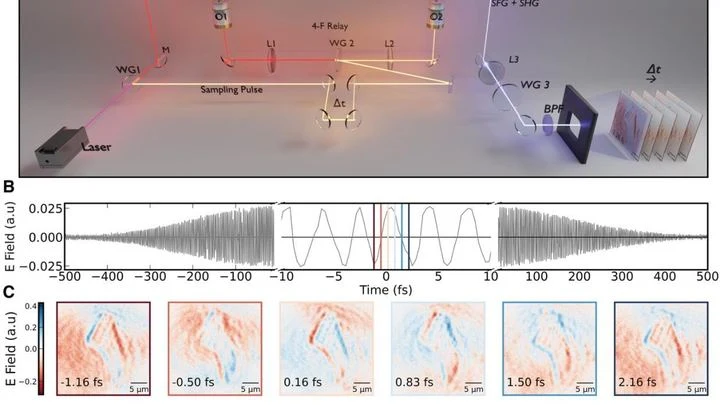
Light is not just a beam but a wave with an electric field that changes at a speed unimaginable to ordinary clocks. Until now, this field could only be measured at a single point, like taking temperature with a single thermometer. Now researchers have created a method that shows the entire field at once, like a thermal imager showing a heat map.
Stellar2026-02-182 minarXiv:2602.16519express
Dust, Light, and Invisible Lines
In the dark cloud L43, where stars are born, dust grains twirl like tiny compasses. Light from a young star pushes them, while the magnetic field lines them up in a specific direction. When a grain is turned sideways to us, its heat reaches us polarized, like light passing through a narrow slit.
Classical Physics2026-01-231 minarXiv:2601.17098express
How Waves Tell Us About the World
A stone drops into a pond — ripples spread across the water. Do short waves outrun long ones? No, in deep water it's the opposite: long waves overtake short ones. In metal, sound of one pitch travels at one speed, another pitch at another.
Fluid Dynamics2026-01-042 minarXiv:2601.01476express
Invisible Waves in the Ocean's Depths
The ocean is like a layered cake: warm, light water on top, cold, heavy water below. Between the layers, at the interface, invisible waves roam. They don't lift crests like a storm; instead, they slowly rock the entire water column, as if someone were shaking a giant aquarium from within.
Quantum Decay Tail: How the Memory of Birth Depends on Color
A quantum system, once born, does not forget it. Even after dozens of lifetimes, a trace of the initial state remains in its decay: a slowly decreasing power-law tail. For two fluorescent dyes, erythrosine B and eosin Y, this tail has been observed for the first time in two spectral channels simultaneously.
Pilot Photons: Relativistic Bohmian Mechanics Seen Directly
A single photon passes through two slits and leaves an interference pattern on a screen. Quantum mechanics describes this process with a wave function, but what happens to the particle itself?
Materials2025-06-023 minarXiv:2506.01292
Time Reversed: What the Schrödinger Equation Misses
Two translators listen to the same symphony. One hears only the fundamental tone: a clean, predictable melody. The other catches the overtones that color every note.