Pilot Photons: Relativistic Bohmian Mechanics Seen Directly ✛
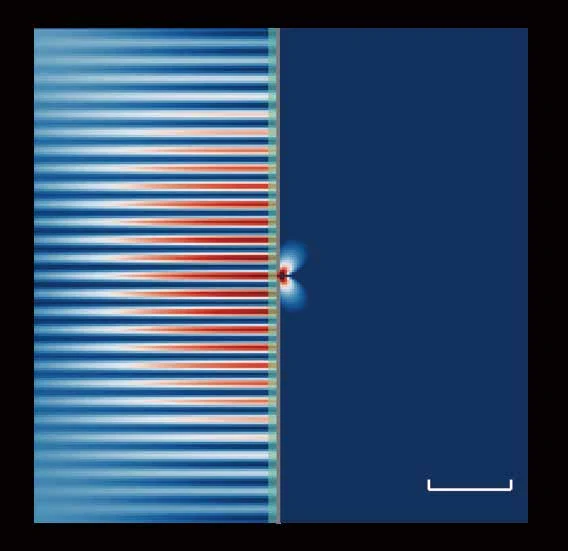
A single photon passes through two slits and leaves an interference pattern on a screen. Quantum mechanics describes this process with a wave function, but what happens to the particle itself? Nearly a century ago, Louis de Broglie proposed the idea of a pilot wave, and David Bohm developed it into a rigorous theory where each particle has a trajectory. However, the relativistic generalization of this theory long remained a mathematical construct. Now, a team of researchers has for the first time traced the trajectories of relativistic photons in a double-slit interferometer using weak measurements.
In the experiment, single photons from an InAs/GaAs quantum dot were directed into a double-slit interferometer. The weak measurement was performed with a birefringent lithium niobate plate 500 nm thick, with a slit 1 μm wide, which scanned the interference pattern in steps of 100 nm along the x-axis and 400 nm along the z-axis. The photon's polarization served as a pointer: its small rotation φ depended linearly on momentum k and energy ω. For each point (x,z), six measurements were taken with different plate orientations, and the weak values ⟨$k_{xw}$⟩, ⟨$k_{zw}$⟩, and ⟨$ω_w$⟩ were extracted by least squares. Then, using the formula v = ⟨$k_w$⟩/⟨$H_w$⟩, the velocity field was computed, and trajectories were constructed using a fourth-order Runge–Kutta method.
The results were striking. The reconstructed average photon trajectories matched theoretical simulations. In regions of destructive interference, the trajectories bent, corresponding to superluminal speeds. The effective squared mass density m̄²_eff took negative values precisely in those zones, reaching magnitudes less than −(ℏω₀)². In constructive regions, it remained positive and did not exceed (ℏω₀)². A check of the Klein–Gordon continuity equation gave a standard deviation of 186.6±4.2 THz, whereas for the Schrödinger equation the deviation was 362.0±3.3 THz, almost twice as large. This confirms that in the relativistic regime, energy is conserved rather than particle number.
Why does this matter? Relativistic Bohmian mechanics existed only as a theoretical construct without experimental confirmation. Now, for the first time, relativistic trajectories of single photons have been directly measured, negative effective mass has been found in zones of destructive interference, and it has been shown that energy is conserved rather than particle number. This strengthens the status of Bohmian mechanics as a full relativistic interpretation, not just a nonrelativistic model. The result also shows that weak measurements can serve as a bridge between quantum field theory and trajectory descriptions.
The method can be extended to correlated photon pairs, allowing investigation of nonlocal aspects of relativistic Bohmian mechanics. Further extension to fermions via the Dirac equation would open up new effects related to spin. It may also be possible to test predictions for interacting fields, where particle trajectories could exhibit even more exotic behavior. For now, this is pure knowledge, but it could be useful for developing new methods of visualizing quantum processes and for testing interpretations of quantum mechanics.
The experiment used a slit 1 micrometer wide, about 50 times thinner than a human hair. The scan took 8326 steps, with photons accumulating for 3 seconds at each step.
The idea of particles moving along trajectories set by a pilot wave echoes the image of the 'navigators' in Frank Herbert's novel 'Dune', who chart a course through spacetime.