Pilot Photons: Relativistic Bohmian Mechanics Directly Observed ✛
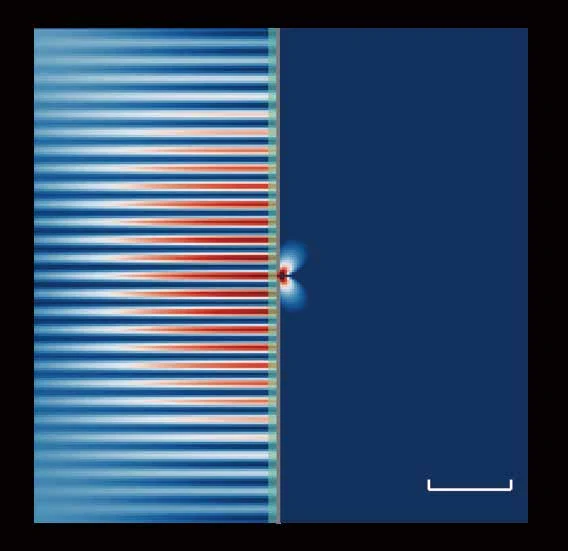
Context
For nearly a century, Bohmian mechanics remained nonrelativistic: its quantum potential implied instantaneous action at a distance, contradicting special relativity. Attempts to extend the theory to the relativistic case faced theoretical difficulties and a lack of experimental confirmation. This work stands apart: neighboring studies deal with quantum gravity, black holes, and open systems, but no one had tested relativistic effects within Bohmian mechanics itself. The authors have now carried out the first direct experiment demonstrating these effects.
Methods
Single photons from an InAs/GaAs quantum dot were directed into a double-slit interferometer. The weak measurement was performed using a birefringent lithium niobate plate 500 nm thick with a slit 1 μm wide, which scanned the interference pattern in steps of 100 nm along the x-axis and 400 nm along the z-axis. The photon's polarization served as a pointer: its small rotation φ depended linearly on momentum k and energy ω. For each point (x,z), six measurements were taken with different plate orientations, and the weak values ⟨$k_{xw}$⟩, ⟨$k_{zw}$⟩, and ⟨$ω_w$⟩ were extracted by least squares. The velocity field was then computed via v = ⟨$k_w$⟩/⟨$H_w$⟩, and trajectories were constructed using a fourth-order Runge–Kutta method.
Results
The reconstructed average photon trajectories matched theoretical simulations. In regions of destructive interference, the trajectories bent, corresponding to superluminal speeds. The effective mass-squared density m̄²_eff took negative values precisely in these zones, reaching magnitudes below −(ℏω₀)². In constructive regions, it remained positive and did not exceed (ℏω₀)². A test of the Klein–Gordon continuity equation gave a standard deviation of 186.6±4.2 THz, whereas for the Schrödinger equation the deviation was 362.0±3.3 THz, almost twice as large. This confirms that in the relativistic regime, energy is conserved rather than particle number.
Implications
This work provides the first experimental test of relativistic Bohmian mechanics based on weak values. Unlike neighboring theoretical studies, it yields direct data on trajectories, negative mass, and violation of particle-number conservation. This strengthens the status of Bohmian mechanics as a full relativistic interpretation, not just a nonrelativistic model. The result also shows that weak measurements can serve as a bridge between quantum field theory and trajectory descriptions.
Future development
The method can be extended to correlated photon pairs, allowing investigation of nonlocal aspects of relativistic Bohmian mechanics. Further extension to fermions via the Dirac equation would open up new effects related to spin. It may also be possible to test predictions for interacting fields, where particle trajectories could exhibit even more exotic behavior.
Impact
The results will influence interpretive debates in the foundations of quantum mechanics and the development of weak measurement techniques in quantum optics.
Next steps
Plans include an experiment with entangled photons to test relativistic nonlocality. The approach may also be adapted to massive particles.
Key open problems
This work directly addresses the problem of quantum measurement and the question of which interpretation of quantum mechanics is closer to reality. It also clarifies how to reconcile deterministic trajectories with relativistic causality.
The knowledge machine's view
This section is addressed to the author of the paper and their colleagues. Neighbouring works were found by meaning-based search across our archive, not by word overlap. We do not review: we show the field around the work.
What the work does
The study reconstructs the average trajectories of individual photons in a double-slit interferometer using weak measurements of momentum and energy. The effective quadratic mass density was computed and found to be negative in regions of destructive interference, indicating superluminal velocities. A check of the continuity equation showed that energy is conserved but particle number is not, which aligns with relativistic Bohmian mechanics.
Where its strength is
For the first time, relativistic effects of Bohmian mechanics have been experimentally demonstrated: negative effective mass and violation of particle number conservation. Direct trajectory data were obtained that agree with theoretical predictions, strengthening the theory's status as a relativistic interpretation.
Where it could go next
- One could consider the connection with pair production in strong fields: in relativistic Bohmian mechanics, negative mass density may be related to particle creation and annihilation processes. In our archive, there is a nearby paper on the production of heavy particles by light, which discusses similar effects.based on: Light Gives Birth to Heavy Particles arXiv:2601.21574
- It would be interesting to extend the weak measurement technique to multiphoton states or entangled photons, to test how nonlocality manifests in relativistic trajectories. The archive contains a paper on a quantum dot that entangles light, which could be useful for such experiments.based on: A Quantum Dot That Entangles Light arXiv:2603.25341
- One might investigate the influence of external fields on relativistic Bohmian trajectories, for example, a magnetic field that imparts an effective magnetic moment to the photon. The archive has a paper on a photon in a magnetic field that could suggest new experimental configurations.based on: A Photon in a Magnetic Field: How Light Acquires a Magnetic Moment arXiv:2603.07010
Worth trying
- Test whether negative mass density arises in the presence of a strong electromagnetic field, where pair production becomes significant.
- Use entangled photons to test whether causality is preserved in relativistic Bohmian mechanics under nonlocal correlations.
- Adapt the weak measurement scheme for photons in a magnetic field to study how trajectories change when an effective magnetic moment appears.
Why this may matter
Experimental confirmation of relativistic Bohmian mechanics opens the way for its application in quantum field theory and possibly quantum gravity. This could provide a new tool for visualizing quantum processes and testing fundamental principles such as causality and probability conservation.
Nearby works in our archive
- Light Gives Birth to Heavy Particlessimilarity 0.52
- Spacetime Bricks: How Tensor Networks Catch an Elusive Field Theorysimilarity 0.52
- Four Photons in One Spotsimilarity 0.52
- A Quantum Dot That Entangles Lightsimilarity 0.50
- A Photon in a Magnetic Field: How Light Acquires a Magnetic Momentsimilarity 0.50
- X-ray memory with a magnetic hintsimilarity 0.50
The archive is sparse around this work: the closest review is only 0.52, against a usual 0.64. It looks like few have drilled nearby.
The experiment used a slit 1 micrometer wide, about 50 times thinner than a human hair. The scan took 8326 steps, with photons accumulated for 3 seconds at each step.
The idea of particles moving along trajectories guided by a pilot wave echoes the image of the 'navigators' in Frank Herbert's novel 'Dune', who chart a path through spacetime.
Key numbers
- slit width: 1 μm
- birefringent plate thickness: 500 nm
- scanning step along x: 100 nm
- scanning step along z: 400 nm
- number of scanning points: 8326
- standard deviation for Klein–Gordon equation: 186.6±4.2 THz
- standard deviation for Schrödinger equation: 362.0±3.3 THz