Magnetic Construction Set: Unexpected Flexibility of Atomic Layers express
The new magnetic material is structured like a stack of pancakes: in each layer, all atomic 'arrows' point the same way, but the neighboring layer is magnetized in the opposite direction. The pattern of triangles — a kagome lattice — is distorted because some atoms were replaced with germanium dumbbells. Rare-earth atoms display magnetic order only at temperatures around -264°C, for which liquid helium is used. X-ray diffraction (a method developed by Bragg) and spectroscopy allowed scientists to unveil this structure.
Calculations revealed unexpected flexibility: flipping the entire layer requires a prohibitively large energy, while rotating a single chain of atoms inside the layer is easy. This order dramatically reduces entropy — a measure of disorder. This paves the way for controlled creation of magnetic patterns for future quantum devices.
Original abstract
as written by the authors arXiv:2511.17398
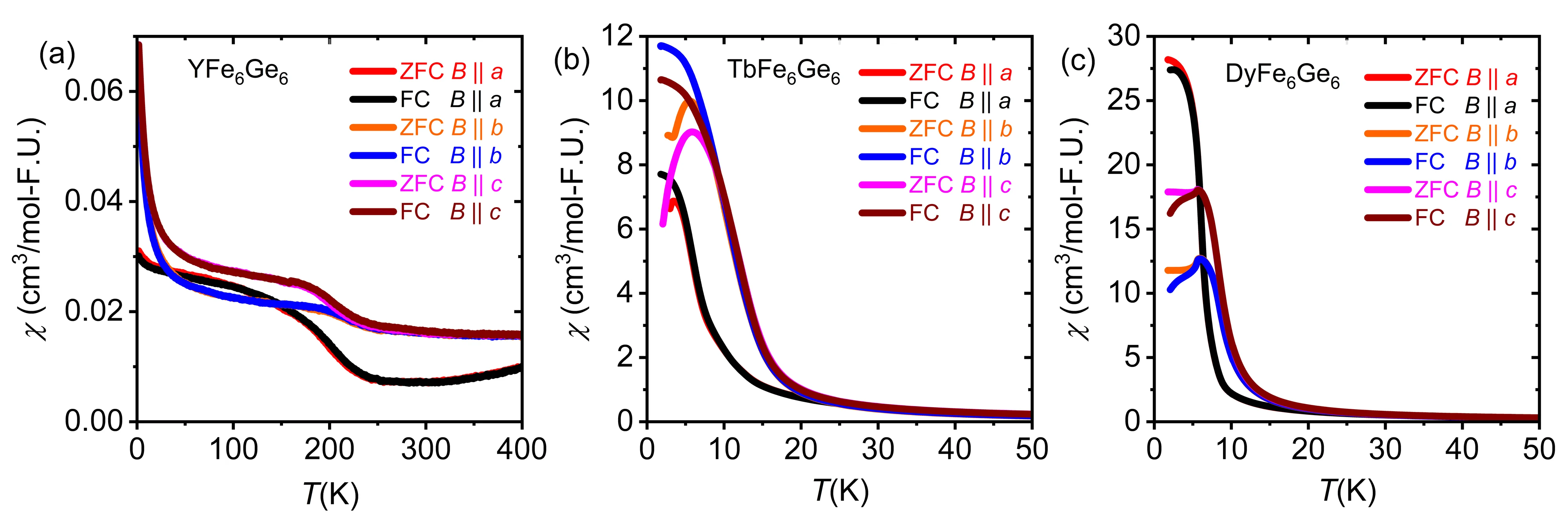
Kagome magnets represent a promising class of materials that exhibit intriguing electronic and magnetic properties, and they have recently garnered significant attention. While most kagome-lattice compounds are hexagonal, we report here single-crystal growth and physical property measurements of $$R$$Fe$$_6$$Ge$$_6$$ ($$R$$ = Y, Dy, Tb) compounds, which crystallize in an orthorhombic structure. The structure can be derived from a hexagonal prototype $$R$$Fe$$_3$$Ge$$_2$$ by replacing every other $$R$$ atom with a covalent Ge$$_2$$ dimer. Ordering of these dimers renders the structure orthorhombic, slightly distorts the kagome net, and makes the three Fe sites formally inequivalent. The iron and rare-earth sublattices order independently. Fe moments order above 400 K, forming ferromagnetic kagome planes stacked antiferromagnetically, while rare-earth moments order below 9 K. TbFe$$_6$$Ge$$_6$$ exhibits a single magnetic ordering transition associated with the Tb atoms, whereas DyFe$$_6$$Ge$$_6$$ shows two distinct magnetic phase transitions, strongly influenced by crystal electric field effects on the Dy$$^{3+}$$ ions. Density functional theory (DFT) calculations indicate that the ferromagnetic ordering of the Fe planes is driven by a high density of states at the Fermi energy. They also reveal three dramatically different structural energy scales: $$R$$ and Ge$$_2$$ form alternating 1D chains perpendicular to the kagome planes, and violating this alternation incurs a large energy cost. Aligning these chains is less costly, and achieving a two-dimensional order of anti-aligned chains requires very little energy. These compounds represent a unique class of materials, offering new opportunities to investigate the interplay between the distinct crystal lattice geometry and the underlying electronic and magnetic properties.
The word 'kagome' translates from Japanese as 'woven basket' — exactly the pattern of triangles that the atoms form.