The Carbon Diet of Young Stars express
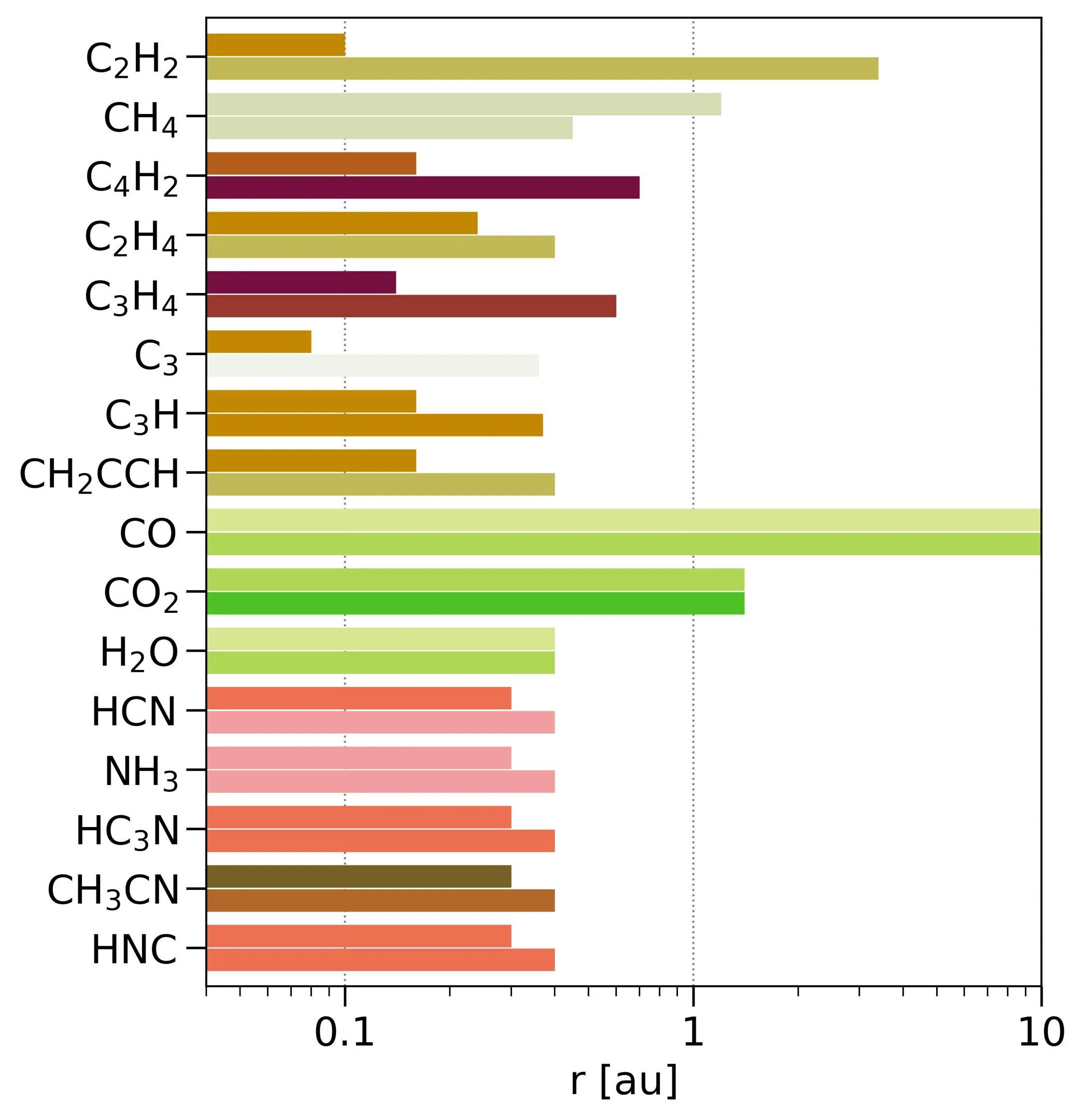
Young stars are surrounded by disks of gas and dust, like construction sites for future planets. From this material, rocky worlds and gas giants will eventually assemble. So the chemical composition of the disk directly determines what the planets will be like. The James Webb Space Telescope looked into the disks around very low-mass stars, those weighing about ten times less than the Sun, and found that these disks contain far more hydrocarbons than models expected.
Hydrocarbons are molecules made of carbon and hydrogen, such as acetylene. In disks around low-mass stars, they turned out to be several times more abundant than calculations predicted. To understand where this excess comes from, scientists built a chemical model of a disk around a dwarf star. They varied the carbon-to-oxygen ratio — from the usual solar value to strongly carbon-rich. And here's what happened: the amount of hydrocarbons is very sensitive to this ratio. Just doubling the carbon or reducing oxygen by a factor of ten makes hydrocarbons noticeably more abundant.
The result, however, was obtained for one specific level of X-ray emission from the star. And X-rays also affect chemistry: they break molecules apart and speed up reactions. So we can't yet completely rule out that the hydrocarbon excess is caused not only by carbon but also by weaker X-rays. But overall, the picture is clear: for disks around low-mass stars to have this many hydrocarbons, the carbon-to-oxygen ratio must be higher than the solar value.
This matters for planets. If a disk is rich in carbon, the planets that form could end up with different atmospheric compositions and even carbon-rich crusts. Such worlds would be very different from our Earth, where oxygen in rocks is more abundant than carbon. Webb's observations of disks around low-mass stars offer a glimpse of the chemistry from which exoplanets will be born.
Disks around very low-mass stars can contain hundreds of times more hydrocarbons than the disk from which the Solar System formed. If planets form there, their atmospheres could be rich in methane and other carbon-bearing gases.
In Arthur C. Clarke's novel Rendezvous with Rama, an alien spacecraft has a carbon-based hull — echoing the idea of planets with carbon-rich crusts that might arise in carbon-rich disks.