Popular

Birth of Light from the Quantum Void ⚡ экспресс

Original: "Quantum Vacuum Radiation Near a Critical Point"
arXiv:2604.10406 · 2026-04-12 · CC BY 4.0 · ⏱ 1 min · Quantum Physics
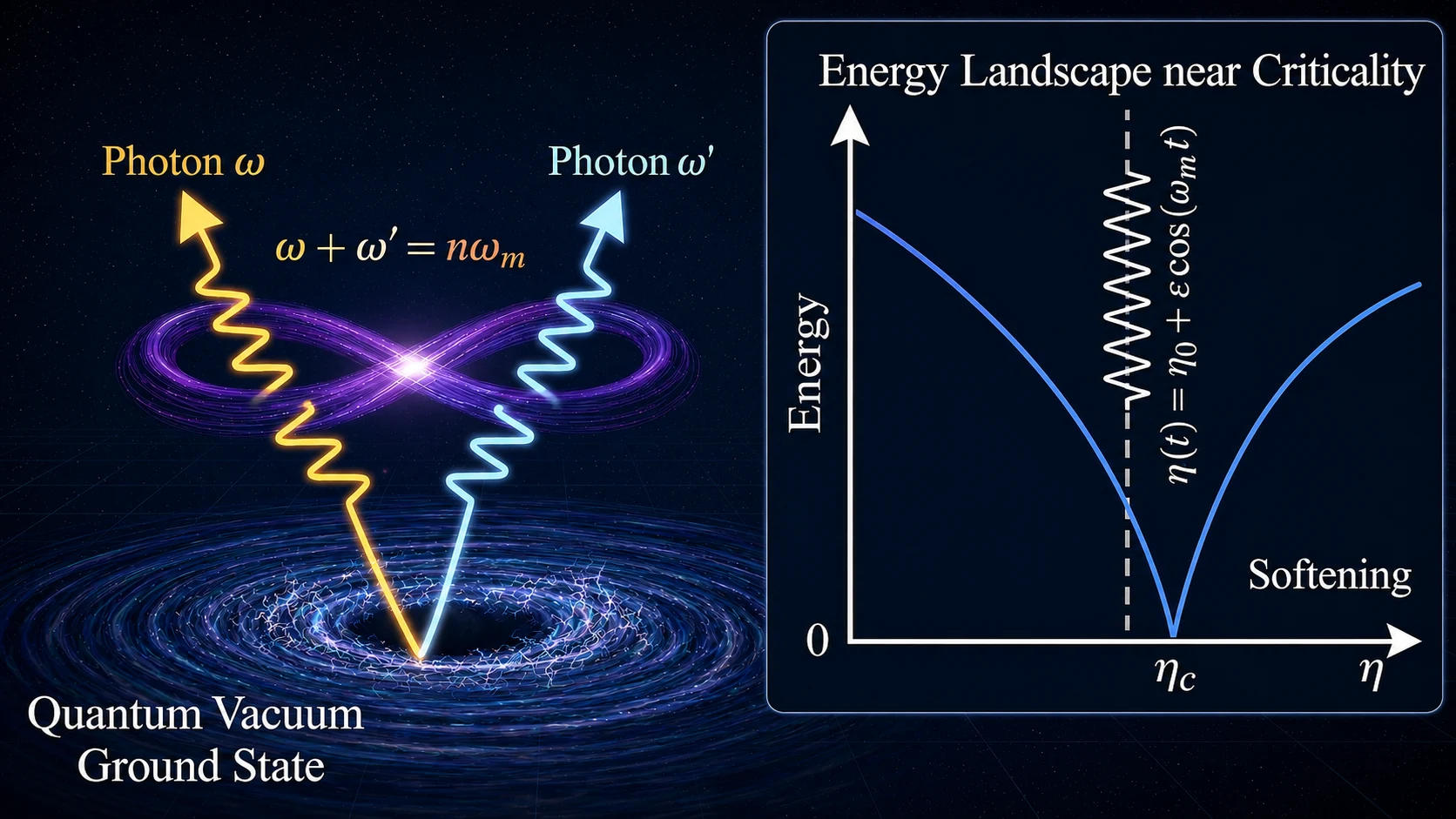
When a system teeters on the edge of a quantum transition, bright light bursts from the vacuum.
Abstract

The study shows that rapid change of a system parameter (nonadiabatic modulation) can convert virtual quantum excitations into real radiation. Near a quantum critical point, photon flux and the nonclassical character of radiation are sharply enhanced, even when thermal fluctuations dominate. Remarkably, even weak modulation activates multiphoton processes, for which a general approach has been developed. Criticality acts as a powerful amplifier of vacuum fluctuations—like a microscope that makes the invisible visible.

Links in the knowledge graph 1

📄 Showing the "Simple" version — "Popular" is not ready yet. Add it to favorites to help prioritize it.

The quantum vacuum is not emptiness, but a tautly stretched string, where particles constantly appear and vanish. Abruptly changing conditions—like shifting the mirrors of a microcavity—causes the 'string' to emit real photons. Near a quantum phase transition, the critical point where matter's state changes abruptly, the effect intensifies. Even a tiny disturbance triggers an avalanche of photons flying at the speed of light. Thermal disorder usually silences quantum effects, but here it only whip-flicks the string, without quenching the glow. This gives rise to non-classical light, impossible with ordinary sources.

Einstein proved light's quantum nature. Glauber explained how photons form a coherent beam.

This opens the door to hypersensitive detectors and new emitters based on vacuum flashes. Spectroscopy—analyzing light by wavelength—reads quantum states like the sheet music of a vibrating string.

🎯 Quantum vacuum fluctuations are so real that they create a subtle attractive force between two closely spaced mirrors—the Casimir effect.

Scientists
Christian DopplerD. B. McLaughlinDidier QuelozMichel MayorR. A. RossiterAlbert Einstein
Tags
Standard Model speed of light entropy spectroscopy
Laws
second law of thermodynamicsDoppler effectprinciple of constancy of the speed of lightNoether's theoremBekenstein-Hawking entropymass–energy equivalence
Original: arXiv:2604.10406 · CC BY 4.0 · bridge42worlds