Seeing the Invisible Gas: Lasers and Machine Learning express
A hundred people are talking at once in a large hall. You try to hear one, but voices blend, some whisper, and you don't even suspect the existence of others. That's roughly how a conventional laser gas analyzer feels when dozens of substances mix in a combustion chamber or a factory pipe. The laser shines through the gas, and each type of molecule takes its tiny share of light at a specific wavelength, like a key fitting only its own lock. But when there are many keys and the locks look alike, sorting it out is nearly impossible.
The authors of this work taught neural networks to do what standard algorithms can't. First, they applied deep denoising networks, like a sound engineer removing the hum of equipment and the breathing of the audience, leaving a clean voice. Experiments in a shock tube (where gas is heated to thousands of degrees in fractions of a second) showed that the method pulls out the signal even for molecules that are barely present. Then they went further. They trained the network HT-SIMNet to work when some components of the mixture are completely unknown. It doesn't try to identify each 'voice' by name but simply extracts its contribution from the overall chorus — much like a blind source separation app that separates guitar from vocals without knowing who's playing.
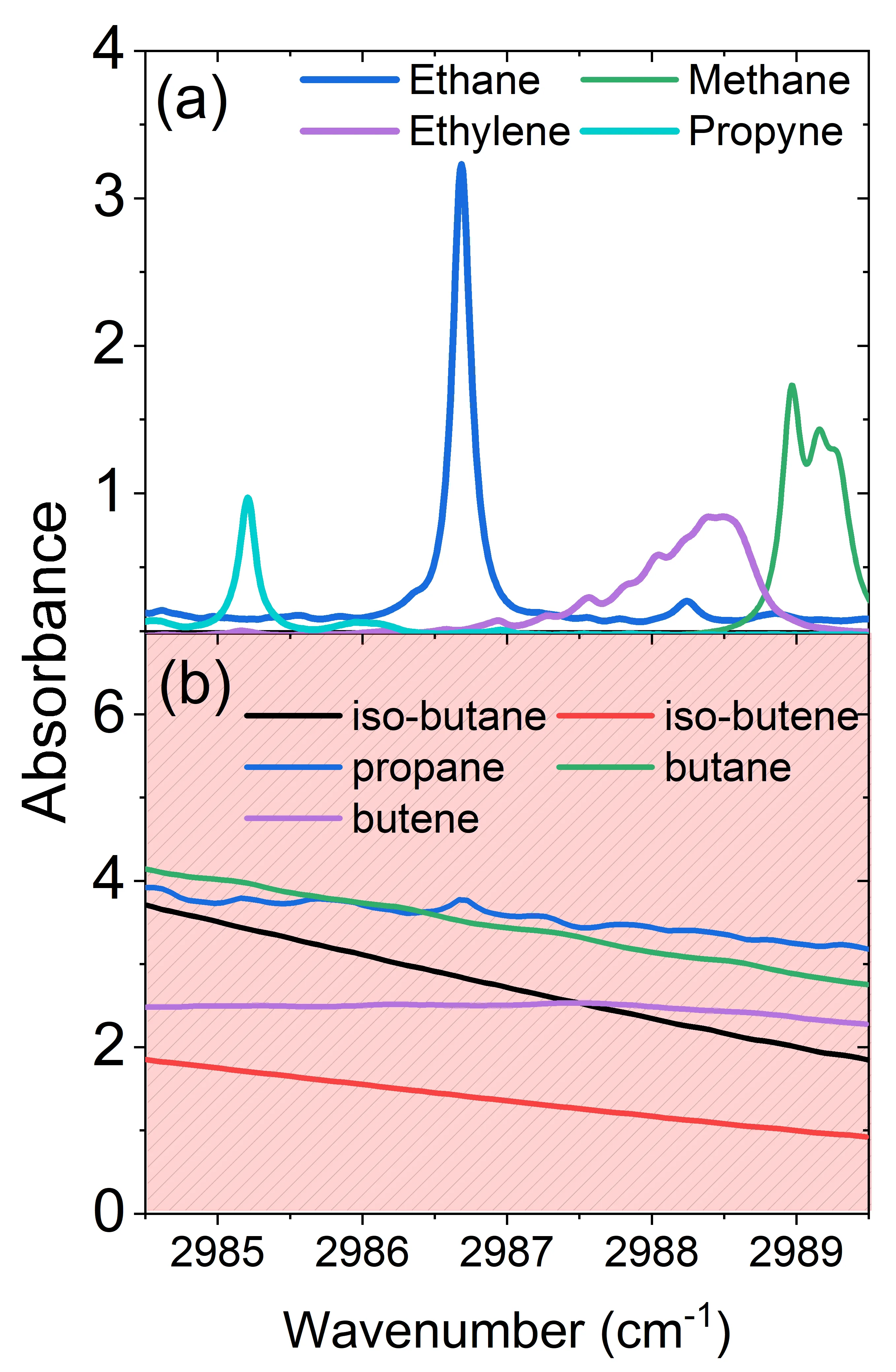
For weak gases hiding behind strong neighbors, they devised a 'derivatives and convolutions' method: it accentuates subtle spectral features, like a contrast filter making faint wall paintings visible. And the classifier VOC-certifire, inspired by the idea of smoothing, doesn't just say 'this is benzene' but also gives a numerical guarantee that the answer is correct under any reasonable interference — a rare quality for neural networks.
All methods were tested not in simulation but on real mixtures — up to eight gases at once. The laser remains the same as in conventional devices, but its 'brain' becomes capable of discerning the invisible. This union of optics and machine learning promises detectors that don't need lengthy tuning for each new smell — be it fire smoke, a chemical plant leak, or a patient's breath. And then, in the noisy hall of a gas mixture, every voice can be heard without error.
In a shock tube, gas is accelerated to speeds where the temperature behind the wave front can exceed 10 000°C — hotter than the Sun's surface, all within a tube the diameter of a soda can.
In 'Star Trek,' Dr. McCoy's tricorder could determine the composition of any planet's atmosphere in seconds — the described methods take a step toward such a device, just without the fictional 'subspace' magic.