The Shadow Life of the Cosmos: How the Dark Sector Leaves Traces on Ancient Light express
A pond with ripples spreading from a fallen stone. So it is on cosmic scales: a sudden burst of energy in the dark sector, an invisible substance that emits no light, creates ripples in the fabric of space. These ripples alter the path of light particles traveling to us from the very birth of the cosmos.
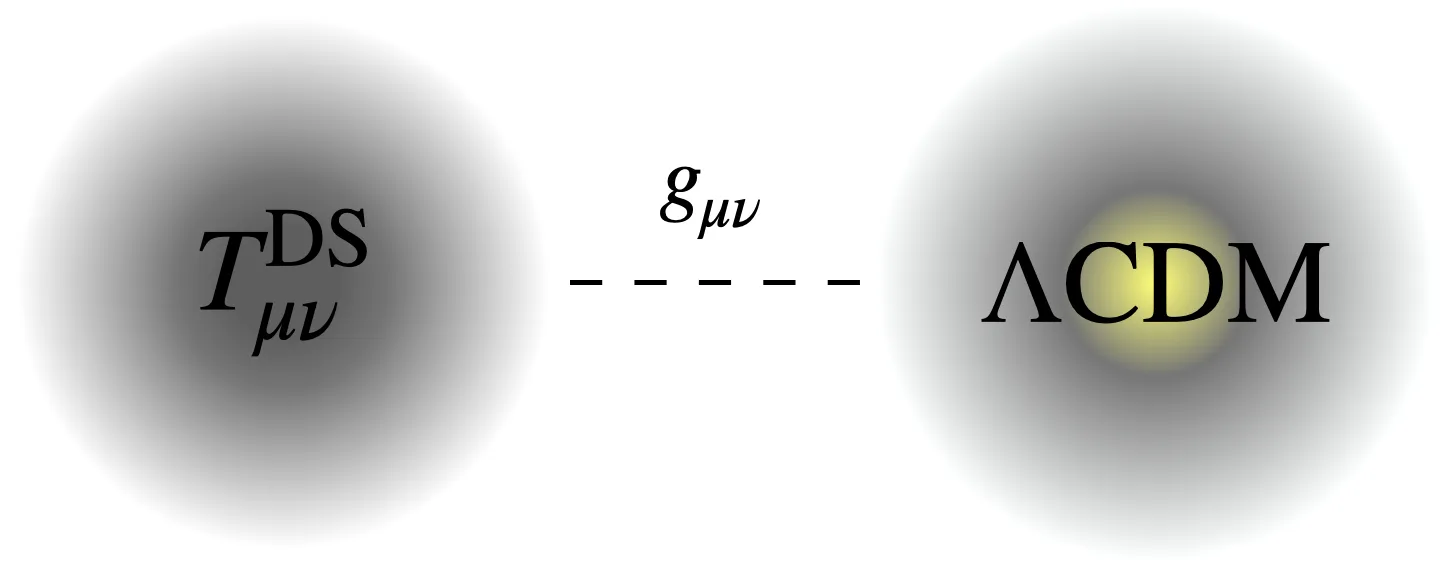
The authors of the new study built a mathematical framework to describe these distortions. They considered what happens when energy is injected very rapidly — over a time that is negligible compared to the age of the Universe. It turns out that the main signature is left not just by a clump of energy, but by an instantaneous stress in space (anisotropic pressure) that arises during such events. This signature appears in the cosmic microwave background — ancient light that has reached us 13.8 billion years after the Big Bang.
As an example, the scientists applied their theory to first-order phase transitions in the dark sector. This is similar to water freezing: the substance abruptly changes state, releasing hidden energy. Such transitions could have occurred as the Universe cooled, leaving a characteristic pattern on the cosmic microwave background map. Comparing predictions with actual data, the researchers found that even an energy injection at the level of a few thousandths of the total density of the Universe would be noticeable. Current observations do not see such a signal, meaning that if such events occurred, they were extremely weak.
Thus, the dark sector, while remaining invisible, betrays itself through a barely perceptible tremor in the ancient light, like ripples on water from a thrown stone that can be measured billions of years later.
Original abstract
as written by the authors arXiv:2605.03007
We develop a formalism to characterize the imprints of late-time sources of cosmological fluctuations under the sole assumption that the injection occurs on timescales short compared to the horizon. For post-recombination injections, we derive the general modification of photon geodesics in the presence of scalar, vector, and tensor perturbations, and compute the resulting impact on the Cosmic Microwave Background through the integrated Sachs-Wolfe effect. We show that the signal is generically dominated by instantaneous injections of anisotropic stress. As an application, we consider first-order phase transitions in a sequestered dark sector and show that current observations constrain fractional energy injections at the permille level.
The cosmic microwave background was discovered by accident in 1964, when engineers mistook it for interference from pigeon droppings on the antenna.
In Liu Cixin's novel "The Dark Forest," dark matter turns out to be a weapon of an ancient civilization — here we are looking for its natural manifestations.