Coffee with Milk: The Secret of Neutron Stars ✛ ✦
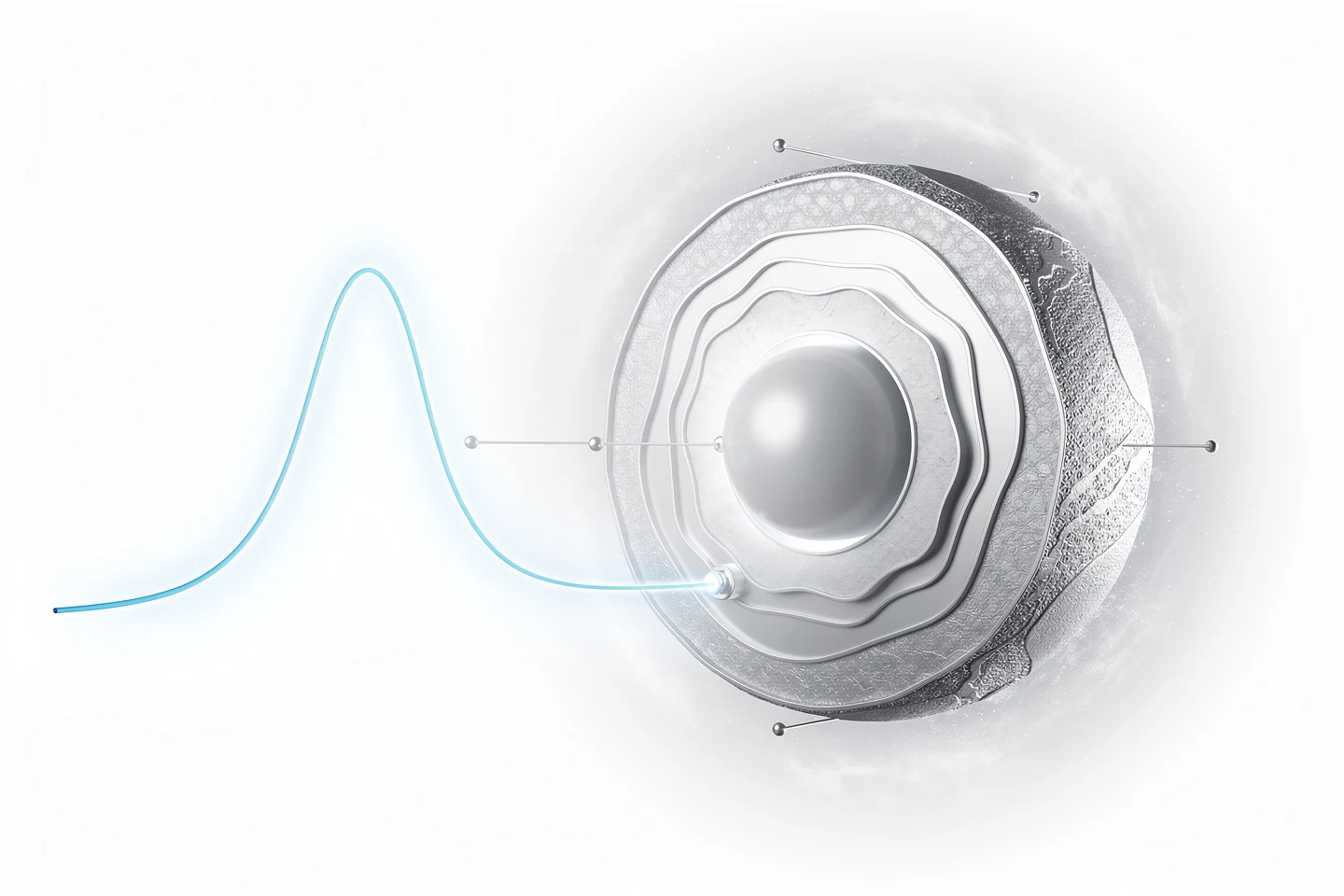
Neutron stars neutron stars are the final stage of stellar evolution for massive stars: after the explosion, the core collapses to the size of a city but weighs as much as the Sun. In the 1930s, Fritz Zwicky predicted them, and in 1967, Jocelyn Bell Burnell discovered pulsars pulsars — rotating neutron stars emitting radio signals like cosmic lighthouses.
Inside these bodies, the density exceeds nuclear density, causing protons and neutrons to break down into quarks. For a long time, it was thought that there was a sharp boundary between nuclear matter and the quark phase. However, scientists combined data from gravitational waves ripples in spacetime from neutron star mergers with results from the NICER telescope, which measures spacetime curvature around them. Using computer simulations computer simulations and calculations based on quantum field theory quantum field theory and the standard model the accepted theory of particles — the part describing the strong interaction was created by Frank Wilczek — they found that the transition is smooth, like coffee with milk. Matter gradually transforms into quark-gluon plasma, without a clear line, like milk swirling into espresso.
This crossover explains why neutron stars can weigh twice as much as the Sun without collapsing into a black hole: the matter becomes easier to compress, rather than resisting rigidly. Thanks to this, they also spin furiously — some rotate at over 700 revolutions per second, without tearing apart.
Sound waves in a neutron star travel faster than a third of the speed of light — a signal from the center reaches the surface in milliseconds.
In Robert Forward's novel 'Dragon's Egg,' intelligent beings live on a neutron star — a fantasy based on the unusual properties of matter at ultra-high densities.